 Posts with this logo use


February 28, 2007
QFT of Charged n-Particle: Gauge Theory Kinematics
Posted by Urs Schreiber

Some basic remarks on how gauge theory in -dimensions fits into the general framework of the charged -particle, followed by a semi-close look at how
Christian Fleischhack
Representations of the Weyl Algebra in Quantum Geometry
math-ph/0407006
realizes, in a continuous (instead of smooth) version of gauge theory, the algebra of observables.
QFT of Charged n-Particle: Algebra of Observables
Posted by Urs Schreiber
February 27, 2007
Quantization and Cohomology (Week 16)
Posted by John Baez
This week in our course on Quantization and Cohomology we considered some fancier path integrals. Then, fortified by these examples, we returned to the more abstract issues this course is really about:
- Week 16 (Feb. 27) - More examples of path-integral quantization. The particle in a potential on the real line. The Lie-Trotter Theorem. The particle in a potential on a complete Riemannian manifold. Back to general questions: how do we get a Hilbert space from a category equipped with an action functor? The problem of Cauchy surfaces.
Last week’s notes are here; next week’s notes are here.
February 25, 2007
This Week’s Finds in Mathematical Physics (Week 246)
Posted by John Baez
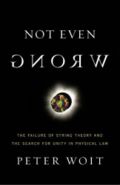
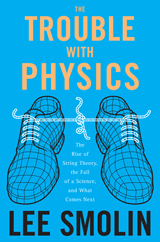
In week246 of This Week’s Finds, read about Peter Woit’s Not Even Wrong and Lee Smolin’s The Trouble With Physics:
Amplimorphisms and Quantum Symmetry, II
Posted by Urs Schreiber
In the last entry in this series, Amplimorphisms and Quantum Symmetry, I, I talked about algebras of physical observables and their Doplicher-Haag-Roberts representations.
Here I make a remark on how this is related to the statement
February 23, 2007
The Health Book
Posted by David Corfield
How to Write Mathematics Badly
Posted by John Baez
Everyone who cares about mathematics should watch this hilarious and educational video:
- Jean-Pierre Serre, How to Write Mathematics Badly.
If you don’t know who Serre is, read a bit about him before watching the video. You’ll enjoy it more.
Classical vs Quantum Computation (Week 15)
Posted by John Baez
In this week’s class on Classical vs. Quantum Computation, we continued to work through an example of how typed -calculi give cartesian closed categories:
- Week 15 (Feb. 22) - The λ-theory of commutative rings and the cartesian closed category it generates: the "free cartesian closed category on a commutative ring object". What is a cartesian closed functor from this to Set? Guess: just a commutative ring! Blog entry.
Last week’s notes are here.
February 21, 2007
Noncommutative Geometry Blog
Posted by David Corfield
Cake Talk
Posted by David Corfield
An Introduction to Algebraic Topology
Posted by John Baez
This quarter, besides my seminars on Quantization and Cohomology and Classical vs. Quantum Computation, I’m also teaching the graduate qualifier course on algebraic topology. While a bit elementary for some Café regulars, it might be fun for other folks:
- John Baez, Mike Stay and Christopher Walker, Algebraic Topology.
Quantization and Cohomology (Week 15)
Posted by John Baez
This week in our course on Quantization and Cohomology, we finished off the path-integral quantization of the free particle:
- Week 15 (Feb. 20) - The free particle on a line (part 2). Showing the path-integral approach agrees with the Hamiltonian approach. Fourier transforms and Gaussian integrals.
Last week’s notes are here; next week’s notes are here.
February 17, 2007
Congratulations!
Posted by David Corfield
It’s John’s wedding day today!
I’m sure all the Café regulars will join me in wishing you and Lisa a happy continuation of your life together.
February 16, 2007
Classical vs Quantum Computation (Week 14)
Posted by John Baez
This time in our course on Classical vs. Quantum Computation, we sketched how a typed λ-calculus serves as a presentation of a cartesian closed category, and how every cartesian closed category arises this way. Since the students seemed to be struggling with the levels of abstraction involved, we slowed down to tackle an example:
-
Week 14 (Feb. 15) - The cartesian closed category generated by a typed λ-calculus, and how this construction gives a functor . The ‘internal language’ of a cartesian closed category, and how this gives a functor . and are adjoint,
and in fact give an equivalence between typed λ-calculi and
and cartesian closed categories. Example 1: the λ-theory of
commutative rings.
Supplementary reading:
- Joachim Lambek and Phil Scott, Introduction to Higher-Order Categorical Logic, Cambridge U. Press, 1988. Part 1, Section 11: the cartesian closed category generated by a typed λ-calculus.
Last week’s notes are here; next week’s notes are here.
QFT of Charged n-Particle: T-Duality
Posted by Urs Schreiber
Last time I described how the idea of pull-push propagation in quantum mechanics should look like when we refine the formalism to quantization on a category, or even to quantization on an -category, i.e. when we systematically replace spaces by categories and regard, for instance, a string not just as an interval but as a poset propagating not just on a target space but on the corresponding category of 2-paths
In particular, I drew a pasting diagram that descibed the pull-push of a section,
of an -bundle with connection through a suitable correspondence.
supposed to describe the quantum evolution of the state corresponding to that section over the worldvolume .
I claim that this is the natural operation of a worldvolume on a state. And I claim that it is once again crucial that we have understood a section as a transformation (1) between transport functors. Notice that, by passing to the components of (2), the 2-morphisms filling this diagram– which are forced upon us by the transformation nature of sections – turn the bare correspondence into a correspondence with an -bundle on the correspondence space Moreover, by the rules for composition of transformations of functors, the pull-push through this correspondence automatically and naturally incorporates the action of that bundle on the section pulled up the correspondence space.
Such a transformation is known to categorify ordinary linear operations, as recalled in Fourier-Mukai, T-Duality and other linear 2-Maps.
In particular, (topological) T-duality for 2-particles is an example for such a transformation, as described in Mathai on T-Duality, II: T-dual K-classes by Fourier-Mukai.
February 15, 2007
Quantization and Cohomology (Week 14)
Posted by John Baez
This week in our course on Quantization and Cohomology, I decided it was time to do an example for the students who’d never seen path integrals:
- Week 14 (Feb. 13) - An example of path-integral quantization: the free particle on a line (part 1).
Last week’s notes are here; next week’s notes are here.
Higher Morphisms of Lie n-Algebras and L-infinity Algebras
Posted by Urs Schreiber
A Lie algebra is a vector space with a skew linear product map satisfying the Jacobi identity.
A Lie 2-algebra is a 2-vector space with a skew linear product functor having a Jacobi isomorphism satisfying a coherence condition.
For the case that the 2-vector spaces in question are Baez-Crans 2-vector spaces, i.e. -module categories, the (“semistrict”) Lie 2-algebras obtained this way are equivalent to 2-term -algebras.
All that is the content of
J. Baez, A. Crans, HDA VI: Lie 2-Algebra
-algebras have been extensively studied, long before John and Alissa dreamed up Lie 2-algebras, by people like Jim Stasheff, Tom Lada, Martin Markl and many others. I once collected some literature that I found helpful here.
So what’s the point of Lie -algebras, then? What’s the point of reformulating -term -algebras as linear categories with a skew-linear product functor on them satisfying a Jacobi identity up to higher coherent isomorphism?
One point is that, while equivalent to -term -algebras, the Lie -algebras are conceptually more transparent. The equivalence tells us that and how -algebras are indeed a categorified notion of Lie algebra.
That’s more than just a philosophical point. In particular, since Lie -algebras are a kind of monoidal -categories, there is a canonical way to see what the right notion of morphisms between them are. And, crucially, what the right higher morphisms are.
When John and Alissa wrote their paper, they could not locate in the literature a definition of 2-morphism of -algebras #. And it is not really easy to just guess the right definition.
But what is rather straightforward, (though getting increasingly tedious as increases), is to work out the right notion of 1- and 2-morphisms of Lie -algebras. These come from functors and natural transformations of the underlying categories, respecting the available structure in a suitable way. It’s clear what these should look like. (def. 37, p. 36 in the above paper.)
The issue of higher morphisms is of course most crucial for understanding the structure of our categorified Lie algebras, since they determine the notion of equivalence between these.
So : what is known about higher morphisms and about the notion of equivalence for -algebras?
Behind the scenes there is a long dicussion going on about this. Here I collect some remarks and some literature.
February 13, 2007
Category Theoretic Probability Theory II
Posted by David Corfield
Encouraged by the comment of a statistician as eminent as Phil Dawid, I shall continue with what category theory has to say about probability theory. Recall that we were considering a monad on the category of measurable spaces, . For a number of reasons, researchers prefer to work with , the category of Polish spaces, i.e., separable metric spaces for which a complete metric exists. We have an endofunctor , which sends a space, , to the space of probability measures on the Borel sets of . is equipped with the weakest topology which makes continuous for any , a bounded, continuous, real function on . We also need a map :
Now, there are interesting developments of this idea, such as Abramsky et al.’s Nuclear and Trace Ideals in Tensored ∗-Categories, which looks to work Giry’s monad into a context even more closely resembling the category of relations, but let’s look about to see if we can make contact with some probability theory. Well, a natural kind of thing to do would be to work out the algebras for the monad. And this is just what Ernst-Erich Doberkat does in Characterizing the Eilenberg-Moore Algebras for a Monad of Stochastic Relations. What you’re looking for are measurable maps between and , such that the ‘fibres’ are convex and closed, and such that , the delta distribution on , is in the fibre over . And there’s another condition which requires a compact subset of to be sent to a compact subset of .
Slides for Freed’s Andrejewski Lecture
Posted by Urs Schreiber
As Bruce Bartlett kindly pointed out to me, the slides of (the first part of) Dan Freed’s Anrejewski Lecture in Leipzig last spring are available on his website:
Dan Freed
Twisted K-Theory and the Verlinde Ring
On these introductory slides, Freed recalls the Freed-Hopkins-Teleman theorem, mentions how fusion of loop group representations can be understood from the fusion of strings, how quantum field theory is about representations of cobordism categories and how quantum evolution by means of the path integral can be understood from pull-push through correspondences of configuration spaces.
February 12, 2007
QFT of Charged n-Particle: Dynamics
Posted by Urs Schreiber
Given an -particle (a point, a string, a membrane, etc.) coupled to a -bundle with connection (an electromagnetic field, a Kalb-Ramond field, a 2-gerbe, etc.), what is the corresponding quantum theory?
The answer to this question has a kinematical and a dynamical aspect and up to now I had concentrated on the kinematics:
Definition, point particle, string on , open string on .
Here I start talking about dynamics. The right abstract point of view on the dynamics of quantum systems, as far as path integrals are concerned, is certainly that adopted for instance in
E. Lupercio, B. Uribe
Topological Quantum Field Theories, Strings, and Orbifolds
hep-th/0605255.
A parameter space , describing the shape of the quantum object (the point, the circle, the sphere, etc.) propagates along “worldvolumes” (graphs, surfaces, 3-manifolds, etc.), which are spaces whose boundaries look like , by pull-push along correspondences of the form
Here I formulate this in an arrow theoretic way (a little more arrow-theoretic than the discussion in the above text, that is) that fits into the context of kinematics that I discussed before.
While everything is categorical, a crucial point is that, as opposed to the kinematics, the dynamics requires the push-forward of a set at one point. In the absence of a notion of adjoint morphisms of sets, this requires extra structure on our sets: a measure. This is the infamous measure that appears in the path integral.
The following definition is taken from
This Week’s Finds in Mathematical Physics (Week 245)
Posted by John Baez
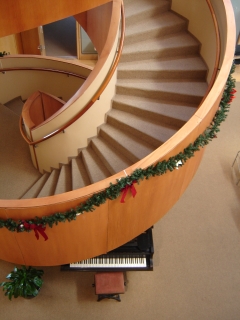
In week245 of This Week’s Finds, read about the Fields Institute workshop on Higher Categories and Their Applications — and the piano Coxeter played at the age of three!
February 10, 2007
Why Do I Bother?
Posted by David Corfield
Terence Tao has placed on the ArXiv an article submitted to the Bulletin of the AMS, ‘What is good mathematics?’ After a substantial list of criteria of what constitutes a good piece of mathematics, there follows a lengthy case study of Szemerédi’s theorem to support a conjecture:
It may seem from the above discussion that the problem of evaluating mathematical quality, while important, is a hopelessly complicated one, especially since many good mathematical achievements may score highly on some of the qualities listed above but not on others. However, there is the remarkable phenomenon that good mathematics in one of the above senses tends to beget more good mathematics in many of the other senses as well, leading to the tentative conjecture that perhaps there is, after all, a universal notion of good quality mathematics, and all the specific metrics listed above represent different routes to uncover new mathematics, or difference stages or aspects of the evolution of a mathematical story.
As readers will know, I’ve been pushing for philosophers of mathematics to address the problems of values other than truth. In ‘Towards a Philosophy of Real Mathematics’, I moved beyond a Lakatosian conception of progress to tackle the arguments used for and against the extension of groups to groupoids. And in the past couple of years I’ve been advocating MacIntyre’s idea of a rational tradition of enquiry as governed by overarching dramatic narratives.
I’ve also been working on a conception of mathematical reality close to Michael Polanyi’s:
A new mathematical conception may be said to have reality if its assumption leads to a wide range of new interesting ideas. (Personal Knowledge: 116)
…while in the natural sciences the feeling of making contact with reality is an augury of as yet undreamed of future empirical confirmations of an immanent discovery, in mathematics it betokens an indeterminate range of future germinations within mathematics itself. (Personal Knowledge: 189)
February 9, 2007
Classical vs Quantum Computation (Week 13)
Posted by John Baez
In this week’s class on Classical vs. Quantum Computation, we begin tackling our main example of how ‘processes of computation’ show up as 2-morphisms in a 2-category. We start by recalling the concept of a ‘typed λ-calculus’. Next time we’ll show how a typed λ-calculus can serve as a presentation of a cartesian closed category. Then we’ll try to get a cartesian closed 2-category instead, where the relations give 2-morphisms instead of equations between morphisms.
-
Week 13 (Feb. 8) - Categorifying the lambda-calculus. Lambek and Scott’s definition of a "typed lambda-calculus": types, terms, and relations (including η-reduction and β-reduction).
Supplementary reading:
- David C. Keenan, To dissect a mockingbird.
- Joachim Lambek and Phil Scott, Introduction to Higher-Order Categorical Logic, Cambridge U. Press, 1988. Part 1 Sections 9-11: natural numbers objects in cartesian closed categories, typed λ-calculi, and the cartesian closed category generated by a typed λ-calculus. Note that I’m including the material on natural number objects (Section 9) mainly so you can see how to ignore it in Sections 10 and 11: in class, we are keeping things simple by considering typed λ-calculi and cartesian closed categories without a natural numbers object.
Last week’s notes are here; next week’s notes are here.
Day on RCFTs
Posted by Urs Schreiber
The short note
Brian J. Day
Association schemes and classical RCFT’s as “graphic” Fourier transformations
math.CT/0702208
is apparently a message from a mathematician to physicist saying: “Notice this standard fact. It might be useful for what you are doing.” As Brian Day writes in the abstract:
Mathematically, this is a fairly straightforward observation, but may be worth pursuing from a physical viewpoint.
The main statement seems to concern a construction of something “realising” a fusion ring, i.e. a ring of equivalence classes in a semisimple braided tensor category. These fusions rings are a big deal in (rational) conformal field theory.
Unfortunately, the note is entirely internal to enriched category theory. I curse myself for still not having taken the time to learn how make ends and coends meet in enriched category theory.
On the train back home I will look at
G. M. Kelly
Basic Concepts in Enriched Category Theory
Hopefully after that I’ll be able to decode Brian Day’s message.
Infinitely Categorified Calculus
Posted by John Baez
Vasiliy Dolgushev gave a nice talk here at UCR today. He started by explaining how the usual concepts of calculus must be infinitely categorified to apply to noncommutative geometry!
-categories are pretty scary. But, they’re less scary when they’re strict: when all the laws holds as equations instead of ‘up to isomorphism’. And they’re even less scary when they’re also linear: when they’ve got a vector space of objects, a vector space of morphisms, a vector space of 2-morphisms and so on, with all the operations being linear. It turns out that a strict linear -category is just a chain complex of vector spaces!
If you already know and love chain complexes, this revelation might leave you unmoved. But it really does explain a lot about what people do with chain complexes.
In particular, when people start taking ordinary concepts from linear algebra, replacing all the vector spaces in sight by chain complexes, and making all the usual axioms hold ‘up to coherent homotopy’, they’re really -categorifying these concepts.
Here’s what happens to some familiar concepts when we do this:
- associative algebras become -algebras
- Lie algebras become -algebras
- commutative algebras become -algebras
Now, calculus on a manifold is really just a heavy-duty version of linear algebra: we’ve got differential forms, and vector fields, and so on, and a bunch of linear operations. Recently the whole lot have been formalized into a single mathematical gadget called — boldly but aptly — a ‘calculus’.
We can get a calculus not just from a smooth manifold but from any commutative algebra. When we use the algebra of smooth functions on a smooth manifold, we’re back where we started — but it’s really a vast generalization.
What if we start with a noncommutative algebra? Here it turns out we just get a ‘ algebra’: in other words, an infinitely categorified calculus!
February 8, 2007
Isham on Arrow Fields
Posted by Urs Schreiber
In
Chris J . Isham
A New Approach to Quantising Space-Time: I. Quantising on a General Category
gr-qc/0303060
the author considers the concept of an arrow field on a category.
I recall his definition, reformulate it in arrow-theoretic terms, discuss the connection of “arrow fields” to ordinary vector fields and describe how to generalize it to a notion of covariant transport of sections of bundles with connection.
February 7, 2007
QFT of Charged n-particle: Chan-Paton Bundles
Posted by Urs Schreiber
It’s me again, chewing on the other end of the bone.
On my side the bone looks like this:
A “background gauge field” is a parallel transport -functor An -particle is determined by its shape and its configurations Whatever quantization is, we know that in the Schrödinger picture it is something that reads in the above data and spits out another -functor:
There is a natural canonical way this could arise from the above data, namely as the pull-push of through the correspondence
After collecting some evidence I decided that this must be right and gave a discussion of this definition in
The Globular Extended QFT of the Charged n-Particle: Definition .
My motivation and goal is to understand Chern-Simons theory as the quantization of the 3-particle (“membrane”) propagating on and coupled to a 2-gerbe , and to understand the FFRS state sum model this way.
As a preparation for that, I discussed something like a decategorified Chern-Simons theory, describing a 2-particle (“string”) , propagating on and coupled to a trivial 1-gerbe in
Globular Extended QFT of the Charged n-Particle: String on .
While this example is nice for understanding things related to Chern-Simons, we would want to see more familiar examples of “ordinary” -particles that zip around in ordinary spacetime.
For the ordinary 1-particle propagating on some space and coupled to an ordinary vector bundle the above pull-push quantization reproduces the familiar result.
As we move from 1-particles to 2-particles (“strings”), we want to see our arrow-theoretic formalism reproduce standard stringy phenomena. In particular, the formalism should know that the ends of an open 2-particle couple to a Chan-Paton vector bundle on a D-brane.
See Brodzki, Mathai, Rosenberg & Szabo: D-Branes, RR-Fields and Duality for details on what this means.
In my second talk at Fields I indicated how a coupling of the open 2-particle to a nontrivial line 2-bundle transport (also known as a line bundle gerbe with connection and curving) yields, by the above pull-push quantization, a coupling of the endpoints and to a gerbe module. This is nothing but a Chan-Paton bundle twisted by a gerbe – and is what, in parts of the mathematical string literature, is taken as the definition of a D-brane.
Among other things, this gives a nice definition of a gerbe module simply as a morphism where is the 2-anafunctor respresenting the gerbe, and is the tensor unit in the 2-category of all these.
But before even getting into the discussion of these twisted Chan-Paton bundles, it is interesting and instructive to consider in more detail the simple situation of an open 2-particle coupled to the trivial line-2-bundle , forgetting about all twists and turns.
From looking at the standard string theory textbooks, we expect this to have (2-)states that involve a combination of sections on path space of and a morphism between two vector bundles on .
Here I want to talk about how this comes about in the arrow-theoretic framework of pull-push quantization of the charged -particle.
Category Theoretic Probability Theory
Posted by David Corfield
Having noticed (e.g., here and here) that what I do in my day job (statistical learning theory) has much to do with my hobby (things discussed here), I ought to be thinking about probability theory in category theoretic terms. What would seem to be the most promising approach is described by Prakash Panangaden in Probabilistic Relations.
The category SRel (stochastic relations) has as objects sets equipped with a -field. Morphisms are conditional probability densities or stochastic kernels. So, a morphism from to is a function such that
- is a bounded measurable function,
- is a subprobability measure on .
If is a morphism from to , then from to is defined as .
February 6, 2007
Quantization and Cohomology (Week 13)
Posted by John Baez
This week in our course on Quantization and Cohomology, we saw how statistical mechanics involves a number system that depends on the temperature . In the ‘chilly limit’ , this reduces to the number system suitable for classical statics, where energy is minimized:
-
Week 13 (Feb. 6) - Statistical mechanics
and deformation of rigs. Statistical mechanics (or better, ‘thermal
statics’) as matrix mechanics over a rig that depends on
the temperature T.
As T → 0, the rig reduces to and
thermal statics reduces to classical statics, just as
quantum dynamics reduces to classical dynamics as Planck’s constant
approaches zero.
Tropical mathematics, idempotent analysis and Maslov dequantization.
- Supplementary reading: G. L. Litvinov, The Maslov dequantization, idempotent and tropical mathematics: a brief introduction.
Last week’s notes are here.
Amplimorphisms and Quantum Symmetry, I
Posted by Urs Schreiber
Last time I mentioned that a concept called amplimorphisms plays a role in certain algebraic descriptions of quantum field theory. I gave an interpretation of the structure of these concepts in arrow-theoretic terms.
I would like to continue with talking about the relation to quantum symmetries.
Here I give an arrow-theoretic exegesis of section 2 of
J. Fuchs, A. Ganchev, P. Vecsernyes
On the quantum symmetry of rational field theories
hep-th/9407013.
February 5, 2007
Amplimorphisms
Posted by Urs Schreiber
In some parts of the quantum field theory literature, that concerned with algebraic formulations, one finds the concept of an amplimorphism of algebras.
For a -algebra and a vector space ( some field), people call an algebra homomorphism of the form an amplimorphism.
Without actually admitting it, people are talking about an entire 2-category of such amplimorphisms. (Update: the 2-category of amplimorphisms is made explicit in section 2.1 of P. Zito’s thesis.)
All this is done – “old school” – in components (as far as I am aware), which makes it a little hard to see what amplimorphisms really are.
After thinking about it for a while, it seems I found that the 2-category of amplimorphisms is a certain natural 2-category of rectangles internal to the 3-category – the 1-object 3-category obtained from the monoidal 2-category of algebras and bimodules over .
This is described here:
Does anyone here know anything about amplimorphisms? And how best to think about them? What they really are?
In the Footsteps of Rudolf Carnap II
Posted by David Corfield
The next day I set off East to Jena, following the path taken by Carnap, and by my host, David Green, a British mathematician who works on the cohomology of finite groups. While in Wuppertal, David had become interested in philosophy and had read my book, hence the invitation. In the afternoon I spoke to the mathematical colloquium about my work, stressing its two strands:
- The study of mathematics as a rational tradition of enquiry, with special attention to value judgements.
- That changes in the ‘foundations’ of mathematics brought about by -category theory should be explored both for themselves, and for their possible importance to philosophy.
I was very pleased to see in the audience a philosopher friend, Mike Beaney. Through his questions we established a certain ambiguity in my term ‘philosophy of real mathematics’. It could suggest that I am advocating that philosophers look to contemporary mainstream mathematics to ask and resolve completely new philosophical questions. I certainly don’t see it that way. The value judgements of a field like mathematics, and the way they are elaborated through time, in a community which supports a certain kind of dialogue are surely not radically different topics for attention. On the other hand, less common is my according this an historical dimension, in that, like scientists, mathematicians have learned how to learn, and presumably will continue to do so. An important difference boils down to how likely you think it is that mathematicians will have done important work to resolve fundamental tensions in the conceptual organisation of their field. I take it that that is precisely the first place we should look. To my mind, category theory and its higher-dimensional variety have been devised to deal with deep problems at the core of mathematical activity.
In the Footsteps of Rudolf Carnap I
Posted by David Corfield
Last week I gave a couple of talks in Germany. Thursday saw me in the town of Wuppertal, famous for its Schwebebahn, a railway built above the river Wupper, which snakes its way through the middle of the town. As you can see from the pictures, the trains hang underneath the rail. Wuppertal is also well-known for being home to the factories of Friedrich Engels’ family. Somewhat less known is that it was the birthplace of the philosopher Rudolf Carnap, a central figure in the Vienna Circle.
I’d gone to the town at the invitation of the IZWT, the university’s history and philosophy of science group. Now, one of the best things about giving a talk is, of course, the chance it offers to find weak points in your position, and to learn about related work. I wasn’t disappointed. At dinner afterwards, we discussed the Hungarian contribution to history and philosophy of mathematics. Imre Lakatos’s work I know well, and behind him there was the figure of Árpád Szabó, best known for his thesis that Greek mathematics arose hand-in-hand with the dialectical method of Eleatic philosophy. Szabo and Lakatos had planned to write a two volume work on the use of the dialectic method in mathematics, Szabo for the Greeks, Lakatos for modern mathematics.
February 3, 2007
This Week’s Finds in Mathematical Physics (Week 244)
Posted by John Baez
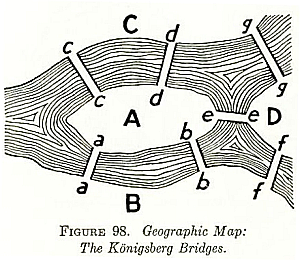
In week244 of This Week’s Finds, guess when the first calculus textbook was written, and in what language. Learn about Tom Leinster’s method of computing the size of a category. This generalizes the "Euler characteristic" in topology, but it’s also related to "Möbius inversion" in combinatorics. Also - hear how Heisenberg invented matrix mechanics, and how Euler might have invented the Euler characteristic while strolling the bridges of Königsberg!
February 2, 2007
Higher Structure in Geometry and Physics – and in Paris
Posted by Urs Schreiber
Two weeks ago ended the conference in honor of Murray Gerstenhaber’s 80th and Jim Stasheff’s 70th birthdays
Higher Structures in Geometry and Physics.
As Jim Stasheff kindly points out #, slides of many of the talks are now available online.
Huisken on Uniformization, II
Posted by Urs Schreiber
After some motivations in part I, here the second part of my transcript on G. Huisken’s talk on Uniformization via the Heat Equation.
Huisken on Uniformization, I
Posted by Urs Schreiber
Yesterday I heard a talk by Gerhard Huisken on Uniformization via the Heat equation.
A review of some ideas of the theory of Ricci flow, and how Perelman completed the proof of the Poincaré conjecture by using the dilaton field of string theory.
Here is my transcript, part I.
February 1, 2007
Classical vs Quantum Computation (Week 12)
Posted by John Baez
In this week’s class on Classical vs. Quantum Computation, we finally see a simple example of how ‘processes of computation’ shows up as 2-morphisms in a 2-category. In this example, our 2-category is just a monoidal category:
-
Week 12 (Feb. 1) - 2-categories of computation. The word problem for monoids. Given a presentation of a monoid, we get not only a monoid but also a strict monoidal category where the relations in the presentation are interpreted not as equations but as ‘rewrite rules’: that is, morphisms. Terminating and confluent categories. The Diamond Lemma. Normal forms. The monoidal functor , where rewrite rules are squashed down to equations.
Supplementary reading:
- Mathworld articles: Reduction system, Confluent, Finitely terminating, Knuth-Bendix completion algorithm.
- Yves Lafont and Alain Proute, Church-Rosser property and homology of monoids.
Last week’s notes are here; next week’s notes are here.
Towards the FFRS Description of 2dCFT (B)
Posted by Urs Schreiber
More of our little seminar preparing us for the description of 2-dimensional conformal field theory in terms of “state sum models” internal to modular tensor categories.
In Memory of Max Kelly
Posted by John Baez
Max Kelly died on January 26, 2007.
Max Kelly initiated the study of category theory in Australia; he was the advisor of Ross Street, and he was the originator of enriched category theory and many other important ideas.
Here are a couple of posts by his friends on the category theory mailing list. The first one shows that even in his last days, he was busy developing cutting-edge mathematics — in fact, n-category theory! The others show how much people love him and his work.