 Posts with this logo use


June 30, 2008
Block on L-∞ Module Categories
Posted by Urs Schreiber

Jim Stasheff and Aaron Bergman kindly pointed out to me (here) work by Jonathan Block,
Jonathan Block
Duality and equivalence of module categories in noncommutative geometry I
arXiv:math/0509284
Part II: Mukai duality for holomorphic noncommutative Tori
arXiv:math/0604296
The way I would say it is that what Jonathan Block studies here are modules and bimodules for actions of -algebroids on -vector bundles, even though this is not quite the way he puts it.
The Manifold Geometries of QFT, I
Posted by Urs Schreiber
Spent today over at the Max-Planck Institute for Math in Bonn, close by the Hausdorff Institute, attending the first day of the conference
The manifold geometries of quantum field theory.
Here are some notes on what I have heard, concerning a) perturbative AQFT, b) algebraic AdS/CFT and c) rigorous path integrals for Chern-Simons theory.
Lerman on Orbifolds
Posted by David Corfield
Eugene Lerman gave us his views on orbifolds in a discussion beginning here. Now you can read a whole paper of his on the subject Orbifolds as Stacks?:
Abstract. The goal of this survey paper is to argue that if orbifolds are groupoids, then the collection of orbifolds and their maps need to be thought of as a 2-category. This 2-category may be either taken to be the weak 2-category of groupoids, bibundles and equivariant maps between bibundles or the strict 2-category of geometric stacks represented by proper étale Lie groupoids. While nothing in this paper is strictly speaking new, it is hoped that differential geometers unfamiliar with groupoids, bibundles and stacks would find it a useful introduction to the subject.
June 28, 2008
Michael Polanyi and Personal Knowledge
Posted by David Corfield
There was a discussion over at the Secret Blogging Seminar about the differences between mathematics and the natural sciences, which interested me greatly as someone who has frequently looked to the philosophy of science for ideas about how to treat mathematics. By and large Anglophone philosophy has chosen to treat these disciplines very differently, and has overlooked opportunities to elaborate their similarities, such as furthering George Polya’s Bayesian treatment of mathematics.
One way to lessen the difference between the disciplines is to bring to centre stage the personal involvement of scientist and mathematician in their respective theories. In that each is a member of a tradition of long standing, each has to struggle against some intransigent reality, and to convince their colleagues that their perspective on this reality is a good one, they can be seen to have much in common. For some, however, the distinction between empirical evidence and whatever support a mathematician receives trumps any such consideration.
Michael Polanyi in Personal Knowledge, written in 1958, while reflecting on this latter difference, seeks to understand it in the context of a general account of participation in a wide range of practices:
The acceptance of different kinds of articulate systems as mental dwelling places is arrived at by a process of gradual appreciation, and all these acceptances depend to some extent on the content of relevant experiences; but the bearing of natural sciences on facts of experience is much more specifiable than that of mathematics, religion or the various arts. It is justifiable, therefore, to speak of the verification of science by experience in a sense which would not apply to other articulate systems. The process by which other systems than science are tested and finally accepted may be called, by contrast, a process of validation.
Our personal participation is in general greater in a validation than in a verification. The emotional coefficient of assertion is intensified as we pass from the sciences to the neighbouring domains of thought. But both verification and validation are everywhere an acknowledgement of a commitment: they claim the presence of something real and external to the speaker. As distict from both of these, subjective experiences can only be said to be authentic, and authenticity does not involve a commitment in the sense in which both verification and validation do. (p. 202)
June 27, 2008
AQFT from Lattice Models (?)
Posted by Urs Schreiber
In AQFT from -functorial QFT (blog, arXiv) I had discussed how -functors on -paths in pseudo-Riemannian spaces give rise to local nets of algebras (or rather, more generally, of monoids) which are taken in algebraic quantum field theory (AQFT) as the definition of the local observables of QFT and indeed of QFT itself.
Now I am thinking about more examples in 2 dimensions.
Eli Hawkins on Geometric Quantization, II
Posted by Urs Schreiber
Today Eli gave the second of his two talks on -algebraic geometric quantization at HIM, based on his Groupoid approach to quantization.
I had reported on the first talk here and summarized some related results by Landsman and Ramazan here. One nice thing Eli explained today was how his approach encompasses the one by Landsman and Ramazan.
Recall that the basic idea here is this:
given a Poisson manifold (possibly but not necessarily symplectic), thought of as the phase space of a physical system, one wants to construct the -algebra quantizing (deforming) the Poisson Lie algebra of functions on phase space.
In more standard geometric quantization one would assume the Poisson structure to be actually symplectic, then try to build a Hilbert space from this data, cut it down a bit using a “polarization”, and finally find the above quantum deformed algebra as a subalgebra of the bounded operators of that Hilbert spaces.
In contrast, here the Hilbert space plays a secondary role or does not even appear explicitly. This is motivated by observations such as those by Landsman and Ramazan that in large classes of examples the quantum algebras turn out to be groupoid algebras of certain groupoids naturally associated with the original Poisson manifold.
Eli Hawkins’ approach aims to completely clarify this situation in that it explains in general which groupoid algebra is the right one. In brief words, the situation is simple and nice:
Every Poisson manifold naturally carries the corresponding Poisson Lie algebroid . If this integrates, then the integrating Lie groupoid (the source-simply connected cover or one of its quotients) is necessarily a symplectic groupoid (a groupoid with multiplicative symplectic structure on its space of morphisms) with the space of objects.
Using ordinary prequantization we may happen to get a line bundle on the space of morphisms (a line bundle with connection whose curvature is the given symplectic form) and furthermore – that’s Eli Hawkins’ big contribution here – there is a natural notion of polarization on the groupoid here, such that, finally, the quantum algebra in question is the groupoid convolution algebra of polarized sections of this line bundle.
The resulting groupoid -algebra can be regarded as a -algebraic deformation quantization of the original Poisson algebra. Notice that this is different from and really “stronger” than formal deformation quantization in terms of formal power series. See maybe my discussion here or, better, the nice introduction in the Landsman-Ramazan article.
In particular, the Landsman-Ramazan situation is recovered as follows:
recall that they observe that the -algebraic deformation quantization of any Poisson manifold arising as the fiberwise dual of a Lie algebroid is the groupoid algebra of the groupoid integrating .
Now, in Eli Hawkins setup we are to form the Poisson Lie algebroid over , integrate that, cut down functions on that to polarized ones and then form the convolution algebra of those. And, lo and behold, this does reproduce the direct prescription. The reason for that is the following nice
Fact. The Lie groupoid integrating the Poisson Lie algebroid over the dual of a Lie algebroid is the cotangent Lie groupoid of the Lie groupoid integrating .
Then it is clear that there is a choice of polarization which divides out the cotangent fibers and hence the polarized sections on are just the ordinary sections on .
(I recall more details below. This beautiful result is discussed on p. 32.)
Eli Hawkins has a wealth of concrete examples beyond this large class of examples. Today he only found time to say a bit about the Moyal space and the noncommutative torus. But look at his article for more.
June 26, 2008
Category Algebras
Posted by Urs Schreiber
Currently Masoud Khalkali over from Noncommutative Geometry Blog is giving an introductory lecture series on – right – noncommutative geometry, here at the Hausdorff institute.
He is following his notes
Masoud Khalkali
Very basic noncommutative geometry
arXiv:math/0408416 .
Today he started talking about noncommutative algebras arising as groupoid algebras (or “groupoid convolution algebras”, special cases of category algebras, see p. 58) motivating them by their ubiquitousness in noncommutative geometry:
The good news is that most of the noncommutative spaces which are currently in use in noncommutative geometry are constructed by this method.
p. 53
Here I want to use this opportunity to point out how category algebra works from the point of view of groupoidification along the lines of the discussion in An Exercise in Groupoidification: The Path Integral.
June 24, 2008
Tim Porter on Formal Homotopy Quantum Field Theories and 2-Groups
Posted by David Corfield
Guest post by Bruce Bartlett
I’d like to give something of a report-back on Tim Porter’s second talk at Barcelona, on Formal Homotopy Quantum Field Theories and 2-Groups (slides).
Firstly let me say that this was the first time I had the pleasure of meeting Tim. If anyone at the Café would like to know, Tim is one of those curious and charming breeds of Englishmen who was born in Wales but occasionally lapses into an Irish accent, and whose constitution requires for its good upkeep a steady diet of fine European cuisine (especially seafood), regular cups of rooibos tea, a daily dollop of French, bird sightings (you live in Buenos Aires or Birmingham? Tim will tell you the magical birds you can see there!), and frequent screenings of The Two Ronnies.
Is it Tim’s love of birds that caused him to title his gimungous pedagogical opus on cohomology, simplicial sets and crossed gadgetry, the Crossed Menagerie?
June 23, 2008
Behrang Noohi on Butterflies and Morphisms Between Weak 2-Groups
Posted by Urs Schreiber
guest post by Timothy Porter
At the meeting in Barcelona, on Thursday morning, we had Behrang Noohi talking on “Butterflies and morphisms between weak 2-groups”. This was a fun expanded version of his preprint, (see arXiv:math/0506313).
Aldrovandi on Non-Abelian Gerbes and 2-Bundles
Posted by Urs Schreiber
guest post by Bruce Bartlett
Just a quick report back on one of the talks given at the workshop on categorical groups in Barcelona - the one given on Thursday afternoon by Ettore Aldrovandi. Tomorrow I hope to report back on part II of Tim Porter’s talk (slides) on Friday. (The other talks on Friday were very important and impressive too of course, focusing on stable homotopy theory… but I don’t know enough to say anything intelligent there. I hope that a certain Professor Porter will report back on the morning talk by Behrang Noohi. [he did - urs])
June 22, 2008
Landsman on Quantization of Poisson Algebras Associated to Lie Algebroids
Posted by Urs Schreiber
In the last entry I mentioned the work in
N.P. Landsman, B. Ramazan
Quantization of Poisson algebras associated to Lie algebroids
arXiv:math-ph/0001005
summarizing it with the remarkable slogan
Quantization is Lie integration.
true at least in all the cases where the classical Poisson manifold to be quantized is the dual of a Lie algebroid or of a coadjoint orbit inside of that.
This article states and proves a theorem (two versions, actually) which asserts that the -algebraic deformation quantization of such a Poisson manifold is the groupoid C-star algebra of one of the Lie groupoids integrating the given Lie algebroid.
June 20, 2008
Eli Hawkins on Geometric Quantization, I
Posted by Urs Schreiber
Recently I had mentioned Eli Hawkins’ Groupoid approach to quantization. Today at HIM he gave the first of a two-part lecture on this. This first one was on basics of geometric quantization. Next Friday we’ll here the corresponding groupoid version.
Here are some of the interesting aspects of today’s talk, including a remarkable slogan on the relation of quantization and Lie integration.
This Week’s Finds in Mathematical Physics (Week 266)
Posted by John Baez
In week266 of This Week’s Finds visit Io, the volcanic moon of Jupiter:

Then read about Pythagoras, the Pythagorean tuning system, the tetractys, and the categorical groups workshop in Barcelona.
June 19, 2008
Fundamental 2-Groups and 2-Covering Spaces
Posted by John Baez
guest post by David Roberts
This is a talk prepared for the Categorical Groups workshop in Barcelona. With the technology at hand, why let funding issues stop me from presenting it? You can see the slides here:
Fundamental 2-groups and 2-covering spaces
Abstract: By our knowledge of fundamental groups we can discover the properties of covering spaces. We turn this on its head, and use 2-covering spaces, which have groupoids for fibres instead of sets, and consider fundamental 2-groups. In the process, it is necessary to define the fundamental 2-group of a topological groupoid, and investigate homotopy lifting properties. The induced map from the 2-covering space to the base leads us to a consistent notion of sub-2-group.
Thanks are due to everyone at the Café for comments and inspiration over the time this and related work was done.
June 18, 2008
Schommer-Pries on Classification of 2-Dimensional Extended TFT
Posted by Urs Schreiber
Today at the Hausdorff institute we heard a nice talk by Chris Schommer-Pries over from the Secret Blogging Seminar on a generators-and.relations presentation of an extended 2-dimensional cobordism category.
June 17, 2008
Teleman on Topological Construction of Chern-Simons Theory
Posted by Urs Schreiber
Imagine me drowned in chocolate. Or similar. Here: drowned in interesting stuff (at the Hausdorff institute). I didn’t know that I could get too much of it. But this is getting close. :-)
Today Constantin Teleman gave a talk on ongoing joint work with Dan Freed, Michael Hopkins and Jacob Lurie on describing Chern-Simons theory as an extended QFT – or as an -tiered QFT as they sometimes say.
We have talked about that a lot here already, and most of the things in his talk, except for a new construction at the very end, we have seen here in one form or other before. In particular, with each talk like this I hear I am being reminded of Bruce Bartlett’s mysteriously unpublished PhD thesis which contains various of the central ideas appearing here.
Here is an attempt at a quick transcript of the notes that I took in the talk. The main point is towards the end, where a candidate construction for the 2-category assigned by Chern-Simons theory to the point is given. I don’t think I’ll make it that far. But it is supposedly a generalization of the situation for the Dijkgraaf-Witten case with a finite gauge group.
After the talk I asked Constantin Teleman about his opinion about the observation which I made in the entry with the curious title 2-Monoid of observables on String-G, where I pointed out that Simon Willerton’s rephrasing of the Freed-Hopkins-Teleman result has a nice generalization from finite to Lie groups as follows:
for the strict String Lie 2-group and its incarnation as a one-object 2-groupoid, we have, up to dealing with technicalities, that Chern-simons theory assigns to the point
and to the circle the transgression obtained from homming into
following some general pattern.
I am not sure if I expressed myself well in the attempt to propose this as a useful reformulation which may point in interesting directions. I think Constantin Teleman replied that this is what they are doing anyway.
The Mathematical Sublime
Posted by David Corfield
June 14, 2008
Computation and the Periodic Table
Posted by John Baez
After visiting Barcelona and Granada, I’m going to this conference:
- Algebraic Topological Methods in Computer Science, University of Paris Diderot, July 7–11, 2008, organized by Eric Goubault, Emmanuel Haucourt, Michel Hirschowitz, Sanjeevi Krishnan and Martin Raussen.
It will cover diverse subjects including concurrency theory, rewriting systems, computational algebraic topology, visualization and image analysis, distributed computing, and sensor networks. It’s the third of a series; I went to the first in Stanford back in 2001. I don’t see a program for this one yet, but there’s a poster listing some invited speakers.
June 13, 2008
An Exercise in Groupoidification: The Path Integral
Posted by Urs Schreiber
As we have been reminded of by the last entry a while ago some of us had been very busily thinking here about
What is the quantum path integral really?
We were trying to understand this by looking at simple finite combinatorial toy models. I can’t tell how far John Baez and Alex Hoffnung have gotten since then, but I know how far I got. Here is where I am coming from:
Extended quantum field theory of -model type should work like this:
a) the “classical” data is: a target space together with a nonabelian differential -cocycle on it, expressed in terms of a parallel transport -functor.
b) the quantization procedure is, roughly: to each piece of parameter space assign the result of forming the “space of sections” of the transgression of to .
It’s comparatively clear that and how this works for : transgression of transport is just forming the inner hom and then taking sections.
The more mysterious part is this: with the really right way of looking at this, it should be true that turning this crank for magically leads to the path integral itself, thus realizing Dan Freed’s old observation that the path integral should be just the top dimension part of a general process which always just transgresses and then takes sections. If this comes out as hoped, one would begin to hope that this provides hints for how we should really be thinking of the mystery of the path integral.
Anyway, I had a bunch of ideas about this but didn’t quite get to the point where I was entirely happy. Now here is something which is simple but looks a bit like progress to me. A simple exercise in Groupoidification. I haven’t really had the time to think it true in its entirety. But that’s one reason more for me to share it.
June 12, 2008
A Groupoid Approach to Quantization
Posted by Urs Schreiber
Eli Hawkins kindly points me to his work
Eli Hawkins
A groupoid approach to quantization
arXiv:math/0612363
in which he argues that the right way to think of geometric quantization of Poisson manifolds is in terms of forming convolution algebras (aka category algebras) of symplectic groupoids.
His article gives a nice quick review of geometric quantization and its technical problems, and then describes the proposed alternative formulation in terms of groupoid algebras.
While his emphasis is on the differential geometric technical details, this is in spirit close to the point of view described by John Baez for the finite version (finite sets instead of manifolds) in
Quantization and Cohomology (Week 17): Getting Hilbert spaces and operator algebras from categories.
Quantization and Cohomology (Week 18): Building a Hilbert space from a category C equipped with an “amplitude” functor.
While typing this I get the information that Eli will lecture on this here at HIM in Bonn next week:
Nonommutative Geometry Seminars
Friday, June 20, 14:00, HIM Lecture Hall (Pop. Allee 45)
Friday, June 27, 14:00, HIM Lecture Hall (Pop. Allee 45)Speaker: Eli Hawkins (HIM)
Title: Geometric Quantization and GroupoidsAbstract:
The mathematical idea of (strict deformation) quantization is to deform from a commutative algebra of functions on a manifold to a noncommutative -algebra. This is an abstraction of the transition from classical to quantum physics. In part 1 of this talk, I will describe different geometric examples of quantization, constructed using geometric quantization and groupoids. To describe these examples, I will explain prequantization, polarization, Lie groupoids, Lie algebroids, and convolution algebras.
In part 2, I will show how these examples can be unified through a general construction using symplectic groupoids. This involves my new concept of groupoid polarization. This general construction is still incomplete, but it holds the possibility of quantizing most Poisson manifolds.
Klein 2-Geometry XI
Posted by David Corfield
Everything’s gone very quiet at the Café. For my part it’s due to having fried my brains over the past three days as Chief Examiner, having to keep a thousand details in my head. The one tiny thought I managed to have in the past few days though came via a question to myself:
Why when trying to categorify Klein geometry did we never think to look at internal categories in some category of geometric spaces?
Next question then is
What is a category of geometric spaces?
Presumably much has been done on this. From a brief foray it seems that there are choices to be made. In version 1 of this article, Wolfgang Bertram says
The question is simply: what shall be the morphisms in the “category of projective spaces (over a given field or ring )”? - shall we admit only maps induced by injective linear maps (so we get globally defined maps of projective spaces) or admit maps induced by arbitrary non-zero linear maps (so our maps are not everywhere defined)? The answer is of course that both definitions make sense and thus we get two different categories.
June 9, 2008
Categories, Logic and Foundations of Physics: The Videos
Posted by John Baez
guest post by Bob Coecke
The videos from the 2nd Categories, Logic and the Foundations of Physics workshop in London are now available here. There are also some talks from Logic, Physics and Quantum Information Theory organised by Prakash Panagaden in Barbados. Unfortunately some of the talks didn’t come out well, e.g. Selinger’s completeness result for dagger compact categories. We hope to make up for this at Quantum Physics and Logic this summer in Iceland. Credits go to Ben Jackson and Jamie Vicary for doing the filming and Jamie for putting them online.
The dates for the next Categories, Logic and the Foundations of Physics workshop, which will take place in Oxford, are August 23, 24 — so two days this time.
June 8, 2008
2-Groups in Barcelona
Posted by John Baez
Next Saturday, I’m flying to Spain. Then on Monday I’ll go to this:
- Workshop on Categorical Groups, Institut de Matemàtica de la Universitat de Barcelona, June 16-20, 2008, organized by Pilar Carrasco, Josep Elgueta, Joachim Kock and Antonio Rodríguez Garzón.
A categorical group, or ‘2-group’ for short, is a category equipped with structures mimicking those of a group. So, for example, you can ‘multiply’ objects, and every object has an inverse. I like 2-groups because they’re much easier to handle than more general -groups — but they still offer many fresh opportunities for categorifying familiar math and discovering new connections between fields.
Let me tell you a bit about this workshop…
June 7, 2008
Farey Sequences and the Stern-Brocot Tree
Posted by John Baez
guest post by Tim Silverman
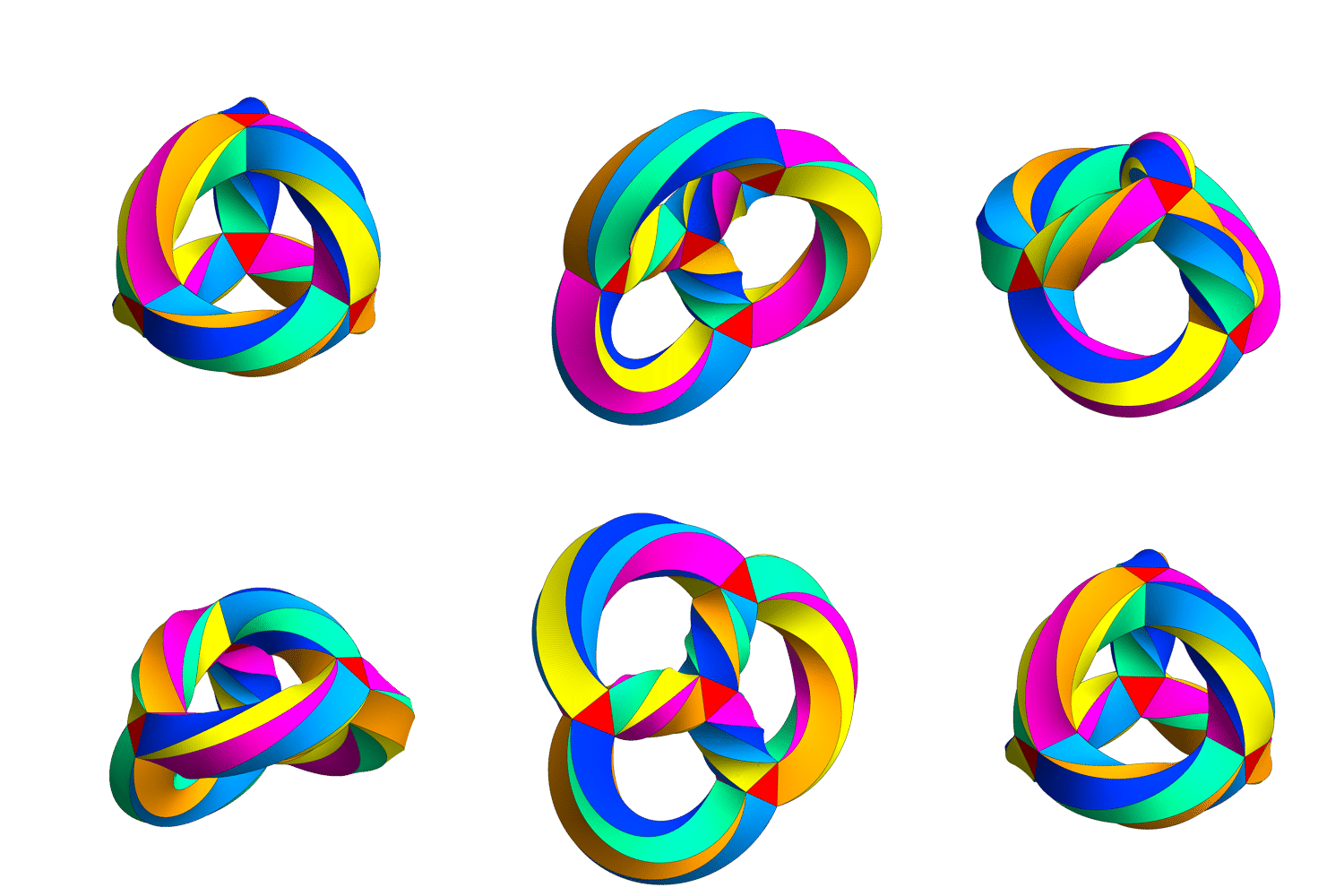
I want to discuss in more detail the modular curves , and , that is, the quotients of the upper half plane by , and respectively (with cusps filled in). These are charismatic entities — for example, you may have seen Greg Egan’s movie of , also known as Klein’s quartic curve:
I also want to talk about the actions of the Hecke operators and on modular forms—or at least the corresponding actions on modular curves. Alas, I don’t think I’m going to get there in this post, but I can at least make a start.
June 6, 2008
Urban Myths in Contemporary Cosmology
Posted by Urs Schreiber
June 4, 2008
Dumbing Down
Posted by David Corfield
Mathematics exams for 16 year olds are getting easier, it is claimed. It’s fairly easy to check for yourself. Take a look at the Arithmetic, Algebra and Geometry papers from 1959 and compare with a contemporary specimen GCSE paper.
Even though the contemporary paper is one for ‘higher’ level students, this is taken by a larger proportion of 16 year olds than the old ‘O’ level. But this surely cannot be enough to justify the limited ambitions of the contemporary syllabus.
My son, who last week finished his one hour 45 minute paper with an hour to spare, was fascinated by the 1959 paper which makes you have to think. He was also surprised to find that the contemporary international version of the GCSE is more demanding than the home version.
June 2, 2008
Classical String Theory and Categorified Symplectic Geometry
Posted by John Baez
As categorification sweeps the land, it hits some areas sooner than others. While it’s had a big impact on fancy forms of mathematical physics like ‘topological quantum field theory’, it hasn’t yet encroached quite so visibly on more basic subjects, like classical mechanics.
However, this is typical of mathematical ideas: they’re often discovered in fancy contexts, but when it becomes clear how simple they are, their realm of application spreads. I believe categorification can be applied to classical mechanics… and then it leads to higher-dimensional field theories, including classical string theory!
Chris Rogers, Alex Hoffnung and I are writing a paper on one aspect of this topic:
-
Chris Roger, Alex Hoffnung and John Baez,
Categorified symplectic geometry and the classical string, draft version. For a more up-to-date version try
this.
Abstract: A Lie 2-algebra is a ‘categorified’ version of a Lie algebra: that is, a category equipped with structures similar to those of a Lie algebra, but where the usual laws hold only up to isomorphism. It is well known that given a manifold equipped with a symplectic 2-form, the Poisson bracket gives rise to a Lie algebra of observables. Multisymplectic geometry generalizes the classical mechanics of point particles to -dimensional field theories, decribing such a theory in terms of a ‘phase space’ that is a manifold equipped with a closed nondegenerate -form. Here, given a manifold with a closed nondegenerate -form, we construct a Lie 2-algebra of observables. We then describe how this Lie 2-algebra can be used to describe dynamics in classical bosonic string theory.
In fact, Chris just gave a series of 5 lectures on the subject, which you can see here…