 Posts with this logo use


May 29, 2008
HIM Trimester on Geometry and Physics, Week 4
Posted by Urs Schreiber

I didn’t quite manage to report from the HIM trimester program as regularly as I set out to do. There was just too much going on, talking to people, giving various talks, hearing highly interesting lecture series by Stephan Stolz and Peter Teichner, by Dan Freed and Michael Hopkins (I managed to report on Mike Hopkins’ first lecture so far, for the stuff by Stolz and Teichner my last summary is still pretty close, lacking mostly the new sophisticated discussion of the cobordism category as a framed bicategory (with diffeos and cobordisms as vertical and horizontal morphisms, respectively) internal to categories fibered over (super-)manifolds), Zoran Šcoda and Igor Bakovic visiting, finishing my article on AQFT from extended functorial QFT (have a look now before this goes to the arXiv next week!), and the like.
And now I am even missing one week of the program: am currently in Stanford, where today I give a colloquium talk:
On nonabelian differential cohomoloy
(pdf, blog)
(the talk itself follows the new notes in section 2.1).
Somewhat related to that: I had started typing up notes I took in a very nice talk by Dan Freed last Friday at Bonn University on differential cohomology, differential K-theory and the index theorem, but didn’t get very far. But below are my notes as far as I got last Friday, hopefully to be completed at some point.
May 28, 2008
Manin on Foundations
Posted by David Corfield
Out of the series of observations made by Yuri Manin in Truth as value and duty: lessons of mathematics most relevant to us here is:
For a working mathematician, when he/she is concerned at all, “foundations” is simply a general term for the historically variable set of rules and principles of organization of the body of mathematical knowledge, both existing and being created. From this viewpoint, the most influential foundational achievement in the 20th century was an ambitious project of the Bourbaki group, building all mathematics, including logic, around set-theoretical “structures” and making Cantor’s language of sets a common vernacular of algebraists, geometers, probabilists and all other practitioners of our trade. These days, this vernacular, with all its vocabulary and ingrained mental habits, is being slowly replaced by the languages of category theory and homotopy theory and their higher extensions. Respectively, the basic “left-brain” intuition of sets, composed of distinguishable elements, is giving way to a new, more “right brain” basic intuition dealing with space-like and continuous primary images, both deformable and deforming.
Has mathematics learned better to employ its corpus callosum?
May 27, 2008
Cahiers Free Online!
Posted by John Baez
Yay! The journal founded by the famous geometer and category theorist Charles Ehresmann and ably continued by his wife Andrée is now free online! It began in 1957 as the Séminaire Ehresmann, and in 1966 it became Cahiers de Topologie et Géométrie Différentielle. You can read a wee bit of its history here.
Double Categories — Warm and Cuddly?
Posted by John Baez
This abstract of a forthcoming talk by Ross Street is sort of interesting… and not just because it’s the first abstract of a math talk I’ve seen that contains the word ‘cuddly’.
May 26, 2008
Number Theory on YouTube?
Posted by John Baez
If you publish a paper in the Journal of Number Theory, they now want you to put your abstract on YouTube! It sounds like a fun idea.
This Week’s Finds in Mathematical Physics (Week 265)
Posted by John Baez
In week265 of This Week’s Finds, see Europa, the icy moon of Jupiter:
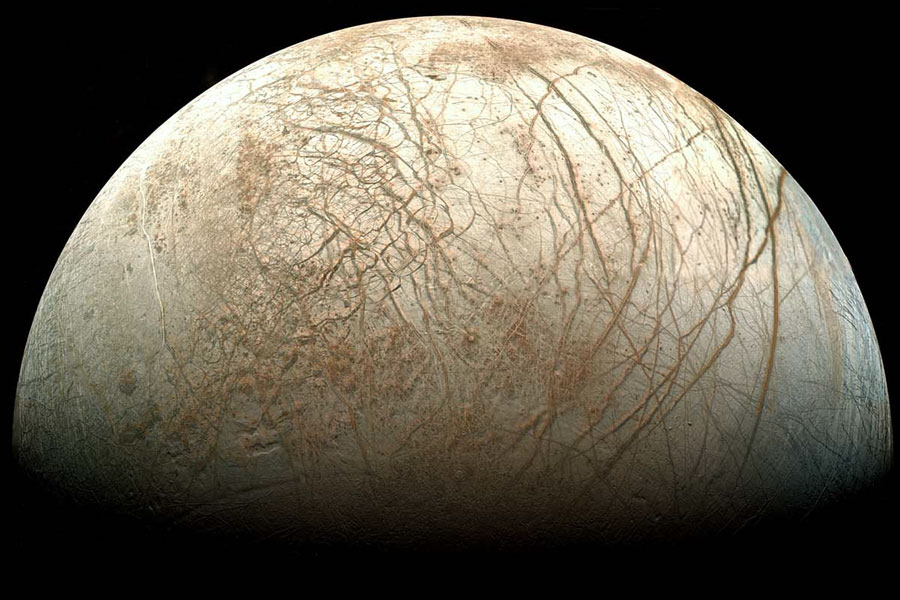
Then read about the Pythagorean pentagram, Bill Schmitt’s work on Hopf algebras in combinatorics, the magnum opus of Aguiar and Mahajan, and quaternionic analysis!
May 22, 2008
Workshop: Non-Commutative Constructions in Arithmetic and Geometry
Posted by Urs Schreiber
guest post by Minhyong Kim
This is a reminder to people with reasonable access to London that there will be a workshop on
“Non-commutative constructions in arithmetic and geometry”
at University College London on 7 and 8 June. Further information can be found on the page
http://www.ucl.ac.uk/~ucahmki/ncc.html
Unfortunately, I couldn’t get enough funding to support general participants. But, as you will see from the directions there, UCL is very easy to reach from St. Pancras station (Eurostar) or Luton airport (EasyJet), and practically next door to Euston station, allowing the possibility of a day trip from many locations.
Although higher categories do not occur as an explicit theme, the discussion should include many points of interest in common with the regulars of the café.
I hope to see you there.
Minhyong Kim
May 20, 2008
Hopkins-Lurie on Baez-Dolan
Posted by Urs Schreiber
I just heard at HIM from Mike Hopkins apparently the kind of talk that Jacob Lurie gave a while ago, as recounted here.
It’s about their work on formulating the Baez-Dolan tangle hypothesis/extended TQFT hypothesis (which essentially says that every extended TQFT is already fixed by the “-space of objects” which it assigns to the point) within -categories and then proving it (proof done for low and sketched for all ).
Relation between AQFT and Extended Functorial QFT
Posted by Urs Schreiber
Update: the article is now on the arXiv.
This is your last chance (your first chance was here) to make it into the acknowledgements of
Urs Schreiber
On the relation between algebraic QFT and extended functorial QFT
arXiv:0806.1079
by complaining about which important references I missed, or complaining about how un-understandable the main argument is, or other complaints like this.
Abstract. There are essentially two different approaches to the axiomatization of quantum field theory (QFT): algebraic QFT, going back to Haag and Kastler, and functorial QFT, going back to Atiyah and Segal. More recently, based on ideas by Baez and Dolan, the latter is being refined to “extended” functorial QFT by Freed, Hopkins, Lurie and others. The first approach uses local nets of operator algebras which assign to each patch an algebra “of observables”, the latter uses -functors which assign to each patch a “propagator of states”.
Here we present an observation about how these two axiom systems are naturally related: we demonstrate under mild assumptions that every 2-dimensional extended QFT 2-functor (“parallel surface transport”) naturally yields a local net. This is obtained by postcomposing the propagation 2-functor with the formation of 2-endomorphisms. The argument has a straightforward generalization to higher dimensions.
May 19, 2008
Ambiguity Theory
Posted by David Corfield
This paper – Ambiguity theory, old and new – is rather fun and would be good to understand thoroughly if we hope to get 2-Galois to do anything important. It’s by Yves André of the ENS, and refers to a comment made by Galois that he was working with a théorie de l’ambiguïté. Good to see Albert Lautman receiving a mention.
For those who want something less introductory, on the same day André has deposited Galois theory, motives and transcendental numbers. Lots there about Kontsevich and Zagier’s Periods, described in their article of that name in Mathematics Unlimited – 2001 and beyond, pages 771-808, unfortunately now no longer available on the Web.
Integrals and Valuations using Geometric Logic
Posted by Urs Schreiber
guest post by Bas Spitters
Thierry Coquand and I have
just released the paper Integrals and
Valuations.
In this paper we investigate the theory of integrals and measures(=valuations) motivated by both topos (or locale) theory and the theory of operator algebras. Not surprisingly this was precisely we needed for our work on a topos for algebraic quantum theory.
This Week’s Finds in Mathematical Physics (Week 264)
Posted by John Baez
In week264 of This Week’s Finds, learn about this doomed Martian moon:
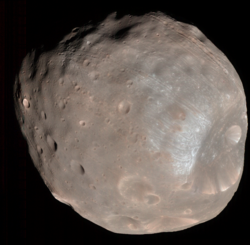
Then learn a wonderful description of the homotopy groups of the 2-sphere in terms of braids, and guess the significance this sequence:
And if you can, help me with theta functions!
May 18, 2008
Harrison’s Geometric Calculus
Posted by Urs Schreiber
In
Jenny Harrison
Lectures on Geometric Calculus
arXiv:math-ph/0501001
Morris Hirsch # is quoted as having said the following:
A basic philosophical problem has been to make sense of “continuum”, as in the space of real numbers, without introducing numbers. Weyl [5] wrote, “The introduction of coordinates as numbers… is an act of violence”. Poincaré wrote about the “physical continuum” of our intuition, as opposed to the mathematical continuum. Whitehead (the philosopher) based our use of real numbers on our intuition of time intervals and spatial regions. The Greeks tried, but didn’t get very far in doing geometry without real numbers. But no one, least of all the Intuitionists, has come up with even a slightly satisfactory replacement for basing the continuum on the real number system, or basing the real numbers on Dedekind cuts, completion of the rationals, or some equivalent construction.
Harrison’s theory of chainlets can be viewed as a different way to build topology out of numbers. It is a much more sophisticated way, in that it is (being) designed with the knowledge of what we have found to be geometrically useful (Hodge star, Stokes’ theorem, all of algebraic topology,…), whereas the standard development is just ad hoc – starting from Greek geometry, through Newton’s philosophically incoherent calculus, Descarte’s identification of algebra with geometry, with additions of abstract set theory, Cauchy sequences, mathematical logic, categories, topoi, probability theory, and so forth, as needed. We could add quantum mechanics, Feynman diagrams and string theory! The point is this is a very roundabout way of starting from geometry, building all that algebraic machinery, and using it for geometry and physics. I don’t think chainlets, or any other purely mathematical theory, will resolve this mess, but it might lead to a huge simplification of important parts of it.
May 17, 2008
Electric-Magnetic-Duality and Hodge Duality Extended to Differental Cocycles
Posted by Urs Schreiber
On
M. Caicedo, I. Martín and A. Restuccia
Gerbes and Duality
(arXiv:hep-th/0205002).
Convenient Categories of Smooth Spaces
Posted by John Baez
Ever since Urs and I first started working on higher gauge theory, we’ve needed something more general than manifolds. You’ve probably heard about the misanthrope who loves humanity as a whole but can’t stand anyone individually. It’s the other way with manifolds. They’re very nice individually — but the category of manifolds as a whole is really annoying. It lacks almost all the properties we expect from a good category!
Grothendieck faced a similar problem long ago in algebraic geometry. He realized that a nice category that includes nasty objects is better than a nasty category with only nice objects. This is why he generalized algebraic varieties and invented ‘schemes’. You can do lots of constructions with schemes that you can’t do with varieties. Sometimes these constructions will lead to nasty schemes. But, that’s a worthwhile price to pay.
It’s time to do the same thing in differential geometry! So, that’s what my grad student Alex Hoffnung has been pondering:
-
John Baez and Alex Hoffnung, Convenient categories of smooth spaces.
Abstract: A ‘Chen space’ is a set equipped with a collection of ‘plots’ — maps from convex subsets of Euclidean space into — satisfying three simple axioms. In many respects Chen spaces provide a more convenient setting for differential geometry than the category of smooth manifolds. For example, any subspace or quotient space of a Chen space is a Chen space, the space of smooth maps between Chen spaces is a Chen space, and the category of Chen spaces has all limits and colimits. Souriau’s ‘diffeological spaces’ share all these properties. Here we give a unified treatment of both formalisms. Following ideas of Dubuc, we show that Chen spaces, diffeological spaces, and even simplicial complexes are examples of ‘concrete sheaves on a concrete site’. As a result, they are locally cartesian closed categories with all limits and colimits, and a weak subobject classifier. For the benefit of differential geometers, our treatment explains much of the category theory that we use.
May 15, 2008
Theorems Into Coffee III
Posted by John Baez
Okay… I was visiting George Washington University, takling to my friend Bill Schmitt about matroids and giving a practice version of my talk on the number 5 — but now I’m back and ready to offer more coffee for more theorems!
So, here are some more PROPs for you to ponder.
May 14, 2008
HIM Trimester Geometry and Physics, Week 1
Posted by Urs Schreiber
I had thought I could get some work done here, but I hardly find the time to reply to my email.
But there are lots of things that would deserve blogging about.
May 10, 2008
E8 Quillen Superconnection
Posted by Urs Schreiber
A remark on the nature of Quillen superconnections with values in -graded Lie algebras, such as .
May 8, 2008
On Lie oo-Theory
Posted by Urs Schreiber
Taking a day off at HIM (will report tomorrow on what Liang Kong has been teaching us about vertex operator algebras from Segal’s CFT axioms, using theorems by Huang), today I am giving a talk in Hamburg in our series on BRST-BV formalism (as you will have guessed), the goal being to illuminate the geometric -categorical meaning of the BRST complex regarded as a -algebroid:
The things I’ll say and draw to the board are those at the beginning of section 1 of
On action Lie -groupoids and action Lie -algebroids
(pdf)
Pernicious Symbolization
Posted by David Corfield
Gian-Carlo Rota upset a number of analytic philosophers when in The pernicious influence of mathematics upon philosophy he likened their use of symbolism to someone paying for groceries with Monopoly money. But it didn’t take an outsider to object to such practices. Gilbert Ryle, one of the so-called ‘ordinary language philosophers’, reviewing Rudolf Carnap’s Meaning and Necessity in Philosophy XXIV, 1949, remarks on Carnap’s
…growing willingness to present his views in quite generous rations of English prose. He still likes to construct artificial ‘languages’ (which are not languages but codes), and he still interlards his formulae with unhandy because, for English speakers, unsayable Gothic letters. But the expository importance of these encoded formulae seems to be dwindling. Indeed I cannot satisfy myself that they have more than a ritual value. They do not function as a sieve against vagueness, ambiguity or sheer confusion, and they are not used for the abbreviation or formalization of proofs. Calculi without calculations seem to be gratuitous algebra. Nor, where explicitness is the desideratum, is shorthand a good substitute.
(Interlard is literally ‘to intersperse with alternate layers of lard’.)
May 7, 2008
Integrability of Lie Brackets
Posted by Urs Schreiber
I would like to advertise the beautiful review
Marius Crainic, Rui Loja Fernandes
Lectures on Integrability of Lie Brackets
arXiv:math/0611259
on the integration of Lie algebroids to Lie groupoids .
Section 3.2 has a nice review of the method of integrating Lie algebras to Lie groups using equivalence classes of paths in the Lie algebra. Then in 3.3 it is discussed how this generalizes to Lie algebroids.
In section 5.3 of On action Lie -groups and action Lie -algebras (pdf) I describe how this integration method is secretly (well, it’s pretty obvious, but still deserves to be made explicit) nothing but forming the fundamental path groupoid of the smooth classifying space of -valued differential forms:
May 6, 2008
Ambimorphic?
Posted by Urs Schreiber
A question on the interpretation of the fundamental path -groupoid as an ambimorphic object: an -groupoid valued co-presheaf:
Quaternionic Analysis
Posted by David Corfield
Nobody else has mentioned it, but perhaps a few extracts from a paper by one of the founding fathers of categorification, Igor Frenkel, might be of interest, even if not on our topic:
Quaternionic Analysis, Representation Theory and Physics, Igor Frenkel and Matvei Libine.
Abstract
We develop quaternionic analysis using as a guiding principle representation theory of various real forms of the conformal group. We first review the Cauchy-Fueter and Poisson formulas and explain their representation theoretic meaning. The requirement of unitarity of representations leads us to the extensions of these formulas in the Minkowski space, which can be viewed as another real form of quaternions. Representation theory also suggests a quaternionic version of the Cauchy formula for the second order pole. Remarkably, the derivative appearing in the complex case is replaced by the Maxwell equations in the quaternionic counterpart. We also uncover the connection between quaternionic analysis and various structures in quantum mechanics and quantum field theory, such as the spectrum of the hydrogen atom, polarization of vacuum, one-loop Feynman integrals. We also make some further conjectures. The main goal of this and our subsequent paper is to revive quaternionic analysis and to show profound relations between quaternionic analysis, representation theory and four-dimensional physics.
Theorems Into Coffee II
Posted by John Baez
Nobody instantly solved my first coffee challenge, but I hope that interest is brewing. Maybe some of you will perk up if I throw another $15 in the pot?
It’s a slight variation on the same theme: taking a nice category where the morphisms are matrices, interpreting it as a PROP, and asking what sort of algebraic gadget is defined by this PROP.
May 4, 2008
Theorems Into Coffee
Posted by John Baez
As the famous quote goes, “a mathematician is a machine for turning coffee into theorems”. But every chemical reaction is reversible, at least under the right conditions. So, there’s got to be some way turn theorems into coffee!
And now you can do it here.
FQXi
Posted by Urs Schreiber
I agreed to participate in the review panel of FQXi’s new round of grant competition.
(You can find useful discussion of the nature of FQXi in blog posts over at Cosmic Variance: The Foundational Questions Institute (Anthony Aguirre) and Foundational Questioners announced.)
The review meeting is June 3 to June 5 somewhere in California.
I am just mentioning this in case anyone feels like taking advantage of me being in the US with flight tickets having been taken care of :-) I just need to check how many days the HIM allows me be be away. On June 10 I give a talk in Hamburg, so I need to be back at least by then.