 Posts with this logo use


March 31, 2008
Limits and Push-Forward
Posted by Urs Schreiber

The limit and colimit of a functor can be understood as the “push-forward of the functor to a point”: the image of the functor under the right or left adjoint functor of the pullback of functors from the terminal category .
Is there a useful generalization of this correspondence between limits and push-forward for the case of indexed limits?
March 30, 2008
This Week’s Finds in Mathematical Physics (Week 262)
Posted by John Baez
In week262 of This Week’s Finds, see the Southern Ring Nebula and the frosty dunes of Mars:

Then read about quantum technology in Singapore, atom chips, graphene transistors, nitrogen-vacancy pairs in diamonds, a new construction of , and a categorification of quantum .
March 29, 2008
Test Your Singlish
Posted by John Baez
Singlish is a creole language based on English, Malay, Hokkien, Teochew, Cantonese, Tamil and various other languages. I didn’t hear much Singlish during my recent visit to the Singapore, but I found a nice book about it in Kinokuniya, which is conceivably the world’s best bookstore chain.
There’s a lot of wit in some Singlish expressions, and I hope they catch on elsewhere in the English-speaking world. Try guessing what these mean:
- action (verb)
- arrow (verb)
- blur (adjective)
- catch no ball (verb)
- havoc (adjective)
- stylo mylo (adjective)
- Z-monster (noun)
(Of course you can resort to various online Singlish dictionaries, but that’s cheating.)
March 27, 2008
Categorified Quantum Groups
Posted by David Corfield
Once in a distant blog, John was quick to pour cold water on the suggestion I made that the aims of those categorifying might differ sufficiently to merit distinguishing types of ‘categorification’:
I don’t like this “Frenkelian” versus “Baezian” distinction. Baez was inspired to work on higher categories thanks to the work of Crane and Frenkel. Frenkel’s student Khovanov cites Baez’s work on 2-tangles in his first paper on categorified knot invariants. Frenkel’s student Khovanov has taken on Baez’s student Lauda as a postdoc at Columbia starting next fall. Will their work on categorifying quantum groups and using these to get 2-tangle invariants be “Frenkelian” or “Baezian”?
Some results of the collaboration are now out. Aaron has just posted A categorification of quantum sl(2) to the arXiv.
Did the Geometric Representation Theory Seminar reach the point of having categorified quantum groups? Not that I’m after differences of approach, of course.
What Has Happened So Far
Posted by Urs Schreiber
The -Category Café has recently passed beyond entries, trackbacks and comments. Maybe a good time to look back at what has happened so far.
Our subtitle says “A blog on math, physics and philosophy”. For me, there is one major question sitting at the intersection of these three subjects. It is
The fundamental question of quantum physics: What is a -model, really?
I have been exclusively talking about this question ever since we started the blog. I started referring to it as the question of the QFT of the charged -particle #. I still think this is the more descriptive term, but it was rightly indicated to me that it is not politically advisable for somebody in my position to make up new terminology.
Since it was also pointed out to me ## that it may at times be hard to remember the big picture, let me recall:
The proposed answer to the fundamental question of quantum physics: Pull-push of nonabelian differential cocycles.
We are in the setting of general cohomology theory, where generalized/homotopy/ana-morphisms between “spaces” (usually # presheaves with values in a homotopy category) are “cocycles” encoding higher fiber bundles. And also higher fiber bundles with connection, which are addressed as (nonabelian) differential cocycles #.
Given a (nonabelian, differential) cocycle on , and given another “space” , there is a canonical way to obtain a cocycle on : we pull-push through the correspondence
The pullback along (followed by the hom-adjunction) is transgression of the cocycle on to a cocycle on . The push-forward along is “taking sections” ## #.
Usually the push-forward along won’t exist. The chances that it exists increase when the original cocycle is pushed-forward along a representation
In the context of quantum physics, is the target space in which an “()-brane” (= -particle) with worldvolume # of shape propagates and is charged # # under a background field . The pull-push is quantization in the extended/localized # sense of Freed ##. is the Schrödinger picture # propagation. Applying an endomorphism functor sends it to the Heisenberg picture # of AQFT #. Since quantization sends differential cocycles to differential cocycles, we can iterate. This is second quantization #.
While following through this program, we ran into one big puzzle, concerning the proper nature of -curvature: it turned out that a differential cocycle “with values in ” is actually a certain constrained generalized morphism into # . Understanding that funny shift in dimension properly used up maybe 50 percent of my time here, and is probably the reason if the effort looked less than coherent at times.
Making recourse to the “rationalized” approximation of -connections # the pattern was finally understood, and now there are very nice relations emerging # between this question and major programs of my co-bloggers: higher topos theory and geometric representation theory/groupoidification.
There is one main class of examples which motivates all this effort: quantization of # (higher) Chern-Simons bundles with connection to Chern-Simons QFT ## and its holographic # #boundary theory. Indeed, the realization # that the known modular category theoretic formulation of 2-dimensional CFT # # was in fact secretly a differential cocycle was what originally lead to the proposed answer above. This is being worked out with Jens Fjeldstad #.
The hardest part of figuring out the pull-push of a given cocycle is in top dimension. This is no surprise, since there it must reproduce the “path integral”. But first consistency checks in simple toy examples suggest that it does work # # allright.
But with the big picture finally stabilizing, many details need to be worked out further.
March 22, 2008
Nonabelian Differential Cohomology in Street’s Descent Theory
Posted by Urs Schreiber
As a followup to our recent discussion #:
Nonabelian differential cohomology
in Street’s descent theory
(pdf, 20 pages)
Abstract: The general notion of cohomology, as formalized -categorically by Ross Street, makes sense for coefficient objects which are -category valued presheaves. For the special case that the coefficient object is just an -category, the corresponding cocycles characterize higher fiber bundles. This is usually addressed as nonabelian cohomology. If instead the coefficient object is refined to presheaves of -functors from -paths to the given -category, then one obtains the cocycles discussed in [BS, SWI, SWII, SWIII] which characterize higher bundles with connection and hence live in what deserves to be addressed as nonabelian differential cohomology. We concentrate here on -categorical models (strict globular -categories) and discuss nonabelian differential cohomology with values in -groups obtained from integrating L(ie)- algebras.
March 21, 2008
Groupoidfest in Riverside
Posted by John Baez
The next Groupoidfest is here in Riverside!
- Groupoidfest, November 22-23, 2008, Mathematics Department, University of California, Riverside, organized by Aviv Censor.
I hope some of you can come! If you want to, contact Aviv as described on the conference website.
Crossed Menagerie
Posted by Urs Schreiber
Tim Porter kindly made the following notes available online:
Tim Porter
Crossed Menagerie:
an introduction to crossed gadgetry and cohomology in algebra and topology
(pdf with the first 7 chapters (237 pages))
March 20, 2008
This Week’s Finds in Mathematical Physics (Week 261)
Posted by John Baez
In week261 of This Week’s Finds, learn about the Engraved Hourglass Nebula:
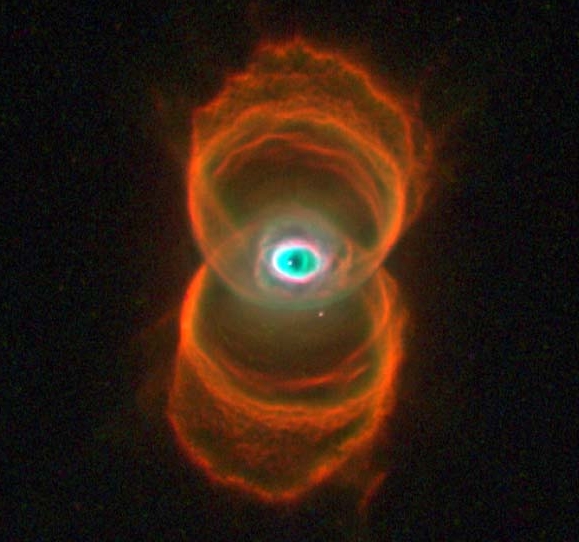
Then read an ode to the number 3, which explains how all these entities are connected:
- the trefoil knot
- cubic polynomials
- the group of permutations of 3 things
- the three-strand braid group
- modular forms and cusp forms
March 17, 2008
The World of L
Posted by David Corfield
March 13, 2008
Slides: On Nonabelian Differential Cohomology
Posted by Urs Schreiber
On nonabelian differential cohomology
(52 pdf slides)
March 12, 2008
Chern-Simons Actions for (Super)-Gravities
Posted by Urs Schreiber
Just as
electromagnetism is a theory of line 1-bundles with connection coupled to electric 1-particles and magnetic 1-particles,
we have that
supergravity # in eleven dimensions is a theory of line 3- and line 6-bundles with connection coupled to electric 3-particles and magnetic 6-particles.
(There is a beautiful discussion of essentially this statement by D. Freed, which I talked about here, and here. Freed doesn’t say “-bundle with connection”, but instead says “differential cocycle”. But it’s the same kind of thing.)
Wonders never cease, and hence there are indications that there is more to 11-dimensional supergravity than meets the eye. The question is: what? What is 11-dimensional supergravity really about?
One idea is: it is really about 1-particles on the “-group manifold”. This we talked about before.
Another idea is: it is really about the higher Chern-Simons theory # of an invariant degree 6-polynomial on a super Lie algebra not unlike super- #.
This speculation was put forward in
Petr Hořava
M-Theory as a Holographic # Field Theory
(arXiv)
The jargon in the title is such as to make certain physicists excited. A completely different, but possibly just as exciting jargon would be: it is speculated here that, very fundamentally, physics is about those representations of extended cobordism categories which are naturally induced from Chern-Simons -bundles with connection.
I was reminded of that by the appearance of the very nicely written basic review
Jorge Zanelli
Lecture notes on Chern-Simons (super-)gravities
(arXiv)
which was updated a few days ago. (Thanks to It’s equal but It’s different for noticing.)
This reviews the action functionals for theories of gravity one obtains by picking a -dimensional manifold , a structure group like together with a degree invariant polynomial on its Lie algebra; and takes the action functional to be the corresponding Chern-Simons integral which sends -valued 1-forms on to where the Chern-Simons -form # satisfies .
For this yields, famously, the ordinary (super) Einstein-Hilbert action in that dimension. For higher (odd) , this yields the (super) Einstein-Hilbert action with higher curvature contributions.
Hořava gave arguments suggesting that and how for the Chern-Simons gravity action reduces to that of ordinary supergravity in the appropriate limit.
Following Singapore’s Lead
Posted by John Baez
Some interesting news from the Los Angeles Times.
In 2005, just 45% of the fifth-graders at Ramona Elementary School in Hollywood scored at grade level on a standardized state test. In 2006, that figure rose to 76%. Why? They started using the same math curriculum that Singapore does.
Ramona isn’t a rich, fancy school. Nine out of ten students at the school are eligible for free or reduced-price lunches. Most are children of immigrants — most from Central America, some from Armenia. Almost six in ten speak English as a second language. But, they’re doing a lot better in math than kids at other nearby schools!
March 11, 2008
A Strange Link
Posted by David Corfield
Guest post by Tim Porter
I have just been looking back over Todd’s guest posts (I and II) from last autumn, and a strange link has just occurred to me. In the paper (Me with A. Bak, R. Brown and G. Minian), Global Actions, Groupoid Atlases and Applications, Journal of Homotopy and Related Structures, 1(1), 2006, pp.101 - 167, we include some examples from group presentation theory (which has a tendency to be a good testing ground for ideas for presenting logics).
Take a group and a family of subgroups (not just one as in Jim and Todd’s discussion). This family can be just ‘discrete’ or may be completed under intersections, it may not make a lot of difference. You cannot form a direct quotient by the family to get a -set because you have more than one (usually)!!! Try it with a nice finite group and two subgroups. The cosets of the subgroups in the family give a covering of the set of elements of and the nerve and Vietoris complexes of that covering give simplicial complexes with a -action, and hence an orbi-hedron in Haefliger’s sense (see the big book by Bridson and Haefliger – Metric Spaces of Non-Positive Curvature).
Physics, Topology, Logic and Computation: a Rosetta Stone
Posted by John Baez
It’s done!
- John Baez and Mike Stay, Physics, topology, logic and computation: a Rosetta Stone.
Learn how category theory serves as a lingua franca that lets us translate between certain aspects of these four subjects… and perhaps, eventually, build a general science of systems and processes! In a nutshell, it goes like this:
It takes a while to explain the details.
March 9, 2008
Learning to Love Topos Theory
Posted by John Baez
I was just working away, listening to some music by Gorillaz, when I checked my email and saw this great quote from Steve Vickers on the category theory mailing list:
As a parable, I think of toposes as gorillas (rather than elephants). At first they look very fierce and hostile, and the locker-room boasting is all tales of how you overpower the creature and take it back to a zoo to live in a cage — if it’s lucky enough not to have been shot first. When it dies you stuff it, mount it in a threatening pose with its teeth bared and display it in a museum to frighten the children. But get to know them in the wild, and gain their trust, then you begin to appreciate their gentleness and can play with them.
The gorilla in the cage is the topos in the classical world.
March 8, 2008
Some Puzzles
Posted by John Baez
Grr! I’m too busy trying to finish that Rosetta Stone paper to post anything really interesting, or even reply sensibly to the posts by my co-bloggers. So, just a few puzzles…
March 6, 2008
Space and Quantity
Posted by Urs Schreiber
Am preparing some notes which are supposed to wrap up the discussion on smooth spaces, smooth function algebras, smooth algebras of differential forms, etc, which we had in
Transgression, Comaparative Smootheology, Question on Smooth Functions
and further develop it. Here is the current status:
Spaces and Differential Forms
(pdf).
I haven’t indicated any author names at this point. I have typed this so far, but, as you all know, this draws heavily on plenty of remarks by Todd Trimle and Andrew Stacey. Most of the proofs currently appearing are simply transcripts of proofs Todd described. (Of course all mistakes in the document are mine.) I also benefitted from discussing this stuff with Bruce Bartlett in person.
Worrying About 2-Logic
Posted by David Corfield
Here’s a possible problem for the idea of modal logic as 2-logic.
In ordinary first order logic a model of a theory is a set . To an -ary predicate of the theory we assign a subset of , to a constant an element of , and so on.
For a given , we can derive a Galois correspondence between theories modelled on and subgroups of , the permutations of , as Todd shows.
Now, in first order modal logic (FoS4) a model of a theory is a sheaf. To show completeness we can stick with bog standard sheaves on topological spaces, as Awodey and Kishida show in their paper Topology and Modality. This combines the topological semantics of propositional modal logic with the set-valued semantics of first-order logic. Necessity relates to taking the interior of subsets of the base space.
March 4, 2008
Sections of Bundles and Question on Inner Homs in Comma Categories
Posted by Urs Schreiber
In the spirit of groupoidification a section of an associated bundle can be conceived in the following way:
let be a group, the corresponding one-object groupoid, a space, a “good” regular epimorphism, the corresponding groupoid. Then -bundles on are equivalent to functors
Now let be a linear representation of (or any other representation) and denote by the corresponding action groupoid, which sits canonically in the sequence Given these two morphisms, we are lead draw the cone It is easy to convince oneself that the collection of completions
of this diagram equals the collection of sections of the bundle associated to via :
Charges and Twisted n-Bundles, II
Posted by Urs Schreiber
Last time I recalled how the historically big insight
an electromagnetic field is a line bundle with connection
has to actually be replaced, more generally, by the statement
an electromagnetic field is a twisted line bundle, i.e. a “gerbe module” or “2-section” of the magentic charge line 2-bundle.
This time I recall Freed’s description of the Euclidean action for electromagnetism in the presence of electric currents. Then, again, I rephrase everything in the language of -connections (blog, arXiv) and the arrow-theoretic -model (slide 11).
I’ll do so for the very simple case where all -bundles appearing are actually trivial, so that only their connection forms matter. This makes most of the differential cohomology/-bundle terminology overkill, but allows to nicely see how the action functional on configuration space arises from transgression of a “background field”, following the general tao.
March 3, 2008
Infinity-Groups with Specified Composition
Posted by Urs Schreiber
I have a certain desire to do the one-two-three—-infinity thing for -groups while retaining specified composition.
What I mean is this: there is the
bundle point of view
and the
section point of view
on higher categories. The first one uses models where the existence of compositions of -morphisms is guaranteed, but not specified, while the second one explicitly specifies for any two higher morphisms and all possible ways to attach them the resulting composite.
In the first approach it is easy to say -group: “Kan complex with single 0-simplex”.
While that’s easy to say, it is in general hard to do anything with (at least for me). When we want to actually do something in concrete applications, we are often better off with having a model that has specified composites. (I discussed a concrete example for that recently in Construction of Cocycles for Chern-Simons 3-Bundles.)
Well, I might be just ignorant and prejudiced. But be that as it may, it should be an interesting question in its own right to see how far we can get with handling -groups in the second approach, where composites are specified.
There is little chance, with present technology, to handle in the second case -groups with full weakening allowed. On the other hand, entirely strict -groups would be easy to handle, but a bit insufficient. I want something which is as strict as possible while still capturing a “sufficient” degree of weakening.
And here is my condition on what I will consider as sufficient weakening:
The model of -groups must be closed in that for an -group also is an -group.
Because that’s what is needed for doing differential nonabelian cohomology.
Here denotes the one-object -groupoid given by .
For instance, if is an ordinary group, then is the 2-group whose objects are the ordinary automorphisms of and whose morphisms are the inner automorphisms of .
Notice that if is a strict 2-group, then is no longer a strict 3-group – but a Gray group, meaning that is a Gray groupoid, a groupoid enriched over the category of 2-categories equipped with the Gray tensor product. In the language of crossed group structures, this amounts to passing from crossed complexes to crossed squares.
This is described in theorem 4.3 and 5.1 of
R. Brown, I. Icen
Homotopies and automorphisms of crossed modules of groupoids
(arXiv).
and David Roberts and myself talk about it in our article.
So, forming automorphism -groups of -groups takes one from the world of strict -groups into the weakened realm. But how far? Do we need fully weakened -groups to have that is an -group if is? Or is there some explicit “semistrict” notion of -group in between, rather strict, but weak enough to allow for ?
Here is my proposal for how to deal with that (following a similar remark I made in a comment here):
A Deep Sense of Miserable Ignorance
Posted by David Corfield
On p. 171 of Peirce’s lectures, Reasoning and the logic of Things, having favourably compared the universities of Europe to those of America, he explains what is wrong with the latter’s pedagogy:
In order that a man’s whole heart may be in teaching he must be thoroughly imbued with the vital importance and absolute truth of what he has to teach; while in order that he may have any measure of success in learning he must be penetrated with a sense of the unsatisfactoriness of his present condition of knowledge. The two attitudes are almost irreconcilable. But just as it is not the self-righteous man who brings multitudes to a sense of sin, but the man who is most deeply conscious that he is himself a sinner, and it is only by a sense of sin that men can escape its thraldom; so it is not the man who thinks he knows it all, that can bring other men to feel their need of learning, and it is only a deep sense that one is miserably ignorant that can spur one on in the toilsome path of learning. That is why, to my very humble apprehension, it cannot but seem that those admirable pedagogical methods for which the American teacher is distinguished are of little more consequence than the cut of his coat, that they surely are as nothing compared with that fever for learning that must consume the soul of the man who is to infect others with the same apparent malady.
Does this explain the success of This Week’s Finds?
March 1, 2008
Kim on Fundamental Groups in Number Theory
Posted by John Baez
My friend Minhyong recently wrote up a talk he gave at Leeds:
- Minhyong Kim, Fundamental groups and Diophantine geometry.
It starts with some pleasant observations of an elementary nature and works its way up to some ideas I find rather terrifying. Maybe we can ask him some questions and get him to explain what’s going on.
Computer Scientists Needed Now
Posted by John Baez
Thanks to advice from Andrej Bauer, Robin Houston and Todd Trimble, I’ve beefed up the logic section of this paper:
- John Baez and Mike Stay, Categories in Physics, Topology, Logic and Computation: a Rosetta Stone. (Draft version: rose2.pdf)
For example, I’ve included a longer ‘overview’ to give the non-logician reader a slight feel for how proof theory met category theory in the development of 20th-century logic. I hope there are no egregious errors. If you catch any, let me know.
But now I really need comments from anyone who likes categories and theoretical computer science!