 Posts with this logo use


October 21, 2026
The Quasi-Riemann Hypothesis
Posted by John Baez

As part of their big theorem dump, an AI company recently emitted a proof of the ‘quasi-Riemann hypothesis’. Maksym Radziwiłł of New York University said the implications of this result are “staggering”, continuing:
“In a sense, the vast majority of consequences of RH already follow from quasi-RH.”
But what is the quasi-Riemann hypothesis, and what are some of these consequences?
September 24, 2026
Binomial Coefficient Coincidences
Posted by John Baez
These seven equations between binomial coefficients are ‘coincidences’ — they aren’t among the four known infinite families of such equations:
September 8, 2026
The E6 Root Polytope
Posted by John Baez
I’ve been thinking about the exceptional Lie algebra E6, as a spinoff of my project on E7, so I want to get a good mental picture of the E6 root polytope. This is 6-dimensional polytope with remarkable symmetry.
August 17, 2026
Three Generations in E7
Posted by John Baez
It’s long been a mystery why there are 3 generations of quarks and leptons: three sets of particles, apparently identical except for how they interact with the Higgs boson. It would be nice if there were some good physical explanation. Nobody knows one. Barring that, it would be nice if some beautiful mathematical structure made this pattern seem natural. That’s what my new paper is about.
I’ll keep this nontechnical. I’ll say a bit about what the paper does, what it does not do, what led up to it, and how I wrote it.
July 18, 2026
Octonions and the Standard Model (Part 15)
Posted by John Baez
Last time I described a way to get the Standard Model gauge group from the exceptional Jordan algebra. But that approach gave no obvious nice way to put quarks and leptons into the picture. This new paper tackles that problem:
- John Baez, Endre Bokor and Latham Boyle, Jordan pair quantum theory and the Standard Model.
Jordan pairs and Jordan triples are two closely linked formalisms that generalize Jordan algebras. Our paper explains them in detail — and how they’re connected to geometry and quantum mechanics. Here I will mostly skip that wonderful story, so I can quickly explain the connection to the Standard Model.
June 13, 2026
Octonions and the Standard Model (Part 14)
Posted by John Baez
Paul Schwahn and I have come out with a new paper about octonions and the Standard Model:
It builds on things I’ve discussed here, but it goes further. Let me explain a bit.
June 2, 2026
A New Blog
Posted by Mike Shulman
Readers may have noticed that I haven’t been very active here for a while. That isn’t because I haven’t felt the “blogging urge”, but because I felt that the things I want to blog about right now wouldn’t be very interesting to much of the n-Category Cafe audience: they’re mostly fairly technical details about implementing proof assistants (because that’s what I’m mostly working on right now).
Accordingly, I’ve started a new blog! It’s at https://gwaithimirdain.github.io/blog/. (Gwaith-i-Mírdain is the github organization for development of Narya, the experimental proof assistant for Higher Observational Type Theory – and now Multimodal Type Theory as well – that I’ve been spending most of my time on, and will primarily be blogging about.) And I already wrote three posts (mostly about implementing multimodal type theory, with several survey questions for the reader), so you can check it out right now and see whether it’s likely to be your cup of tea.
Never fear, I’ll still come back here when I have more category-theoretic things to write about.
April 29, 2026
Quantum Mechanics of the Inverse Cube Force Law
Posted by John Baez
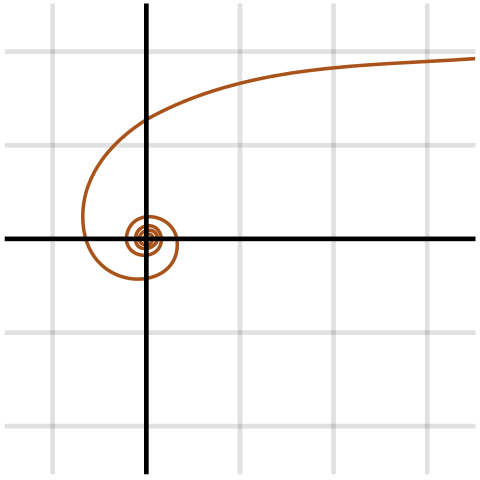
In the last episode of my column in Notices of the American Mathematical Society, we looked at a particle moving in an attractive central force whose strength is proportional to the inverse cube of the distance from the origin. Among other things, we saw that a particle moving in such a force can spiral in to the origin in a finite time. But that was classical mechanics. What about quantum mechanics?
Here things get more tricky. The uncertainty principle tends to prevent the particle from falling in to the origin. But when the attractive force is strong enough, the particle can still fall in. We can make up a theory where the particle shoots back out, but there are choices involved: we need to say how the particle changes phase when shoots back out. So there is not just a single theory, but many!
March 28, 2026
Geometry and the Exceptional Jordan Algebra
Posted by John Baez
I’m giving a talk online tomorrow at the 2026 Spring Southeastern Sectional Meeting of the American Mathematical Society, in the Special Session on Non-Associative Rings and Algebras. The organizers are Layla Sorkatti and Kenneth Price. I doubt the talk will be recorded, but you can see my slides.
March 20, 2026
The Agent That Doesn’t Know Itself
Posted by John Baez
guest post by William Waites
The previous post introduced the plumbing calculus: typed channels, structural morphisms, two forms of composition, and agents as stateful morphisms with a protocol for managing their state. The examples were simple. This post is about what happens when the algebra handles something genuinely complex.
To get there, we need to understand a little about how large language models work.
March 11, 2026
A Typed Language for Agent Coordination
Posted by John Baez
guest post by William Waites
How category theory can be used to help coordinate collections of interacting large language models.
February 11, 2026
The Univalence Principle
Posted by Mike Shulman
(guest post by Dimitris Tsementzis, about joint work with Benedikt Ahrens, Paige North, and Mike Shulman)
The Univalence Principle is the informal statement that equivalent mathematical structures are indistinguishable. There are various ways of making this statement formally precise, and a long history of work that does so. In our recently-published (but long in the making!) book we proved to our knowledge the most general version of this principle, which applies to set-based, categorical, and higher-categorical structures defined in a non-algebraic and space-based style, as well as models of higher-order theories such as topological spaces.
This work achieves three main goals. Firstly, it greatly extends the “Structure Identity Principle” from the original HoTT book, to include any (finite) level of structure, instead of just set-based structures, thus establishing in the strongest sense yet made precise that the Univalent Foundations provide an equivalence-invariant foundation for higher-categorical mathematics. Secondly, it provides very general novel definitions of equivalence between structures and between objects in a given structure that “compile” to most known notions of equivalence in known cases, but which can also be used to suggest notions in new settings; in doing so it extends M. Makkai’s classic work on First Order-Logic with Dependent Sorts (FOLDS). Thirdly, the setting in which our result is proved (a form of Two-Level Type Theory) provides a framework in which to do metamathematics in the Univalent Foundations/HoTT, i.e. carry out the mathematical study of how mathematics is formalized in UF/HoTT. The Univalence Principle we prove is a foundational metamathematical result in that sense.
January 26, 2026
Categorifying Riemann’s Functional Equation
Posted by John Baez
David Jaz Myers just sent me some neat comments on this paper of mine:
and he okayed me posting them here. He’s taking the idea of categorifying the Riemann zeta function, explained in my paper, and going further, imagining what it might mean to categorify Riemann’s functional equation
where is the ‘completed’ Riemann zeta function, which has an extra factor taking into account the ‘real prime’:
My paper categorified the Euler product formula that writes the Riemann zeta function as a product over the usual primes:
I had nothing to say about the real prime.
But it’s the functional equation that sets the stage for focusing on zeroes of the Riemann zeta function with … and then the Riemann Hypothesis! So it’s worth thinking about.
January 6, 2026
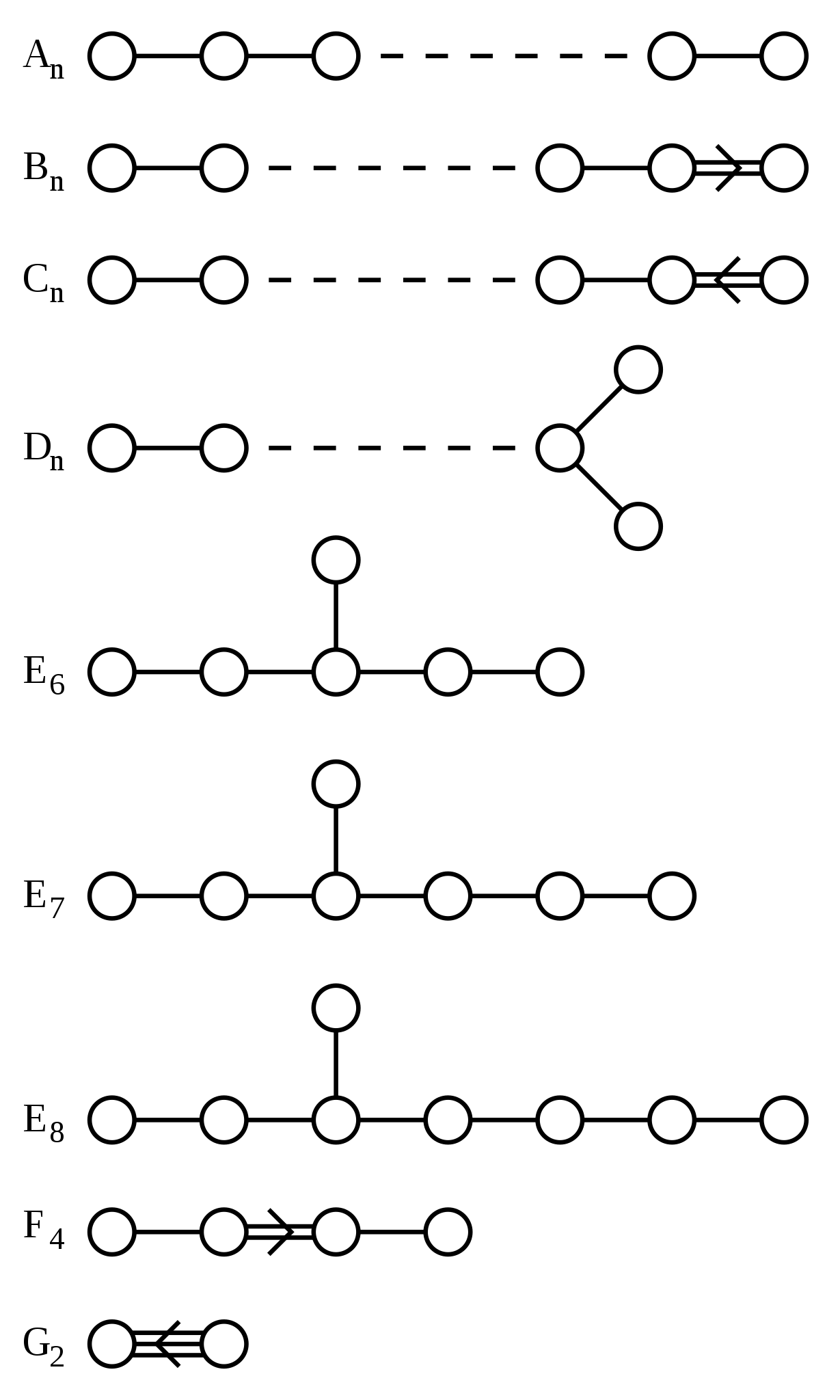
Coxeter and Dynkin Diagrams
Posted by John Baez
Dynkin diagrams have always fascinated me. They are magically potent language — you can do so much with them!
December 7, 2025
Octonions and the Standard Model (Part 13)
Posted by John Baez
When Lee and Yang suggested that the laws of physics might not be invariant under spatial reflection — that there’s a fundamental difference between left and right — Pauli was skeptical. In a letter to Victor Weisskopf in January 1957, he wrote:
“Ich glaube aber nicht, daß der Herrgott ein schwacher Linkshänder ist.”
(I do not believe that the Lord is a weak left-hander.)
But just two days after Pauli wrote this letter, Chien-Shiung Wu’s experiment confirmed that Lee and Yang were correct. There’s an inherent asymmetry in nature.
We can trace this back to how the ‘left-handed’ fermions and antifermions live in a different representation of the Standard Model gauge group than the right-handed ones. And when we try to build grand unified theories that take this into account, we run into the fact that while we can fit the Standard Model gauge group into in various ways, not all these ways produce the required asymmetry. There’s a way where it fits into , which is too symmetrical to work… and alas, this one has a nice octonionic description!