Skip to the Main Content

Note:These pages make extensive use of the latest XHTML and CSS Standards. They ought to look great in any standards-compliant modern browser. Unfortunately, they will probably look horrible in older browsers, like Netscape 4.x and IE 4.x. Moreover, many posts use MathML, which is, currently only supported in Mozilla. My best suggestion (and you will thank me when surfing an ever-increasing number of sites on the web which have been crafted to use the new standards) is to upgrade to the latest version of your browser. If that's not possible, consider moving to the Standards-compliant and open-source Mozilla browser.

February 9, 2007

Infinitely Categorified Calculus

Posted by John Baez

Vasiliy Dolgushev gave a nice talk here at UCR today. He started by explaining how the usual concepts of calculus must be infinitely categorified to apply to noncommutative geometry!

-categories are pretty scary. But, they’re less scary when they’re strict: when all the laws holds as equations instead of ‘up to isomorphism’. And they’re even less scary when they’re also linear: when they’ve got a vector space of objects, a vector space of morphisms, a vector space of 2-morphisms and so on, with all the operations being linear. It turns out that a strict linear -category is just a chain complex of vector spaces!

If you already know and love chain complexes, this revelation might leave you unmoved. But it really does explain a lot about what people do with chain complexes.

In particular, when people start taking ordinary concepts from linear algebra, replacing all the vector spaces in sight by chain complexes, and making all the usual axioms hold ‘up to coherent homotopy’, they’re really -categorifying these concepts.

Here’s what happens to some familiar concepts when we do this:

  • associative algebras become A -algebras
  • Lie algebras become L -algebras
  • commutative algebras become E -algebras

Now, calculus on a manifold is really just a heavy-duty version of linear algebra: we’ve got differential forms, and vector fields, and so on, and a bunch of linear operations. Recently the whole lot have been formalized into a single mathematical gadget called — boldly but aptly — a ‘calculus’.

We can get a calculus not just from a smooth manifold but from any commutative algebra. When we use the algebra of smooth functions on a smooth manifold, we’re back where we started — but it’s really a vast generalization.

What if we start with a noncommutative algebra? Here it turns out we just get a ‘Calc algebra’: in other words, an infinitely categorified calculus!

Let me start by saying what a ‘calculus’ is.

To motivate the definition, suppose M is a smooth manifold. Let

Ω=Γ(ΛT *M)

be the vector space of differential forms on M — the funny notation on the right-hand side mean ‘the space of smooth sections of the exterior algebra of the cotangent bundle of M’, which is nothing but the space of differential forms on M.

Similarly, let

V=Γ(ΛTM)

be the vector space of multivector fields on M. Multivector fields are a bit less famous than differential forms, but they’re also very important. We define them just like differential forms, but starting with the tangent bundle instead of the cotangent bundle.

Both Ω and V have a lot of extra structure which we use all the time in differential geometry. This structure becomes the definition of a ‘calculus’.

What is this structure? For starters, Ω is a supercommutative differential graded algebra. This is a quick way of summarizing the familiar properties of the exterior derivative

d:ΩΩ

and wedge product

:ΩΩΩ.

What about V? This is also a supercommutative graded algebra, with its own wedge product:

:VVV.

But, there’s no ‘exterior derivative’ of multivector fields. As a consolation prize, there’s a bracket operation, the Schouten bracket:

[,]:VVV.

You can define this by saying it’s the unique linear map extending the usual Lie bracket of vector fields in a way that makes the graded algebra V into a graded Poisson algebra — but be careful: since the bracket of vector fields (aka ‘1-vector fields’) is another vector field instead of a 2-vector field, this is a funny sort of graded Poisson algebra where the bracket has degree 1 . This sort of thing is called a Gerstenhaber algebra.

So, we’ve got a supercommutative differential graded algebra Ω and a Gerstenhaber algebra V. But there’s more, because these two structures interact in a nice way!

For starters, the usual ‘Lie derivative’ operation where vector fields act on differential forms extends to an action

L:VΩΩ

making Ω into a module of V, thought of as a graded Lie algebra with bracket of degree 1 . The usual ‘interior product’ operation of vector fields on differential forms also extends to an operation

i:VΩΩ.

And, a bunch of identities hold for all multivector fields v,wV:

[L v,L w]=L [v,w]

[i v,L w]=i [v,w]

L vw=i vL w+(1 ) degvi wL v

[L v,d]=0

i vi w=i vw

The brackets here, except for the bracket in V, are supercommutators.

Taking this all together, we get the definition of a calculus: a supercommutative differential graded algebra Ω and a Gerstenhaber algebra V together with actions L, i where L makes Ω into a module of V and the above identities hold.

(I hope I have everything here! What happened to the Weil identity L v=[d,i v], familiar for vector fields v?)

Now the fun starts…

For any associative algebra A we can define a chain complex of Hochschild chains:

C (A,A)=AA

and a cochain complex of Hochschild cochains:

C (A,A)=hom(A ,A)

Taking homology and cohomology, respectively, we get Hochschild homology:

H (A,A)

and Hochschild cohomology:

H (A,A)

It turns out that if A is the algebra of smooth functions on a compact manifold, the Hochschild homology gives the differential forms on M:

H (A,A)Ω

while the Hochschild cohomology gives the multivector fields:

H (A,A)V.

So, in this case H (A,A) and H (A,A) form a calculus. But it’s always better to do things at the level of co/chains instead of just at the level of co/homology, whenever possible. So, this raises the question of whether C (A,A) and C (A,A) form a calculus as well, in a way that reduces to our familiar calculus on Ω and V when we take co/homology.

And, since Hochschild co/chains make sense for any associative algebra, not just any commutative one, we should wonder if we also get a calculus in the noncommutative case!

The answer, in short, is yes, if we are willing to infinitely categorify the concept of calculus!

In other words, there’s a concept of Calc -algebra, which is like a calculus but where all the usual laws hold up to chain homotopy — and these chain homotopies themselves satisfy all the right laws up to chain homotopy, ad infinitum. And, we have:

Theorem. For any associative algebra A, the Hochschild chains C (A,A) and Hochschild cochains C (A,A) naturally form a Calc -algebra. This in turn makes H (A,A) and H (A,A) into a calculus, in such a way that when A is the algebra of smooth functions on a compact manifold, we recover the usual calculus of differential forms and multivector fields.

A lot of work by a lot of people went into proving this result. For example, the differential

d:C p(A,A)C p+1 (A,A)

is the ‘B’ operator invented by Connes in his work on noncommutative geometry. Tamarkin later showed that C (A,A) is a G -algebra, which is the infinitely categorified version of a Gerstenhaber algebra. (In fact, in this case all the differential graded Lie algebra axioms hold ‘on the nose’, as equations — it’s the other rules that hold only up to coherent homotopy.) The proof of this was deep: it used the Deligne’s conjecture (first proved by Kontsevich) and the formality of the little discs operad (first proved by Tarmakin himself). For more see this:

But, apparently this paper pulled it all together:


By the way — in case you’re curious, the boundary map in Hochschild homology is given by:

d(ba 1 a n)= ba 1 a 2 a nba 1 a 2 a n++(1 ) n1 ba 1 a n1 a n+ (1 ) na nba 1 a n1

while the coboundary map in Hochschild cohomology is given by:

(δf)(a 1 ,,a n)= a 1 f(a 2 ,,a n)f(a 1 a 2 ,,a n)++(1 ) n1 f(a 1 ,,a n1 a n)+ (1 ) nf(a 1 ,,a n1 )a n.

I should also correct a slight oversimplification above. When A is the algebra of algebraic functions on a smooth affine variety, H (A,A) is isomorphic to the space of differential forms on M, while H (A,A) is isomorphic to the space of multivector fields. A similar thing holds when A is the algebra of smooth functions on a compact manifold, but apparently some analysis intervenes, and we need to use ‘continuous’ Hochschild co/homology to make these statements hold.

Posted at February 9, 2007 12:17 AM UTC

TrackBack URL for this Entry:   http://golem.ph.utexas.edu/cgi-bin/MT-3.0/dxy-tb.fcgi/1155

58 Comments & 1 Trackback

Re: Infinitely Categorified Calculus

making Ω into a module of the differential graded Lie algebra V.

But V is not a differential graded Lie algebra!

The proof of this was deep: it used Deligne’s conjecture and the formality of the little discs operad.

If the proof uses a conjecture, does this mean that it hasn’t actually been proved? Or is this the proved one? (Wikipedia says that there are about 7 Deligne’s Conjectures, one of which has been proved.)

Posted by: Toby Bartels on February 9, 2007 4:31 AM | Permalink | Reply to this

Re: Infinitely Categorified Calculus

The conjecture in this case is that Hochschild cochains are an algebra over the singular chains on the little discs operad. It’s been proven any number of times, like, for example, in the paper that JB links to :).

The way I like to think of it is that the little discs operad is just multiplication of string states which are (dual to) Hochschild cohomology. This follows from Costello’s work.

Posted by: Aaron Bergman on February 9, 2007 4:52 AM | Permalink | Reply to this

Re: Infinitely Categorified Calculus

The conjecture in this case is that Hochschild cochains are an algebra over the singular chains on the little discs operad. It’s been proven any number of times, like, for example, in the paper that JB links to :).

Yes, this is the one that Wikipedia said is proved. I should have noticed:

It is now regarded as proved, by Kontsevich and others. [strong emphasis added]

Posted by: Toby Bartels on February 9, 2007 5:37 AM | Permalink | Reply to this

Hochschild and closed strings

The way I like to think of it is that the little discs operad is just multiplication of string states which are (dual to) Hochschild cohomology. This follows from Costello’s work.

Each time Aaron says things like that, I am feeling bad for still not understanding these connections deeply.

Somehow it secretly all revolves around the observation by Kapranov and Ganter (example 3.5, p. 7) that Hochschild cohomology is the trace of 2-linear maps – and remembering how tracing makes open strings glue to closed strings.

Posted by: urs on February 9, 2007 8:34 AM | Permalink | Reply to this

Re: Hochschild and closed strings

Somehow it secretly all revolves around the observation by Kapranov and Ganter (example 3.5, p. 7) that Hochschild cohomology is the trace of 2-linear maps – and remembering how tracing makes open strings glue to closed strings.

I argued that the plain open string looking like ab and propagating on a space X is, if we think of it in terms of extended QFT, labeled by the 2-linear map Mod C(X)? C(X)C(PX)Mod C(X) which is a 1-morphism in Bim2 Vect, i.e. by the bimodule C(PX) of functions on path space in X, with the obvious left and right action by function C(X) on X itself.

Remark 1:

A C(X)-module (at least when projective and finitely generated) is nothing but a vector bundle on X – so this is to be thought of as the open string being something that stretches between two vector bundles.

Remark 2: If you are puzzled about what the assignment (ab)(C(X)C(PX)C(X)) is supposed to mean, notice that it is to be thought of as a categorification of the assignment ()HVect which assigns to a point particle looking like its Hilbert space H of states.

Anyway: if we now take the Kapranov-Ganter 2-trace of this (thinking of BimDBim as sitting in the corresponding derived 2-category – this is example 2.4 b), p. 5 in Kapranov-Ganter) then we get (according to example 3.5, p. 7 mentioned before) Tr(C(X)C(PX)C(X))=H C(X) (C(PX)), the Hochschild cohomology of the C(X)-bimodule C(PX).

Hm. What is this H C(X) (C(PX)) like?

Does anyone know?

(As I said, C(X) is supposed to be functions on X and C(PX) functions on free paths in X, with the obvious C(X) bimodule structure , and please feel free to assume that everything is taken to be suitably well-behaved, if that makes it easier to answer the question.)

Posted by: urs on February 9, 2007 9:02 AM | Permalink | Reply to this

Re: Infinitely Categorified Calculus

There is another type of calculus, i.e. the one Urs and I worked on which was motivated by stuff by Dimakis and Mueller-Hoissen, where the algebra is associative and the degree 0 sub-algebra is commutative, but noncommutativity enters between 0-forms and 1-forms.

Interestingly, this algebra leads to stochastic calculus when

[dx,x] = dt

and Schrodinger QM when

[dx,x] = i*dt.

Given an associative, but noncommutative algrebra, you can obtain a nonassociative, but commutative algebra. Sullivan’s student worked on the commutative/nonassociative version, which I think leads to an E -algebra, but I don’t know if our noncommutative/associative version leads to an A -algebra.

I was pretty sure that there was a no-go theorem that said something along the lines that a discrete calculus could not be both associative and (skew) commutative.

I don’t really know what this means, but I thought I would throw some words out there and see if anything sticks. I’ve come across this E and A stuff many times back when I was actively working on discrete calculus, but never could get a good enough grasp to make any connection explicit myself.

Posted by: Eric on February 9, 2007 5:08 AM | Permalink | Reply to this

Re: Infinitely Categorified Calculus

I was thinking about your work with Urs when I wrote this blog entry — but I knew I could count on one of you to make the connection, so I didn’t mention it myself.

Urs has tried to explain your work on discrete differential forms to me, and at the time he made a big deal of the relationship to noncommutative geometry. So, right now I’m hoping that your work is closely related to this more general work that applies to any associative algebra.

And, there may also be a relation to Leinster’s Euler characteristic of a category. After all, any category X gives rise to an associative algebra [X] and thus a theory of differential forms and multivector fields satisfying all the usual rules up to coherent chain homotopy! So, why shouldn’t we be able to compute the Euler characteristic of X using differential forms, just as in ordinary differential geometry?

Calculus on a category!

Posted by: John Baez on February 9, 2007 5:45 AM | Permalink | Reply to this

Re: Infinitely Categorified Calculus

In various other contexts, I believe Hochschild homology is supposed to be the analog of differerntial forms. Of course, to compute something like an Euler characteristic, you could also use de Rham cohomology which would correspond to something like periodic cyclic homology. My copy of Loday’s book is at work, but I think there’s only two of those corresponding to even and odd de Rham which would nicely give you an Euler characteristic.

Posted by: Aaron Bergman on February 9, 2007 6:27 AM | Permalink | Reply to this

Re: Infinitely Categorified Calculus

I suppose it helps to read the post before responding so as to not repeat stuff.

Anyways, doesn’t the association with noncommutative algebras only work for small categories? Most of this Hochschild and cyclic stuff can be defined more generally, I think. Hochschild cohomology, at least, has a nice categorical interpretation in terms of natural transformations, but Hochcshild homology is still somewhat puzzling to me (although it has an intrinsic formulation too, as I understand it).

Posted by: Aaron Bergman on February 9, 2007 6:37 AM | Permalink | Reply to this

spectral geometry

he made a big deal of the relationship to noncommutative geometry

Yes. I made a big deal of the fact that what I considered with Eric Forgy was an example of a spectral triple.

In a way, it was a particularly simple example, in that the underlying algebra was commutative, and only its differentials were slightly non-(graded-)commutative.

On the other hand, as Eric keeps emphasizing, it was very interesting in that it had a “universal” touch to it: everything was naturally encoded in a graph which played a role essentially of the graph of infinitesimal neighbours in synthetic differential geometry.

We had lots of fun playing around with it. And in particular with taking the spectral triple idea seriously and investigating the metric aspects of this, which, somewhat amazingly, had not been considered before, apparently.

Now, from time to time Eric anxiously wonders if I have all forgotten about how fond we were of all these ideas, given that I seem to be talking about everything except this kind of differential geometry.

While I do wish I had been a little more mathematically mature at the time we thought about this stuff, I am still very fond of these ideas.

Actually, even if it is not always obvious, most everything I have done since revolves around this kind of thing:

I believe the notion of spectral triple has not even be fully appreciated yet, generally. It really comes from taking the relation between quantum mechanics and geometry serious:

A spectral triple is the quantum mechanics of a supersymmetric point particle. Geometry is realized as the effective target space that this point particle probes.

(I say some things about this general idea at the beginning of Connes on Spectral Geometry of the Standard Model, I).

Apart from Connes’ own work, one place where this is really taken seriously and applied to great effect is in the description of K-theory in terms of supersymmetric quantum mechanics by Stolz and Teichner. I tried to extract the key ideas at the end of Seminar on 2-Vector Bundles and Elliptic Cohomology, V (scroll down about half-way, right after the example discussing the Euler characteristic).

Spectral geometry, quantum mechanics, it’s in a way the same thing.

Early on – heavily influenced by John Baez – I began fantasizing about categorifying spectral triples and relating that to the geometry as seen not by point particles, but by strings, even though this idea came to me at a point when I was clearly not yet up to do it any justice at all.

I have some remarks of this “2-spectral triple” idea and its possible relation to stringy geometry, in Connes on Spectral Geometry of the Standard Model, II.

I believe there has been progress since then. The definition of the “globular extended quantum n-particle” that I discussed is supposed to be a step in the direction of n-spectral triples that describe geometry as seen by n-particles.

Of course, as I point out there, so far this concentrates mostly on only two thirds of a spectral triple, namely the kinematical part.

1-Kinematics (first two thirds of an ordinary spectral triple) is

- a Hilbert space H (“of states”)

- an algebra A (“of observables”) acting by bounded operators on H .

The remaining ingredient (specifying the dynamics of the quantum particle) is

- an odd graded operator D on H (the “supercharge” defining the “Hamiltonian” Δ=D 2 ).

Categorfying this last part I find much harder than categorifying the two kinematical parts. But chances are that we are making progress.

Posted by: urs on February 9, 2007 10:27 AM | Permalink | Reply to this

calculus on a category

Calculus on a category!

I guess one could interpret calculus “on a category” in several different ways.

But one way is this: regard the objects of the category as points in a space and the morphisms as paths in that space.

This is of course the point of view that many of our discussions here at the n-Café revolve around anyway.

Just for the record, I note that a discussion of vector fields on a category (with “on a category” in the above sense) can be found in the post

Isham on Arrow Fields

Posted by: urs on February 9, 2007 10:39 AM | Permalink | Reply to this

Re: Infinitely Categorified Calculus

You made an interesting point about trying to stay as long as possible at the co/chain level instead of immediately passing to co/holomogy. For my purposes, i.e. building a discrete calculus for use in scientific computation, that is what I wanted. Our differential graded algebra is associative at all degrees and commutative only at degree zero, but one thing we didn’t look at is how commutativity fails.

When you look at how Sullivan’s stuff fails associativity, you end up with A -algebras (unless I’m totally confused, which is likely, but never stops me from blabbering). If you were to look at how our stuff “fails” commutativity, I am willing to bet you get something interesting, e.g. maybe E -algebras or something.

In the simple (but pervasive) examples I gave

[dx,x] = dt

amd

[dx,x] = i*dt

the way commutativity “fails” is a exact 1-form. Is that a general result? It shouldn’t be too difficult to prove. Tempted…

Thinking…

Oh well! Let me try.

In this paper…

Noncommutative Geometry and Stochastic Calculus: Applications in Mathematical Finance

I think I laid out most of the work. Let’s see…

At least in the case where you can define a coordinate basis, Equation (20) denotes the commutator of a general 0- and 1-form. It is not even obvious to me that it is closed. I give up! :)

Urs has tried to explain your work on discrete differential forms to me, and at the time he made a big deal of the relationship to noncommutative geometry. So, right now I’m hoping that your work is closely related to this more general work that applies to any associative algebra.

I think it should be. I’ve always thought (which is why I keep bringing it up) that the stuff Urs and I did is somehow very deep and even he and I don’t fully understand it yet. It is a little bit interesting that what motivated the work in the first place was an attempt to “discretize” Maxwell’s equation in a fundamentally rigorous manner. Electromagnetic theory has been the root of most fundamental ideas in physics. Ok. I’m getting melodramatic :)

So, why shouldn’t we be able to compute the Euler characteristic of X using differential forms, just as in ordinary differential geometry?

I think you should! :)

Calculus on a category!

Yes!

Let me blabber philosophically for a little bit…

What is vaccuum?

What is spacetime?

I am a dork with only a fraction of the brain capacity that most others have, but I spent a minimum 100 hrs/week for 6 years thinking about these questions in grad school. The end result was the work that Urs and I did. It was not a coincidence that I ended up driving several hours on several occasions to listen to you talk about spin networks, spin foams, etc. :)

Over the years I think making a statement like “spacetime is a Feynman diagram” has probably become less contraversial even if not universally accepted :)

With string theory and spin foams, the concept of a Feynman diagram has been generalized to include Feynman tubes, etc. Urs is working on categorifying point QM to study string theory as point QM on loop space. These concepts are obviously all related somehow. Throw in Connes work and we can include noncommutative geometry in the mix and it becomes part of the big picture.

I am pretty sure you have thought it, but I haven’t heard anybody say it out loud, so let me say it and see what happens.

Spacetime is an n-category

When we can logically relate Feynman diagrams, n-categories, and noncommutative geometry, I think that statement will begin to make sense.

Unfortunately, I lack that brain power to do more than speculate about the future :)

Anyway, I think taking the idea of calculus on a category will go a long way toward unifying the concepts I mentioned above. So good luck!

Now, I need to work on categorifying mathematical finance. Think I’m joking?!? My coworker is a category theorist from Australia and is close friends with Ross Street (he attended Street Fest and the recent thing in Toronto).

It might sound strange, but mathematical finance is not so different than quantum mechanics BUT HARDER! :)

Cheers! Enough senseless ranting for one morning :)

Eric

Posted by: Eric on February 9, 2007 2:54 PM | Permalink | Reply to this

Re: Infinitely Categorified Calculus

how Sullivan’s stuff fails associativity, you end up with E -algebras (unless I’m totally confused, which is likely, but never stops me from blabbering). If you were to look at how our stuff “fails” commutativity, I am willing to bet you get something interesting, e.g. maybe A -algebras or something.

Hi Eric,

interesting point. I haven’t thought about it from this perspective.

Hm…

(By the way, I think you have those letters the wrong way around. “A ” is for “associative up to …” while E is for “commutative up to”.)

Posted by: urs on February 9, 2007 3:15 PM | Permalink | Reply to this

Re: Infinitely Categorified Calculus

Eric wrote:

Spacetime is an n-category.

I prefer to think about an n-category where spacetimes are the n-morphisms — I’ve been trying to work out the details for the last decade or so.

Posted by: John Baez on February 11, 2007 2:54 AM | Permalink | Reply to this

Re: Infinitely Categorified Calculus

I prefer to think about an n-category where spacetimes are the n-morphisms — I’ve been trying to work out the details for the last decade or so.

Ok, but what are the spaces then? :)

Smooth manifolds? Noncommutative manifolds? Spin networks? (n-1)-categories? Directed (n-1)-graphs? Oh my! :)

Posted by: Eric on February 11, 2007 3:56 PM | Permalink | Reply to this

Re: Infinitely Categorified Calculus

Eric wrote:

Ok, but what are the spaces then? :)

(n1 )-morphisms. Try this for more details.

Posted by: John Baez on February 12, 2007 2:58 AM | Permalink | Reply to this

Re: Infinitely Categorified Calculus

John Baez wrote:

Eric wrote:

Ok, but what are the spaces then? :)

(n1 )-morphisms. Try this for more details.

I had a feeling you were going to say that! :)

These papers were written back when I was actually trying to do research! :) I think I understand the very basic concept of TQFT (but not much more). Still, you begin with objects being (n1 )-dimensional smooth manifolds and morphisms being the cobordisms connecting them. Or something like that…

This is the first time I heard you say that space was an (n1 )-morphism. I haven’t been listening for a while though. Is that new? Does this approach preclude the possibility that space is something besides a smooth (n1 )-manifold?

To my naive eye, if you look at the pictures of some n-categories and start taking them seriously as representing space and/or spacetime, then it is not obvious that space(time) can be necessarily modelled as a smooth manifold. Maybe “piecewise smooth”?

I obviously don’t know what I’m talking about. Another exhausting day as Mr Mom and I am totally uncaffeinated :)

Posted by: Eric on February 12, 2007 6:40 AM | Permalink | Reply to this

extended cobordisms: local and global

Eric boldly claimed:

Spacetime is an n-category. #

John replied:

I prefer to think about an n-category where spacetimes are the n-morphisms – I’ve been trying to work out the details for the last decade or so.#

But Eric still feels that at least something along the lines of “spacetime is an n-category” should make sense – and now is trying to figure out how # that can be compatible with the Wizard’s replies.

I believe there is a very interesting issue lurking here.

In one way or another, this issue was brought up already several times here in the n-Café (for instance here or here (notice also Bruce Bartlett’s correction # of my attribution of an idea to Stolz&Teichner which has actually not been expressed by them)): it’s about

global and local notions of “extended” cobordisms.

Given some n-dimensional something with boundary, chances are that we are able to interpret it, in its entirety, as a morphisms between its (n1 )-dimensional boundaries.

If so, we are tempted to hit everything in sight with some funky n-functor and say: see, it’s an extended n-dimensional quantum field theory! (Or an “n-tiered” one.)

But – doing so may be very hard. Too hard, even.

What might be easier is to follow a different strategy: instead of hitting the entire n-morphisms with our functor, we first cut it into many small pieces. And since it’s n-dimensional and since we are at at the n-Café we will make all these little pieces into little n-morphisms, too.

If we do this, and if we do it right, then, indeed, as Eric suspected, we realize the former global n-morphism as an n-category itself: the n-category of n-paths inside it.

John reminds us that he has

been trying to work out the details for the last decade or so. #

and is, apparently, referring to the global notion. But in fact, he has also been working on the local notion for quite a while.

For instance, take 2-dimensional quantum field theory, where “space” is one-dimensional.

The simplest examples of such “QFTs” are (these are really “classical” QFTs in a sense) are those coming from parallel transport in an n-vector bundle with connection (in the old paper by Segal on elliptic cohomology you can read that the parallel transport in a 1-vector bundle was the very motivation for his functorial defintion of 2-dimensional conformal field theory).

So, given a gerbe with connection, we may try to label 2-dimensional surfaces with something like a “surface holonomy”.

This has been done in the “global” fashion, for instance by Bunke, Turner & Willerton.

But it may also be done “locally”: instead of assigning a parallel transport to an entire 2-dimensional cobordism going between a set of circles, we may try to cut out just a small disk-shaped piece of the cobordism and do the parallel transport only over that.

This is the big idea in Higher Yang-Mills theory, of course.

While the “local” picture in its explicit form is still not that common, you can see that it is more or less implicitly persued in many areas: for instance AQFT with its diamond-shaped subsets of space is certainly an approach to n-dimensional QFT which tries to build the entire field theory from it behaviour on local patches.

(I have recently remarked # that this should essentially be the “Heisenberg picture” version of the “Schrödinger picture” of n-functorial transport over little n-morphsims. With a little luck, we might be able to make this precise one day.)

But maybe the most developed incarnation of this global/local issue of functorial QFT is in the context of state sum models of 2-dimensional QFT.

As you are certainly all getting tired of seeing me say, I think that these state sum models can be understood as arising from locally trivializing 2 -functors of the local sort that act on little 2-cobordisms cut out of big global surfaces.

I first noticed that here. I think that the reason this simple fact is so easy to overlook, is that local trivialization of parallel surface transport in 2-bundles (as opposed to quantum transport in 2dQFT), while also giving rise to Frobenius algebras, and hence to “state sum models”, does so in a degenerate form, which makes us miss that there is a Frobenius structure in the game at all #.

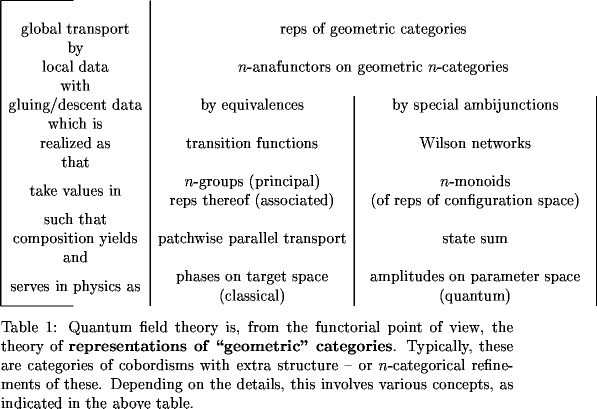
Anyway. Once I tried to compile some of the aspects of this global/local issue of quantum fields theory in this table:

Posted by: urs on February 12, 2007 8:10 PM | Permalink | Reply to this

Re: extended cobordisms: local and global

If we do this, and if we do it right, then, indeed, as Eric suspected, we realize the former global n-morphism as an n-category itself: the n-category of n-paths inside it.

There you go again with that uncanny ability to take some wild and whacky thing I say and turn it into something that actually seems to make sense :)

That is what I had in mind (I think) although I could never actually do it myself and certainly could not describe it as clearly as you just did :)

If you begin the process with a smooth manifold representing spacetime, and “discretize” it with a sampling of nodes as “objects” and morphisms connecting objects and 2-morphisms connecting morphisms, etc etc then you’ve essentially got some kind of n-graph representing spacetime at which point you can forget that you actually started with a continuum manifold in the first place.

That is, if you could somehow define calculus on n-categories.

Oh yeah… :)

While the “local” picture in its explicit form is still not that common, you can see that it is more or less implicitly persued in many areas: for instance AQFT with its diamond-shaped subsets of space is certainly an approach to n-dimensional QFT which tries to build the entire field theory from it behaviour on local patches.

I’m sure you know you cannot use the word “diamond” in this context without raising my interest :)

Posted by: Eric on February 12, 2007 9:04 PM | Permalink | Reply to this

Re: Infinitely Categorified Calculus

John pretended to shout:

PARTICLES ARE (n-2)-MORPHISMS!!!

Urs wrote:

That would be (n2 )-particles, (i.e. (n3 )-branes) wouldn’t it?

Right.

I mean, for n=3 the mechanism that you are thinking of here yields particles, while for n=4 it yields string-like objects, as you describe in your work on BF theory.

No?

You’re right. Sorry. I was oversimplifying and dramatizing things to get Eric interested.

Last time I read something about this in your TWFs (if I remember correctly), I got the impression that this kind of “matter” is rather naturally interpreted as what in other circles would be addressed as “solitonic (n3 )-branes”, in that it arises in terms of certain extended singularities of certain fields in certain gauge theories.

That’s right: for ordinary 1-group gauge theory, these singularities give us a nontrivial holonomy when we walk around a loop that wraps around an (n2 )-dimensional submanifold on which the gauge field is singular. That submanifold is what string theorists might call an ‘(n3 )-brane’, thanks to an awkward numbering scheme. I like your term ‘(n2 )-particle’ better.

It’s just when n=3 that these (n2 )-particles act like particles in the usual sense.

For a 2-group gauge theory we could also see nontrivial holonomies when we wrap a 2-sphere around an (n3 )-dimensional submanifold… and so on.

Posted by: John Baez on February 14, 2007 9:39 PM | Permalink | Reply to this

Re: Infinitely Categorified Calculus

Eric wrote:

This is the first time I heard you say that space was an (n1 )-morphism. I haven’t been listening for a while though. Is that new?

No, it’s far from new. I said it first back in 1995, in that paper I just referred you to. I’ve been working on the ‘details’ ever since.

‘Details’ like: what’s the definition of n-category?

Of course in the paper I didn’t come out and simply scream:

SPACETIME IS AN n-MORPHISM!!!

SPACE IS AN (n1 )-MORPHISM!!!

Maybe I should have.

I said there’s an n-category called nCob where:

  • objects are 0d manifolds,
  • 1-morphisms are 1d cobordisms going between 0d manifolds,
  • 2-morphisms are 2d cobordisms going between 1d cobordisms going between 0d manifolds,
  • … and so on up to dimension n.

In the basic definition of ‘topological quantum field theory’ we only consider the last two levels. We consider cobordisms of dimension n, called spacetimes, going between manifolds of dimension (n1 ), called spaces.

But these are just the n-morphisms and (n1 )-morphisms in nCob.

In extended topological quantum field theory, people realized that the lower-dimensional stuff is very important too. In fact, it lets us conjecture a purely algebraic description of nCob: the Cobordism Hypothesis. Read the paper if you want to know what this says.

Mathematically, the Cobordism Hypothesis is nice because it gives a purely algebraic description of a large hunk of differential geometry.

Physically, it shows how we might someday get ahold of extended TQFTs in a very simple way — simple if we understood n-categories well enough.

It also shows we should broaden our horizons and build physical theories based on n-categories other than nCob. So, the answer to this:

Does this approach preclude the possibility that space is something besides a smooth (n1 )-manifold?

is no. Instead, I’m trying to find a nice framework to generalize the concept of space and spacetime, so it doesn’t need to be a manifold. That’s what ‘spin foams’ are all about: they are top-dimensional morphisms in some other n-category.

More recently, I noticed a very vivid physical significance to the (n2 )-morphisms in nCob. In certain topological quantum field theories, at least, these describe particles. So, if I wanted to sound like a crackpot, I would also shout:

PARTICLES ARE (n2 )-MORPHISMS!!!

But alas, it seems to be true only in special cases.

Anyway, this stuff is the topic of my student Jeff Morton’s thesis. So, the details are top secret, except for what he’s already published. But, I already gave the big picture away in “week242”. In fact, I drew this chart there just for you:

(n-2)-dimensional manifolds: MATTER

(n-1)-dimensional manifolds with boundary: SPACE

n-dimensional manifolds with corners: SPACETIME

and I added, just to ham it up:

I like this a lot: it reminds me of the title of Weyl’s famous book “Raum, Zeit, Materie”, meaning “Space, Time, Matter”. He never guessed this trio was related to the objects, morphisms and 2-morphisms in a weak 2-category! It’s too bad we can’t seem to get something like this to work for full-fledged quantum gravity.

So, you can’t deny that I’ve been trying my best to explain this idea to you for the last decade.

Of course in “week242” I only spoke about 2-categories, not n-categories. But that’s mainly because I was trying to keep things simple. Also, because Jeff Morton’s thesis only works out the details down to (n2 )-manifolds, not all the way down to 0 -manifolds.

I also gave a talk about this stuff at the Perimeter Institute. Try it:

Posted by: John Baez on February 12, 2007 11:26 PM | Permalink | Reply to this

matter, space, time

PARTICLES ARE (n−2)-MORPHISMS!!!

That would be (n2 )-particles, (i.e. (n3 )-branes) wouldn’t it?

I mean, for n=3 the mechanism that you are thinking of here yields particles, while for n=4 it yields string-like objects, as you describe in your work on BF theory #.

No?

Last time I read something about this in your TWFs (if I remember correctly), I got the impression that this kind of “matter” is rather naturally interpreted as what in other circles would be addressed as “solitonic (n3 )-branes”, in that it arises in terms of certain extended singularities of certain fields in certain gauge theories.

Of course this is not to say that it is inconceivable that there are gauge theories such that this kind of “solitonic excitation” reproduce the behaviour of the kind of matter we observe in nature.

Posted by: urs on February 13, 2007 10:16 AM | Permalink | Reply to this

Re: Infinitely Categorified Calculus

Hi Eric — what’s a good reference for “Sullivan’s stuff” “fail”ing associativity? Thanks!

Posted by: Allan E on February 11, 2007 6:33 AM | Permalink | Reply to this

Re: Infinitely Categorified Calculus

Hi Allan,

The best place to look is probably Scott Wilson’s dissertation:

On the Algebra and Geometry of a Manifold’s Chains and Cochains

Posted by: Eric on February 11, 2007 3:24 PM | Permalink | Reply to this

Re: Infinitely Categorified Calculus

Oh yeah, and I summarized what I thought was the main difference on the String Coffee Table here and the posts leading up to it.

Keep in mind that I am pretty cavalier with statements, which are often only partially correct (or just plain wrong). Urs has learned to adapt to my complete lack of rigor, but I feel the need to give that disclaimer to others now and then (if it isn’t already obvious) :)

Posted by: Eric on February 11, 2007 3:41 PM | Permalink | Reply to this

Re: Infinitely Categorified Calculus

Thanks Eric! I wouldn’t worry about being cavalier (not that you seem to!)… people who shoot from the hip often make great expositors, so who cares if they miss and kill the wrong guy occasionally? :-)

Not to mention, this stuff is way above my head, so it *is* exposition I’m looking for… I’d been re-reading week 169 and about alternative algebras recently, so really I’m just on the sniff for new situations where associativity fails to give me a better feel for the ones I’d just been thinking about. Thanks for the links!

Posted by: Allan E on February 12, 2007 5:19 AM | Permalink | Reply to this

Re: Infinitely Categorified Calculus

Well if you’re interested in places where associativity doesn’t hold there’s always “shelf coalgebras”, where the multiplication distributes over itself.

It might just be inexperience, but I’ve only seen three things to do with three-element compositions that occur “in the wild”: associativity, Jacobi identity, and self-distributivity. And Alissa Crans sez that the latter two are “really” the same thing. So are there only two natural things to do with three-element compositions, other than no relation at all?

Posted by: John Armstrong on February 12, 2007 5:51 AM | Permalink | Reply to this

Re: Infinitely Categorified Calculus

What timing! John, I was just now looking at
Carter, Crans, Elhamdadi and Saito: Cohomology of categorical self-distributivity
math.GT/0607417
(how do i make that into a link?)

where does she make that remark about only
two possibilites for 3 variable relations?
jim

Posted by: jim stasheff on February 13, 2007 1:48 AM | Permalink | Reply to this

Re: Infinitely Categorified Calculus

I meant that I’ve only ever seen the three conditions imposed – associativity, Jacobi identity, and self-distributivity. From talking with her and from that paper it seems clear that the latter two are really the same thing. In particular, when you categorify there’s a deep relation between the “self-distributor” and the “Jacobiator”. I think that relation is in her dissertation.

Anyhow, I’m not asserting that those are the only two. I’m saying that those are the only two I’ve seen “in the wild”. Maybe other conditions arise naturally, but I haven’t seen them. I’d love to see others, of course.

Posted by: John Armstrong on February 13, 2007 4:16 AM | Permalink | Reply to this

hyperlinks

(how do i make that into a link?)

Hyperlinks are entered as in standard HTML.

When you type

<a href=”http://here.edu/and/there.pdf”>try this link!</a>

into a comment, you’ll get

try this link!

For more on this and related questions, see John’s entry TeXnical issues!

Posted by: urs on February 13, 2007 10:28 AM | Permalink | Reply to this

Re: Infinitely Categorified Calculus

I wrote:

making Ω into a module of the differential graded Lie algebra V.

Toby wrote:

But V is not a differential graded Lie algebra!

Right — I’ll fix that.

As I explained, V has a Lie bracket extending the usual Lie bracket of vector fields to multivector fields. It satisfies all the Lie algebra axioms in a graded sense, but it’s a bracket of degree 1 . There’s no differential on V.

So, I should have said Ω is a module of V, thought of as a graded Lie algebra with bracket of degree 1 . And, I’ll change my blog entry so it says that. Thanks!

John wrote:

The proof of this was deep: it used Deligne’s conjecture and the formality of the little discs operad.

If the proof uses a conjecture, does this mean that it hasn’t actually been proved?

Deligne’s conjecture was already proved — first by Kontsevich but then in other ways by other folks — by the time Tamarkin used it to show Hochschild cochains form a homotopy Gerstenhaber algebra. There’s a link to a proof in my blog entry.

People still like to call it ‘Deligne’s conjecture’.

Posted by: John Baez on February 9, 2007 5:34 AM | Permalink | Reply to this

Re: Infinitely Categorified Calculus

People still like to call it ‘Deligne’s conjecture’.

So Fermat’s Last Theorem was a theorem before it was proved, and Deligne’s Conjecture is a conjecture after it’s been proved. No wonder people think math is hard.

Posted by: John Armstrong on February 9, 2007 6:09 AM | Permalink | Reply to this

Re: Infinitely Categorified Calculus

Something about the history of Deligne’s conjecture. As far as I know it was first proved by Tamarkin as a consequence of the formality theorem for little disks operads. One year later on Berger-Fress and McClure-Smith gave the proofs which were independent of the formality result.

Kontsevich-Soibelman published a sketch of a proof of Deligne’s conjecture for Aalgebras one year later. The details (sometimes very hard) were left to the reader. In the paper cited by John, Kontsevich and Soibelman claimed that they proved Deligne’s conjecture for the configuration of disks a cylinder with marked points on the boundary. The proof is very short: the same method as for the Deligne conjecture for A-algebra.

I think there are at least two reasons to call Deligne’s conjecture a conjecture rather then Theorem. First, there are many intersting generalisations of it, like higher dimensional Deligne’s conjecture or the version I mentioned above, which are not proved yet. The second reason is that all the proof are quite difficult and not conceptual. I hope that the latest proof of Tamarkin is conceptually quite satisfactory (see my lecture notes). The problem is to do the same for the generalised Deligne’s conjecture.

Posted by: Michael on February 9, 2007 8:14 AM | Permalink | Reply to this

Re: Infinitely Categorified Calculus

As far as I understand, higher dimensional versions of Deligne’s conjecture, aka Kontsevich’s conjecture, have already been proved (I don’t know if this is the one you mean) – by Tamarkin in a “linear” context and by Hu-Kriz-Voronov (or some subset) in a homotopic context. One thing I really liked in Hu’s paper on the subject is the whole Deligne conjecture story appears like an easy tautology from the right point of view — it all boils down to the principle (Eckmann-Hilton argument? I think that’s how Batanin refers to it) that higher homotopy groups are commutative – more formally if you carry an n-fold loop space structure (En product) and a commuting m fold loop space structure (Em product) then you’re actually an n+m fold loop space (En+m).

The Hochschild chains are given by taking loops in an appropriate sense, so if you’re already En then your Hochschild is En+1.

Deligne’s conjecture is the case n=1: for an associative (or A = E1) algebra, i.e. a linear version of a loop space, its Hochschild chains are a (linear version of) a double loop space, i.e. E2, i.e. carry little discs structure, aka homotopy Gerstenhaber algebra etc etc. (This btw is the same exact argument that says the Drinfeld double of a group is a braided tensor category – again group=loop space, braided=E2…)

Posted by: David Ben-Zvi on February 9, 2007 6:08 PM | Permalink | Reply to this

Re: Infinitely Categorified Calculus

hmm…it would be useful to look first
at who’s comments I’m responding to :-)

Posted by: David Ben-Zvi on February 9, 2007 6:14 PM | Permalink | Reply to this

Re: Infinitely Categorified Calculus

Michael and David: if you guys want to include TeX in your posts — as you are already doing (Michael), or almost doing (David) — just pick a text filter like ‘Markdown with itex to html” or ‘itex to MathML with parbreaks’, and the TeX will actually show up as it should, as beautiful math symbols.

The choice of ‘text filters’ is offered to you whenever you post a comment.

Choosing one of those text filters should also cure the ragged right margins that currently afflict your posts — or did, before I polished them up as best I could.

There can be a little bit of a learning curve to posting in TeX — see the TeXnical tips or ask me if you have problems — but if you keep things simple it should often just work without any trouble.

If you don’t want to worry about this stuff, that’s fine too: your mathematical erudition is far more important to me than your typographical skill. Thanks for the history of Deligne’s conjecture, etc!

Posted by: John Baez on February 9, 2007 9:38 PM | Permalink | Reply to this

Re: Infinitely Categorified Calculus

If you want to know more about this material and its connections with higher categories look at
http://www.math.mq.edu.au/~street/BataninMPW.pdf

this is my lecture in Canberra for a general audience so quite informal in places but I hope gives some impression about the subject.

Posted by: Michael on February 9, 2007 7:07 AM | Permalink | Reply to this

Re: Infinitely Categorified Calculus

A reaction to the first, introductory part of this post - possibly giving ideas for the rest:

If we view Associative/Commutative/Lie/whatever-algebras as representations of the corresponding operads, then we may find the infinite categorification as just the process of finding a free resolution, as operads, of the corresponding operad; with for instance, for Ass, we will have a free resolution given as a free dg-operad with a single corolla in each degree, and with the differential mapping that corolla to quadratic expressions, corresponding closely to the Stasheff identities for A -algebras.

Similarily, from resolving the Lie operad, we find the L -operad, and from resolving the commutative, we find the E operad.

So, for a calculus, we seem to have an intimately coupled pair of algebraic structures: do we get what we want by looking at the resolution of the operad controlling Gerstenhaber algebras, coupled with ‘just’ the graded E ? Or is it more subtle than that?

Posted by: Mikael Johansson on February 9, 2007 9:01 AM | Permalink | Reply to this

Re: Infinitely Categorified Calculus