Skip to the Main Content

Note:These pages make extensive use of the latest XHTML and CSS Standards. They ought to look great in any standards-compliant modern browser. Unfortunately, they will probably look horrible in older browsers, like Netscape 4.x and IE 4.x. Moreover, many posts use MathML, which is, currently only supported in Mozilla. My best suggestion (and you will thank me when surfing an ever-increasing number of sites on the web which have been crafted to use the new standards) is to upgrade to the latest version of your browser. If that's not possible, consider moving to the Standards-compliant and open-source Mozilla browser.

February 3, 2007

This Week’s Finds in Mathematical Physics (Week 244)

Posted by John Baez

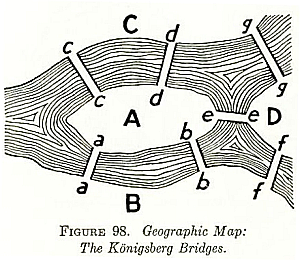
In week244 of This Week’s Finds, guess when the first calculus textbook was written, and in what language. Learn about Tom Leinster’s method of computing the size of a category. This generalizes the "Euler characteristic" in topology, but it’s also related to "Möbius inversion" in combinatorics. Also - hear how Heisenberg invented matrix mechanics, and how Euler might have invented the Euler characteristic while strolling the bridges of Königsberg!

Posted at February 3, 2007 4:45 AM UTC

TrackBack URL for this Entry:   http://golem.ph.utexas.edu/cgi-bin/MT-3.0/dxy-tb.fcgi/1145

105 Comments & 7 Trackbacks

Re: This Week’s Finds in Mathematical Physics (Week 244)

BBC Radio 4’s series “In Our Time” had an interesting program about Indian Mathematics a few weeks ago, which you can still listen to from the BBC website.

Posted by: Stuart on February 3, 2007 8:20 AM | Permalink | Reply to this

Re: This Week’s Finds in Mathematical Physics (Week 244)

John, can you write more about Heisenberg’s matrix formulation of quantum mechanics?

I like very much this thing: there’s a “question”: what happens with electrons when they change orbitals? And answer: question is inappropriate, because changing orbital is a morphism in category of states.

I didn’t get why one calls this algebra of morphisms “observables”, though.

Is there the same story with position? I mean, electron may be only in one of discrete positions on e.g. x-axis and what happens in between “moving” from one such position to another are morphisms in a suitable category?

Posted by: sirix on February 3, 2007 5:13 PM | Permalink | Reply to this

Re: This Week’s Finds in Mathematical Physics (Week 244)

sirix writes:

John, can you write more about Heisenberg’s matrix formulation of quantum mechanics?

If you want to understand how physical processes and also observables can be understood as matrices, the beginning of this book is really good:

  • Richard Feynman, The Feynman Lectures on Physics, vol. 3, Addison-Wesley, New York, 1970.

If you want to know what Heisenberg actually did, try this:

  • Jagdish Mehra and Helmut Rechenberg, The Formulation of Matrix Mechanics and its Modifications, 1925-1926, Springer-Verlag, Berlin, 1982.

One insufficiently advertised fact is that not only quantum mechanics but also classical mechanics and statistical mechanics can be formulated as ‘matrix mechanics’! The main difference is the sort of ‘numbers’ you’re allowed to use as matrix entries.

Right now I’m trying to give a thorough explanation of this, starting in week11 and continuing in week12 and forthcoming weeks of my class on quantization and cohomology. It’ll take me a while to finish telling this story…

I didn’t get why one calls this algebra of morphisms “observables”, though.

It would be better if I called them ‘operators’. It’s a curious and important fact that these operators are used to describe both processes and also observables. For example, the operator H called the ‘Hamiltonian’ corresponds to the observable called ‘energy’, but the operators exp(itH) correspond to the processes called ‘time evolution’.

Is there the same story with position?

The same story works here too, though position is continuous rather than discrete. One just needs ‘× matrices’, which require a little analysis to deal with properly.

Posted by: John Baez on February 4, 2007 8:07 AM | Permalink | Reply to this

Re: This Week’s Finds in Mathematical Physics (Week 244)

“It would be better if I called them ‘operators’. It’s a curious and important fact that these operators are used to describe both processes and also observables. For example, the operator H called the ‘Hamiltonian’ corresponds to the observable called ‘energy’, but the operators exp(−itH) correspond to the processes called ‘time evolution’.”

This is the aspect I have never been told about. Physicists I talked with about quantum mechanics tended to say: “The Universe works like this: anytime you want to measure a position of electron, you ask the Universe, and He gives you one of eigenvectors of apropriate operator. That’s the way things are and nobody knows more”

But I knew there must be something more to this! Actually, there was time when I supposed that the state after measurement is a state that comes from action of the appropriate operator on the state before measurement. But this is not the way things go.

However, now I see that it was not that stupid! You seem to say that these observables are indeed somehow connected with changing states. I’d love to hear more about this. Are references above still appropriate?

Posted by: sirix on February 4, 2007 8:05 PM | Permalink | Reply to this

Re: This Week’s Finds in Mathematical Physics (Week 244)

sirix wrote:

Actually, there was time when I supposed that the state after measurement is a state that comes from action of the appropriate operator on the state before measurement. But this is not the way things go.

It is the way things go if your operator is a projection: a self-adjoint operator p with p 2 =p). These correspond to ‘filters’, like a polaroid filter that only lets light of a specific polarization through. You can read about this in Feynman’s book.

But, it’s not the way things go for a general self-adjoint operator.

I too was very puzzled by this when first learning quantum mechanics. I think everybody who actually thinks about the subject goes through this puzzlement; some people give up thinking about it, while others keep worrying about it. What do operators in quantum mechanics really mean? Why do we use them to describe both processes and observables — and what about the case when the process is an observation?

Are the references above still appropriate?

Yes, you can learn a lot about this from reading Feynman and also the history of what Heisenberg did! But, you’ll have to do a lot of thinking on your own — nobody seems to come right out and give a formal theory relating ‘operators as observables’ and ‘operators as physical processes’, except for the special case of how self-adjoint observables H give rise to one-parameter groups of unitary processes exp(itH).

Posted by: John Baez on February 4, 2007 8:57 PM | Permalink | Reply to this

Re: This Week’s Finds in Mathematical Physics (Week 244)

It is the way things go if your operator is a projection: a self-adjoint operator p with p2 =p). These correspond to ‘filters’, like a polaroid filter that only lets light of a specific polarization through.

This feels almost like a pun. Just to verify my own understanding, you really mean “filter” in the logical sense – a subset of the poset of subspaces of the Hilbert space of states.

I’ve always been rather charmed by Jeff Bub’s approach, as outlined in Interpreting the Quantum World: the poset of (measurable) subsets of phase space lives as the idempotents in the algebra of (measurable) functions on that space. Changing phase space to a Hilbert space and the algebra of functions to linear functions we get quantum mechanics.

In both cases, though, we see what you mentioned above: that observables are special kinds of operators.

Posted by: John Armstrong on February 4, 2007 9:42 PM | Permalink | Reply to this

Observable, infinite matrices; Re: This Week’s Finds in Mathematical Physics (Week 244)

Dr. George Hockney (formerly FermiLab, now JPL) tells me that they really are “observables” because they are NOT about the actual quantum state, but instead about our knowledge of that state. A subtle and rather metaphysical distinction, but perhaps relevant in a universe where negative information seems possible in QM.

Infinite matrices seem strange to those conventionally educated, but, by chance, the first QM book I owned as a child was a translation of Heisenbergian matrix mechanics, and so I learned about matrices first with the infinite case, and only later with 2x2 and up, which I first learned through a popular publication by Isaac Asimov.

I’ve often wondered if children were taught Special relativity first, and afterwards taught Newtonian physics, if they would see the world differently. There’s a famous science fiction story about a Navaho being linguistically biased towards SR, and a film to be released this year based on the classic story about children learning 4-D via toys from the future.

Posted by: Jonathan Vos Post on February 4, 2007 9:46 PM | Permalink | Reply to this

Re: This Week’s Finds in Mathematical Physics (Week 244)

John Armstrong wrote:

This feels almost like a pun. Just to verify my own understanding, you really mean “filter” in the logical sense – a subset of the poset of subspaces of the Hilbert space of states.

No, I was using “filter” in the way people do term in foundations of quantum mechanics. It’s an experiment that lets through the things that have some property, and not the ones that don’t. Mathematically, this corresponds to a specific subspace of a Hilbert space! Or if you prefer, the operator of projecting onto that subspace.

It is funny how this word means these different things…

Posted by: John Baez on February 4, 2007 10:29 PM | Permalink | Reply to this

Re: This Week’s Finds in Mathematical Physics (Week 244)

Well they’re not really so different, it seems. A property state (projection operator) generates a filter in the (non-Boolean) algebra of dynamical propositions. It “lets through” all propositions above the one state in the poset and filters out the rest.

Posted by: John Armstrong on February 4, 2007 11:09 PM | Permalink | Reply to this

Re: This Week’s Finds in Mathematical Physics (Week 244)

Oh, okay — so it is a nice pun: a filter in the physics sense gives a projection, which gives rise to a ‘principal filter’ in the lattice of projections.

Posted by: John Baez on February 5, 2007 7:16 AM | Permalink | Reply to this

Re: This Week’s Finds in Mathematical Physics (Week 244)

Here’s some more about quantum mechanics and the Euler characteristic of a category. Maybe someone can help me out.

Suppose X is a groupoid. Then, the category algebra [X] becomes a *-algebra in an obvious way, by setting

f *=f 1

for every morphism in X, and extending * to be a conjugate-linear map

*:[X][X].

This is why algebras of observables in quantum mechanics are usually *-categories. Here X is a groupoid of ‘states’ and ‘transitions’ for some physical system. A great example is the groupoid Heisenberg was considering when he invented matrix mechanics: the groupoid of n uniquely isomorphic objects. Then C[X] is the algebra of n×n matrices. Using the above recipe to define the * operation on C[X], it turns out that a * is just the usual adjoint of the matrix a!

When X is a groupoid we can talk about Leinster’s ‘weightings’ and ‘coweightings’ in a manner somewhat more palatable to the physicist, as follows.

Recall that the vector space of states H(X) consists of formal linear combinations of objects of X, just as the category algebra [X] consists of formal linear combinations of morphisms.

Recall also that a weighting is the same as a vector ψH(X) such that

Zψ=1

where the zeta operator Z[X] is the formal sum of all morphisms in X, and 1 is the formal sum of all objects in X.

(If X is infinite, consult your local analyst before replacing sums by integrals.)

Now here’s where the *-algebra structure comes in: I believe that in this situation, what Leinster calls a coweighting is the same as a vector ϕH(X) with

Z *ϕ=1 .

If we take the obvious inner product on H(X), where the objects of X form an orthonormal basis, the Euler characteristic χ(X) turns out to equal

ϕ,1 =1 ,ψ

whenever both a weighting and coweighting exist.

It’s fun to see why these two expressions are equal:

ϕ,1 =ϕ,Zψ=Z *ϕ,ψ=1 ,ψ.

I don’t know what this stuff means, but it’s the kind of manipulation physicists love to do in elementary quantum mechanics! So, it should lead to something… I’m just not sure what.

Since when do quantum system come born with a special operator Z, which means ‘do all possible processes and add them all up’? They don’t. So, all this stuff is sort of screwy.

Maybe the operator Z will disappear into the formalism if we work, not with the ‘obvious’ inner product of objects, but some other inner product. Or, maybe we should really treat the coweighting not as element of H(X), but of H(X) *.

For example, suppose I define a new inner product

(,):=,Z

and see how things simplify. Well, one thing we see is that

χ(X)=(ϕ,ψ).

That’s sort of cute, but I’d rather get something like

χ(X)=(1,1 )

since this reminds me of the formula for the total measure of a measure space:

m(X)=1 ,1 L 2 (X).

Even if I get this stuff to work, I’m still just doing the case where X is a groupoid, which is what Jim and I could handle before Tom came along. And in the groupoid case, the really important vector space is the one with isomorphism classes of objects as its basis — not this weird space H(X). So, it’s not clear that I’m making any progress…

Posted by: John Baez on February 4, 2007 10:11 PM | Permalink | Reply to this

Re: This Week’s Finds in Mathematical Physics (Week 244)

This is neat. If I had more time, I wish I could do more than just post a link, e.g. actually think about it, but I’m currently playing the role of Mr Mom.

Here are some of my thoughts the first time I saw Leinster’s stuff and my initial reaction seems to be vaguely similar to what you did here.

One thing I didn’t state explicitly, but is probably obvious is that

ae a=1 ,

which seems reminiscent of your statement “Recall also that a weighting is the same as a vector ψ∈H(X) such that

Zψ=1

where the zeta operator Z∈ℂ[X] is the formal sum of all morphisms in X, and 1 is the formal sum of all objects in X.

Posted by: Eric on February 4, 2007 10:58 PM | Permalink | Reply to this

Re: This Week’s Finds in Mathematical Physics (Week 244)

I’m intrigued by these connections with discrete calculus, which I first met in your previous posts and which I now understand a bit better thanks to the explanations of my friend and colleague Misha Feigin. He also pointed me towards some papers of Novikov and Dynnikov about graph Laplacians, discrete Schrodinger, etc, such as this.

When Rota started developing Mobius inversion for posets, he pointed out that it could be understood as a common generalization of two different things: (i) Mobius inversion in number theory, and (ii) solution of difference equations. Everyone remembers (i), of course, but (ii) is the relevant one here. And we want to replace the usual number line by a general directed graph (especially one underlying a category).

That’s all a bit vague, but I hope to go to a seminar on Thursday that will sharpen my thinking on this.

Posted by: Tom Leinster on February 5, 2007 3:22 PM | Permalink | Reply to this

Re: This Week’s Finds in Mathematical Physics (Week 244)

Allow me to add my three cents worth to this discussion about arrow algebras, and vector space of states!

Cent 1 : Taking the category algebra (or arrow algebra) [X] of a groupoid X is cool, but in my opinion in many cases it is unecessary and obscures the problem.

For instance : If G is a group, one defines the loop groupoid ΛG as the category

(1)ΛG=Fun(Σ,ΣG),

where ‘Σ’ of a group refers to viewing it as a one object category (ΛG is a category Urs and I often talk about ). Thus ΛG is just G acting on itself by conjugation. It has objects xG, and morphisms gx for each g,xG, with composition given by

(2)(hgxg 1 )(gx)=(hgx).

Anyhow, Freed was the first to realize that the Hopf algebra which quantum algebraists call the ‘Drinfeld double’ of G is nothing but the groupoid algebra of G:

(3)D(G)=[ΛG].

Suppose we start talking about representations. Then its clear that

(4)Rep(D(G))Rep(ΛG),

that is, the representation category of the algebra D(G) is the same as the representation category of the groupoid Rep(ΛG). (By the way, this stuff is all done here).

To me, the groupoid picture is much simpler! For a representation of ΛG is manifestly just a vector space V x sitting above each xG, with an linear map V xV gxg 1 sitting above xgxg 1 in ΛG.

Of course, a reprsentation of the algebra D(G) can also be thought of in this way - but only once you’ve applied projection operators, etc. Why bother?

Its the same as with representations of quivers. Nobody I know likes to think of a representation of a quiver Q as a representation of the quiver algebra [Q] - rather, they think of it as a representation of the free category associated to the quiver Q.

Its kind of trivial, but its important, because in the groupoid picture all sorts of geometrical intuition is immediately available. One can talk about cocycles, twistings, sections, etc. which brings me to…

Cent two : John spoke about the space of states H(X) as the vector space of linear combinations of the objects of X. I would venture that perhaps its nicer to think of H(X) as the space of sections Γ(X) of the trivial line bundle with trivial connection over X. Again, all these ideas are borrowed from this.

Cent three : When one thinks about how the arrows act on the states, I am reminded of some stuff I read by Chris Isham : “A new approach to quantising space-time : III. State vectors as functions on arrows”. I think his ideas are cool, and definitely relevant to the stuff we talk about here! (Also his other papers.) One of the interesting things he defines is an arrow field on a category X : this is just a selection A(x) of an arrow xA(x) for each object xX. Note that you can compose two arrow fields, so that the collection of arrow fields form a monoid Arr(X) - which is a group if X is a groupoid.

Anyhow, clearly Arr(X) acts on H(X)… just something to think about. Another thing which acts on H(X) is of course Aut(X) - which is more relevant when H=Γ(X) for a non-trivial connection on X.

Posted by: Bruce Bartlett on February 8, 2007 12:22 AM | Permalink | Reply to this

Re: This Week’s Finds in Mathematical Physics (Week 244)

Bruce wrote:

Nobody I know likes to think of a representation of a quiver Q as a representation of the quiver algebra [Q].

I seem to recall this viewpoint is pretty common, and is used here:

David J. Benson, Representations and Cohomology I, Cambridge U. Press, Cambridge 1991.

However, I agree with you that working with quiver algebras — or more generally category algebras — is a bit feeble. It’s actually better to work with category algebroids, where we take linear combinations of morphisms with the same source and target, getting a new category whose hom-spaces are now vector spaces.

Posted by: John Baez on February 8, 2007 1:54 AM | Permalink | Reply to this

Re: This Week’s Finds in Mathematical Physics (Week 244)

Woops! Hello I knew I was a little out of my league when I wrote that.
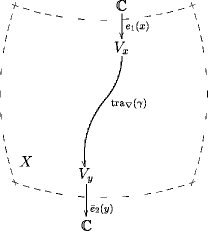
Posted by: Bruce Bartlett on February 8, 2007 2:41 AM | Permalink | Reply to this

Isham’s formulation

Cent three : When one thinks about how the arrows act on the states, I am reminded of some stuff I read by Chris Isham : “A new approach to quantising space-time : III. State vectors as functions on arrows”.

Many thanks for mentioning this!

I was vaguely aware of this work, but have not really read it. I will do so, it is very closely related to what we are talking about.

In particular, Chris Isham’s notion of an arrow field that you mention is directly related to the idea of propagators and the difference between U and Z that I mentioned above.

Isham’s arrow fields are more or less one more way to talk about special “short” arrows in your category, the morphisms of which you want to interpret as paths.

If we were in a SDG context, we would take a morphism to be any path in our manifold, and, and then we would label those morphisms as special which go straight between two infinitesimally neighbouring points.

If we require Isham’s “arrow fields” to take values in these “short” paths, then an “arrow field” becomes precisely a vector field!

Moreover, his momentum operators then coincide exactly with the standard notion of momentum operators.

That’s why I kept emphasizing categories generated from graphs and interpreting the graphs’s edges as “short” morphisms:

take your underlying graph to be that of ordered pair of infinitesimal neighbours in the synthetic description of a differentiable manifold M.

Then the category “generated” from this, and if we allow morphisms consisting of infinitely many edges, is, intuitively at least, the category whose morphisms are paths in M. Small paths are those connecting two infinitesimal neighbours.

Posted by: urs on February 8, 2007 11:08 AM | Permalink | Reply to this

Re: This Week’s Finds in Mathematical Physics (Week 244)

Bruce wrote:

When one thinks about how the arrows act on the states, I am reminded of some stuff I read by Chris Isham : “A new approach to quantising space-time : III. State vectors as functions on arrows”. I think his ideas are cool, and definitely relevant to the stuff we talk about here!

Certainly. Thanks again for recalling that!

Some discussion of how this relates to the stuff I had in mind is now available here:

Isham on Arrow Fields

Posted by: urs on February 8, 2007 7:27 PM | Permalink | Reply to this

Re: This Week’s Finds in Mathematical Physics (Week 244)

This paper

Ihara zeta functions for periodic simple graphs

has a curious expression relating the Euler characteristic, the graph Laplacian, and a zeta function for finite graphs.

The following paper (among other things) makes an interesting statement that is probably obvious to everyone besides me and let’s me guess at the motive behind a cryptic comment Urs made in that other discussion on Euler characteristic of categories.

A Riemannian approach to graph embedding

The statement was: “The eigenvalues of the Laplace–Beltrami operator can be used to determine both the volume and the Euler characteristic of the manifold.”

Posted by: Eric on February 5, 2007 5:16 AM | Permalink | Reply to this

Re: This Week’s Finds in Mathematical Physics (Week 244)

Since when do quantum system come born with a special operator Z, which means ‘do all possible processes and add them all up’? They don’t.

They do: the path integral! :-)

In this entry I tried to describe a way to obtain the quantum propagator using something very similar.

Posted by: urs on February 5, 2007 11:00 AM | Permalink | Reply to this

Re: This Week’s Finds in Mathematical Physics (Week 244)

Since when do quantum system come born with a special operator Z, which means ‘do all possible processes and add them all up’? They don’t.

They do: the path integral! :-)

In this entry I tried to describe a way to obtain the quantum propagator using something very similar.

I’ll expand on that a little:

Consider a system with a set conf of configurations, which, in each time interval τ may jump along any one of a collection of oriented edges E={(ab),(cd),} from one configuration to another.

(Alternatively, if you understand enough topos theoretic synthetic differential algebra or something along these lines, consider this internal to a suitable topos such that it defines the infinitesimal evolution of our system. But this shall not concern me here.)

For simplicity, let’s assume that there is at most one edge with given source and target configuration in E.

Let there be a “phase”, (“cost of transition”) associated with each such edge. More precisely, let there be some abelian category C and a graph map tra:EC.

“Graph map” just means: like a functor, but without any condition on composition (since we have no composition in E). If we pass from E to the graph category it generates, then tra becomes a functor on that.

Now, let’s quantize. What should that mean? Somehow, we should “sum tra over everything in sight”.

So consider the morphism U in C which is defined as follows (think of the “image” of the adjacency matrix of E under tra):

U is an endomorphism U: xconftra(x) xconftra(x) of the direct sum of objects in C that tra assigns to each point in configuration space.

So U is entirely specified by giving all its components U(x,y):tra(x)tra(y), between the fibers over all points in configuration space. Let’s simply set U(x,y)={0 ifxγy does not exist tra(xγy) otherwise.

So U is supposed to be something like “the sum of phases over all one-step evolution paths of our system”. Where “sum” is some blend of “direct sum” and something else.

(All the effort of that entry of mine was to realize this as an honest colimit of something.)

Notice now various things:

- This U is much like the image under tra of what John called the zeta operator, or what Eric Forgy and myself used to call the graph operator. It has a couple of interesting properties.

- This U is essentially U=U(τ) the “quantum propagator” over time τ of our system.

This is maybe better seen by considering its powers U(nτ):=(U) n. The (x,y)-component of this morphism is the morphism between the fiber over x to that over y that is the sum of phases over all possible paths of length n between x and y.

Up to a measure on the space of such paths, this is indeed the (discrete) path integral representation of the quantum propagator!

One might imagine that this measure comes in more or less naturally as we take the continuum limit of the above context, somehow.

When I first wrote about this, I found this very simple observation pretty cool. As you recall, I was trying to understand Freed’s philosophy that “taking the path integral is ‘the same’ as taking the space of sections” concretely in simple examples.

So I tried to see if the above U is the colimit of something nice: because it incorporates the right kind of sum over objects and over morphisms at the same time.

Meanwhile, I feel I have a good understanding of Freed’s prescription at the level of objects #.

But I still feel the need to incorporate the above construction more thoroughly in a general conceptual understanding of “quantization”.

Posted by: urs on February 5, 2007 8:48 PM | Permalink | Reply to this

Re: This Week’s Finds in Mathematical Physics (Week 244)

I should maybe add the simplest example to keep in mind:

let C simply be the category of complex vector spaces, and let the fiber over each point simply be a copy of the complex numbers: tra(x)=𝒞.

Then U=U(τ) is nothing but an n×n-matrix (n=conf the number of configurations) of complex numbers:

U ij=0 if there is no edge between x i and x j, and U ij=some phase if that’s the phase associated to moving from x i to x j in one “unit of time”.

Posted by: urs on February 5, 2007 8:55 PM | Permalink | Reply to this

Re: This Week’s Finds in Mathematical Physics (Week 244)

I like this stuff you’re saying, Urs. A bunch of similar things should show up in my course on quantization and cohomology, where I’ll soon try to build a Hilbert space starting from a category X of ‘states and processes’ and a functor

e iS/:XU(1 )

assigning a phase to each process.

Urs wrote:

John wrote:

Since when do quantum system come born with a special operator Z, which means ‘do all possible processes and add them all up’? They don’t.

They do: the path integral! :-)

My reason for not suggesting that answer was that in the path integral we sum over all processes weighted by phases. We don’t do the path integral starting from just a category X; we also need the functor

e iS/:XU(1 )

But, I bet your answer is actually right. Given a functor of the above sort, it extends uniquely to a linear map

f:[X]

and this linear map sends the zeta operator Z[X] to a complex number f(Z). This number is related to what people call the partition function of the system.

(Amusingly, the partition function is usually called Z.)

Furthermore, any category X comes with a ‘trivial’ choice of e iS/, assigning the phase 1 to each process. So, if we don’t have any more intelligent choice of e iS/ at hand, we can always use that.

I’ve been very lazy about reading what you’ve written about quantization — I’m so busy that when I see a big pile of diagrams involving ‘tra’ and ‘tri’ and ‘pha’ and so on, I tend to skip it and read something easier. But, I suspect we’re chewing on opposite ends of the same bone — and you’re probably chewing a lot faster than me…

Posted by: John Baez on February 7, 2007 1:38 AM | Permalink | Reply to this

powers of zeta and path integrals

this linear map sends the zeta operator Z[X] to a complex number f(Z). This number is related to what people call the partition function of the system.

It is interesting how this is related to Tom’s formula for the Euler characteristic.

What is also becoming very interesting, is how we have two slightly different perspectives both on the possible meaning of Tom’s formula as well as on the operator Z.

I am apparently confused about something – and I’ll need to clarify that!

The difference in perspective is this:

Assume for a moment that the category X that we are talking about is the graph category of some graph.

Then

1) The entity that I called U is essentially the sum of all edges of the graph.

The powers U n of U consist of a sum over all formal concatenations of n edges.

2) The entity that you call Z is the sum of all morphisms, i.e. of all formal concatenations of edges.

The powers Z n of Z consist again of all possible morphisms, but now weighted by the number of ways that they may be broken up into n composable morphisms.

Hm…

Both concepts encode almost the same idea, somehow. The n-th power both of U as well as of Z is like a “path integral” over all paths that “require n time steps”.

The difference is in what counts as a path that may be traversed in a single time step.

In 1) such a “1-step path” is literally the shortest sort of path available.

In 2) every path may be traversed in one time step.

Notice that 1) seems to make some sense in Lawvere-like reasoning if we think of “single time step” as “infinitesimal time interval” and of “edge of the graph” as “two infinitesimally neighbouring points”.

So taking powers of U builds up paths from small (infinitesimal) pieces.

On the other hand, taking powers of Z takes long macroscopic paths and breaks them up into smaller constituents, in a way. (At least it counts the number of ways to do so.)

Posted by: urs on February 7, 2007 4:34 PM | Permalink | Reply to this

Re: powers of zeta and path integrals

I wrote:

1) The entity that I called U is essentially the sum of all edges of the graph.

The powers U n of U consist of a sum over all formal concatenations of n edges.

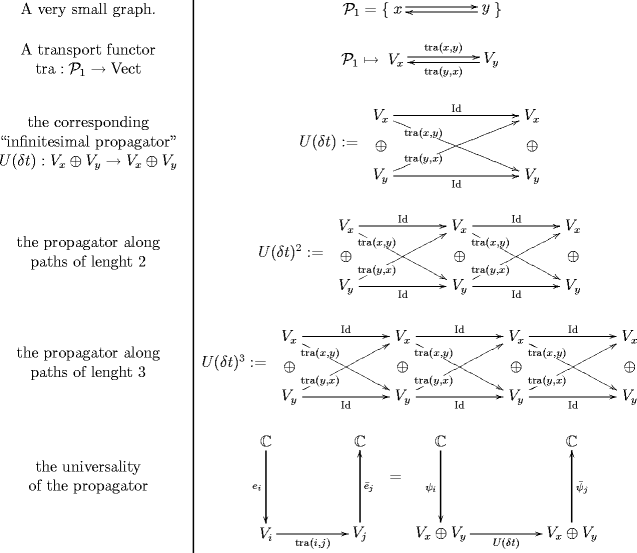
This becomes much clearer in pictures:

Notice that, in this example, V xV y is the space of sections of the vector bundle over the vertices of the graph, i.e. our space of states.

The “universal property” of the propgator is that it is the universal 1-disk phase in that every possible holonomy e 1 V xtra(x,y)V ye¯ 2

over an “infinitesimal 1-disk” (an edge of the graph)

factors through the infinitesimal propagator: it is the “sum of all infinitesimal paths”.

Posted by: urs on February 8, 2007 11:57 AM | Permalink | Reply to this

Re: powers of zeta and path integrals

Hi Urs,

Would it be misguided to relate this to what we did with discrete calculus? If you want to consider a differential algebra with this stuff, then certain “paths” must vanish and there is a maximum “length” path that corresponds to the “dimension” of the graph. Or am I just confused?

I know discrete calculus a lot better than I know n-categories, but I’ve always thought the two had some important relation.

Eric

Posted by: Eric on February 8, 2007 4:27 PM | Permalink | Reply to this

Re: powers of zeta and path integrals

Urs wrote:

The entity that I called U is essentially the sum of all edges of the graph. The powers U n of U consist of a sum over all formal concatenations of n edges.

Tim Silverman (see below) writes about how if you set U=D+S, with D the diagonal part of U, then U=D+S=D(1 +D 1 S) so that

(1)U 1 = 1 1 +D 1 SS 1 = (1 D 1 S+(D 1 S) 2 (D 1 S) 3 +)S 1

This is the old quantum field theory trick : one is calculating the connected partition function, or the effective action, or the renormalized thing-a-ma-jig, or something like that, by summing over all Feynman diagrams. You’ll know more about this than me pic.

In general U is not invertible… but somehow it seems clear that there must be some connection between this ‘sum over paths/Feynman diagram/renormalization’ reasoning, the things you are saying above about propagators, and the Euler characteristic. In fact, I think you’ve already explained this connection… I just haven’t understood it yet!

David Corfield wrote:

Is it surprising that if you take any two categories with the same number of objects and same number of arrows between pairs, but different multiplication between arrows, then the Euler characteristics of their classifying spaces (if well-defined) are equal?

I find it a bit surprising. One possibility that one might imagine is to define χ(C) as the actual Euler characteristic of the nerve of C. In this way its clear that ‘composition information’ is encoded from the very start. The trouble with this is that the Euler characteristic will not converge in general pic. Perhaps one could create a ‘generating function’

(2)χ(C)(z)= i(1 ) iH i(C,)z n

instead?

Anyway, somehow Tom’s approach recovers this nerve version of the Euler characteristic, at least for skeletal categories containing no nontrivial endomorphisms (See Tom’s Prop 2.11), and for many other kinds of categories too I think… like orbifolds and other things. Weird.

Posted by: Bruce Bartlett on February 8, 2007 6:44 PM | Permalink | Reply to this

Re: powers of zeta and path integrals

Bruce says:

Tim Silverman (see below) writes about how […]

somehow it seems clear that there must be some connection […]

This is getting to the point where the suspense is unbearable…

If somebody now comes up with a good way to think about U as something like a “sum”, “colimit”, “push-forward to a point” in a nice way (improving on my attempt at explaining it as the “universal infinitesimal disk holonomy”) and reducing on objects to what we already know, thus giving Freed’s principle a solid conceptual underpinning…

…if somebody now even does this, I’ll faint.

Posted by: urs on February 8, 2007 7:59 PM | Permalink | Reply to this

Re: powers of zeta and path integrals

I meant to make a little note replying to this, and then forgot, and everyone has moved on. But, just for the sake of completeness:

If one is doing this stuff in the context of partition functions and Feynman diagrams, the usual thing one uses is not the inverse of the zeta function but the exponential of the Laplacian, possibly multiplied by factors of time, transition probability or amplitude rates, etc (depending on whether one is doing QFT or statistical mechanics). That way, one still gets a sum over all paths, but they are weighted correctly, and the Laplacian does sensible things like removing a particle from one vertex before transferring it along an edge to the neighbouring vertex. One can do this either with a first-quantised/probabilistic version or a second-quantised/statistical version (or, I guess, a categorified version with structure types over the vertices and structure type operators over the edges :-) .)

In this setup, the paths are precisely the Feynman diagrams: there are no interactions, so all the vertices in the diagrams are the trivial ones with one incoming leg and one outgoing leg.

The inverse of the zeta function behaves a bit differently, though, because of the strange self-amplifying effect produced by the positive entries along the diagonal. It’s really hard to imagine in terms of physics. (I had chains of leaky buckets floating around in my head, and I never got the intuition to work properly.)

I thought I could maybe think of it in terms of a generalisation of Morse functions, but that doesn’t seem to work either …

Posted by: Tim Silverman on February 22, 2007 9:05 PM | Permalink | Reply to this

Re: This Week’s Finds in Mathematical Physics (Week 244)

But, I suspect we’re chewing on opposite ends of the same bone

I am delighted to see your discussion of quantization by passing from the “category of processes” to its category algebra.

Much of my recent effort was devoted to trying to understand that on general enough grounds, such that, in particular, it admits categorification in a nice way.

So, given a category X and a functor e iS:XVect, I can restrict this functor to objects and then “push it to a point” #.

This produces the space of sections of the vector bundle defined by that functor.

If the space of objects of X is a finite set and if that functor sends every object to the ground field , then this space of sections is indeed nothing but the category algebra of the discrete category on the objects of X.

So in this special case we recover the construction of the “space of states” as the object part of forming the category algebra, the way you described #.

All my effort here was devoted to seeing if we can also understand the passage to the category algebra for non-identity morphisms as some “pushforward to a point” or something along these lines. That’s how I started talking about that operator U.

So maybe the question that I am struggling with is:

What is the passage X[X] from a category to its category algebra really?

What is the abstract nonsense way to describe this assignment of algebras to categories?

(By the way, since an algebra is a category with a single object: probably the “point” that we are “pushing forward to”, somehow.)

The “right” answer should allow us to do something like forming a “weighted” category algebra, where we also throw in a functor Xsomething and let that affect the resulting “category algebra”.

Posted by: urs on February 7, 2007 5:18 PM | Permalink | Reply to this

Re: This Week’s Finds in Mathematical Physics (Week 244)

`Don’t come with a special operator Z …’

That’s asking for trouble :D

Posted by: David Roberts on February 7, 2007 1:47 AM | Permalink | Reply to this

deficit angles?

From the end of TWF 244:

This is a bit subtle, and I don’t deeply understand it. But, Leinster proves so many nice theorems about this “Euler characteristic” that it’s clearly the right notion of the size of a category

When we talked about this last time, I had grown somewhat fond of the interpretation mentioned here:

Tom Leinster gives a “local” formula for Euler characteristic, in that he obtains it by adding up quantities that are defined at each vertex.

It is known that, for ordinary manifolds, these local formulas integrate up the curvarture of the manifold at each point: that’s the Gauss-Bonnet theorem.

There is also a version of this for spaces that are not manifolds, but just cell complexes (at least for dimension 2): Here we define at each vertext the deficit angle and sum all these defincit angles up.

I haven’t tried to prove it, but I am willing to bet that Tom Leinster’s “weighting” is secretly a way to talk about the “deficit angle” at a given vertex.

As a consistency check, notice that the weighting at a vertex becomes smaller when more edges coincide at that vertex. That’s what we also expect to be true for a “deficit angle”.

Posted by: urs on February 5, 2007 10:37 AM | Permalink | Reply to this

Re: deficit angles?

Urs wrote:

I haven’t tried to prove it, but I am willing to bet that Tom Leinster’s “weighting” is secretly a way to talk about the “deficit angle” at a given vertex.

(Recall that given a polyhedron and a vertex v of it, the deficit angle or deficiency at v is 2 π minus the sum of each angle at v. For instance, in a cuboid, every vertex has deficit angle π/2 . The sum of the deficit angles of all the vertices is 2 π times the Euler characteristic.)

Anyway - I’d love it if Urs’s bet were right! I don’t quite know what it means, but I agree that it would be great. Maybe someone else can figure out how to make it true.

Posted by: Tom Leinster on February 5, 2007 3:32 PM | Permalink | Reply to this

Re: deficit angles?

I don’t quite know what it means,…

Right, it’s not only that I did not try to prove something here, I did not even try to make something precise enough for it to admit anything like a proof! :-)

But maybe we can figure it out together.

I think I was imagining something like: assume that we take any two morphisms with the same target as “having the same angle enclosed between them”.

Then deficit angles translate into numbers coincident morphisms, which is, in turn, what determines those “weightings”.

One aspect that makes this a little subtle is that you are talking about categories where most of the literature on deficit angles and the likes talks about graphs.

For that reason it might be very helpful to better understand what your construction implies in the special case that the category in question is that generated by a graph.

Posted by: urs on February 5, 2007 4:13 PM | Permalink | Reply to this

Re: deficit angles?

Urs wrote:

I haven’t tried to prove it, but I am willing to bet that Tom Leinster’s ‘weighting’ is secretly a way to talk about the ‘deficit angle’ at a given vertex.

You probably know this… but if your guess is right, I think this simple form of it should only be true when the classifying space BX of our category X is homotopy equivalent to a graph.

In general, the classifying space BX is a simplicial set built from vertices, edges, triangles, tetrahedra and so on. (I sketched how this worked in week244, but I said a lot more in items J and K of week117.) And, Tom’s Euler characteristic of the category X matches the usual Euler characteristic of this space:

χ(X)=χ(BX)

in cases where the right-hand side is well-defined.

So, even for very simple categories, Tom’s Euler characteristic detects higher-dimensional phenomena, not easily visible from thinking just about vertices and edges.

This is even true if our category is a quiver — a category freely generated by a graph.

Posted by: John Baez on February 7, 2007 2:09 AM | Permalink | Reply to this

Re: deficit angles?

Is it surprising that if you take any two categories with the same number of objects and same number of arrows between pairs, but different multiplication between arrows, then the Euler characteristics of their classifying spaces (if well-defined) are equal?

Is it even obvious for the Klein 4-group and the cyclic 4-group that these Euler characteristics should be the same?

Posted by: David Corfield on February 8, 2007 3:32 PM | Permalink | Reply to this

Re: deficit angles?

David wrote:

Is it even obvious for the Klein 4-group and the cyclic 4-group that these Euler characteristics should be the same?

“Obvious” might be going a bit far, but I don’t feel surprised about it. One way to think about the Euler characteristic of a group is via its actions: if G acts freely on a set S then we should have χ(S/G)=χ(S)χ(G). The left-hand side is the cardinality of a finite set, only depending on the cardinality of S and the order of G. So χ(G) must only depend on the order of G.

I view S as a piece of paper and S/G as S folded up and stuck to itself in some way. For a free action, it’s a rather simple kind of folding and there’s a uniform number of layers - namely, the number of elements of G. Different groups G of the same order give the same number of layers but a different pattern of folding.

Posted by: Tom Leinster on February 8, 2007 8:28 PM | Permalink | Reply to this

Re: deficit angles?

I was thinking in terms of nerves, but maybe you could extend your story from groups to categories. Can we imagine a piece of paper S on which a category ‘acts’?

Posted by: David Corfield on February 9, 2007 8:46 AM | Permalink | Reply to this

Re: deficit angles?

David wrote:

Is it even obvious for the Klein 4-group and the cyclic 4-group that these Euler characteristics should be the same?

Once you know that Tom’s Euler characteristic of a category reduces to my ‘groupoid cardinality’ in the case of groupoids, I think there’s a very nice story to tell about why a groupoid containing one object with 4-fold symmetry should have cardinality 1/4.

For example, we need this to get

S//G=S/G

for a finite group G acting on a finite set S, where S//G is the ‘weak quotient’, as explained here.

However, you know all this, so maybe you forgot that Tom’s Euler characteristic equals my groupoid cardinality in the case of groupoids — or maybe you’re wondering if it’s obvious that they’re equal.

Posted by: John Baez on February 10, 2007 3:08 AM | Permalink | Reply to this

Re: deficit angles?

I meant is their equality obvious via the classifying space construction? If we were to build up their classifying spaces according to the recipe you gave us in J and K of TWF 117, via their nerves, we’d have two rather different looking spaces. But do these spaces share some feature which lets us know they came from groups of the same order?

Posted by: David Corfield on February 10, 2007 9:12 AM | Permalink | Reply to this

Euler characteristic vs. homotopy cardinality

John wrote:

Tom’s Euler characteristic equals my groupoid cardinality in the case of groupoids — or maybe you’re wondering if it’s obvious that they’re equal.

David replied:

I meant is their equality obvious via the classifying space construction? If we were to build up their classifying spaces according to the recipe you g