I think we should make manifest the following identifications of familiar concepts in quantum theory with functorial notions:
- system/model -
- quantization -
The main issue is to set up the category of morphisms
in a way such that the coproduct
(1)
is the -functorial version of the path integral. This is supposed to be an operation which swallows an -vector -transport on a “configuration space” , together with a collection of field configurations and spits out an -QFT -functor:
(2)
I think it works like this:
Path integral over a vector transport 1-functor:
I take the liberty of slightly adapting the definition of the various categories involved, just to avoid some technical issues that are irrelevant for the main idea I want to express.
So consider this:
Instead of using the category of 1-dimensional Riemannian cobordisms, I’ll here use the graph
(3)
Even though it is abuse of notation, I feel like calling this graph
(4)
because this graph will play the role of the time line, or the worldline of a non-relativistic particle.
For some finite set, let be groupoid freely generated from
the free directed graph over .
So morphisms here are sequences of elements of , like , and reversing an edge is inverting the corresponding morphism, .
We want to couple our particle to a gauge field on and then find its quantum dynamics.
Let be a vector bundle with connection on . (You should think actually of a complex line bundle, but I won’t need this assumption.)
For me, this is a parallel transport functor
(5)
This is our “action functional” for a particle coupled to a gauge field.
I take a morphism of graphs
(6)
to be a map that sends sequences of edges to sequences of edges, like this
(7)
This is a path traced out in , a possible configuration of our “field” (namely the embedding field from the worldline into the target space) on a small piece of worldline.
Composing with our action , we find the generalized phase associated with this field configuration
(8)
Notice how naturally extends to a functor from the graph category associated to to . (compare Anders Kock’s description of parallel transport #).
Now, the crux of path integral quantization is to “sum” all phases over all possible field configurations.
In our setup everything is categorical and “sum” cannot mean anything but
a coproduct-like object. “Field configuration”
means “functor ” and “phase” means “image of ”.
Hence “sum of phases over field configurations” must be some morphism, which I’ll
denote
(9)
such that all other such functors have morphisms into it
(10)
and such that it is the universal object with this property.
In order for this to yield the desired result, one has to find a suitable notion
of morphism of graph maps.
Something that does seem to work, is the following.
Let the morphisms of the category
(11)
be given on each graph edge by something like a naturality square, but with one arrow
reversed, like this:
(12)
This does not make sense for functors, but it does make sense for graph maps with codomain a category.
Let
(13)
be the object in this category which has morphisms into it from every , and such that for any other object with this propert there is a morphism .
In order to compute this object, we have to consider commuting diagrams of the form
(14)
in .
I think (but you should check it) that this
is precisely the
strange kind of sum that we want.
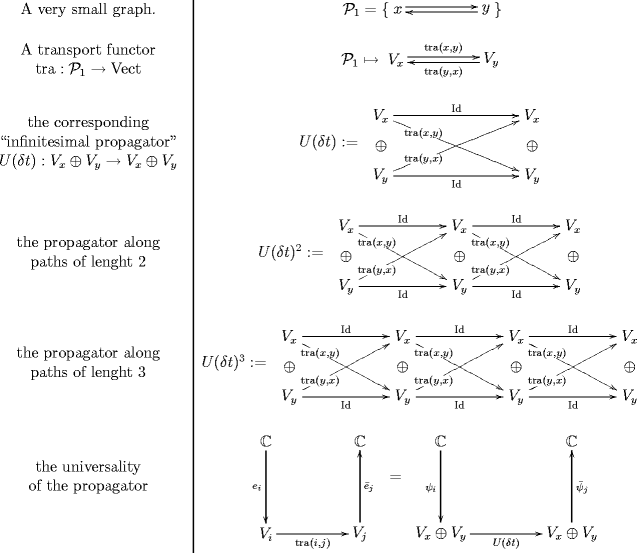
Namely
(15)
where is the -matrix whose -entry is the linear map
(16)
This is indeed the quantum mechnical propagator in the limit where is a tiny period of time.
As we have seen before, we should think of
(17)
as the space of sections of the bundle , hence in fact as the Hilbert space of states of our charged quantum particle.
(In a more detailed derivation we would start with a hermitian vector bundle, which carries a scalar product on each of its fibers. This would then induce the expected scalar product on our Hilbert space of states. Square integrability of sections is one of the technicalities that we are ignoring here, since is assumed to be finite.)
Moreover, is evidently that linear endomorphism of this Hilbert space which is obtained by using the classical action along every possible path (of elementary length) between any two points in .
Accordingly, the power
(18)
is the linear operator on which is obtained by a path integral over all paths of total parameter length .
But that’s precisely the propagator that we are after:
(19)
Voilà, the path integral in terms of something like coproducts of transport functors.
Of course the point of this exercise is to go from to .
Here is a pdf with some related notes.

propagation on n-cobordisms from transport on n-paths
I find myself feverishly thinking (more than is good for me, it seems) about the general idea motivating the above, which is this:
There should be a nice canonical construction that reads in an -vector -transport from globular -paths to -vector spaces and spits out a QFT propagator describing the quantum mechanics of an -particle coupled to .
What I wrote before was an attempt to understand the path integral over all field configurations as a coproduct of a bunch of functors, since Freed’s observation # suggested that the ordinary path integral in -dimensional QFT is just the top component of an entire list of length of various “sums”.
While I already tried to simplify a lot by making everything in sight finite, it seems that the familiar unwieldiness of the path integral still infects the construction.
Usually, the Hamiltonian formulation of the quantum theory is much easier to handle. Is there maybe a nice canonical construction that produces a QFT in Hamiltonian formulation from the input datum of an -transport functor?
That’s what I am currently thinking about. One nice trick one can invoke is a generalization of the fact that the Hamiltonian of the charged 1-particle is just one part of the covariant Laplace-Beltrami operator
where is the obvious covariant exterior derivative associated to .
At least in principle this nicely generalizes to as long as our notion of -vector space is such that -morphisms of -vector spaces are ordinary vector spaces (with extra structure), such that -morphisms are ordinary linear maps.
For instance, let be the 2-category of categories that are equipped with a faithful functor to , and let a 2-vector space be a -enriched category. This is for instance the case for my favorite example, , which is what we need for strings coupled to the Kalb-Ramond field.
So here the basic idea is to pass to the space of loops and find, due to the above assumption on , a vector bundle over that loop space. By an analogous construction as for , our transport 2-functor then provides a Hamiltonian for propagation along paths of loops.
But I want to fomulate this idea in a nice, crisp, canonical way.
Maybe I found one nice solution. I’d be grateful for any comments. Maybe someone has seen something similar somewhere.
Let be the discrete -category on a single object. Say the category of field configurations is the weak -functor category
from the single object to “configuration space” .
The nice thing about this definition is that automatically
- objects of are (closed) -paths in
- morphisms of are indeed -dimensional cobordisms between these objects (due to the nature of pseudonatural transformations of -functors, see the pictures here)
- higher order morphisms are various gauge transformations of these, related to the existence of various base points whose choice is a gauge freedom.
Better yet, instead of we could take some quiver, like and find open/closed cobordisms attached to various branes # (at least if the rest of the program goes through as hoped for).
That way of looking at the situation might be helpful. We can now compose any field configuration with our “exponentiated action” to obtain the generalized “phase”
In particular, by our assumption on the definition of and by the nature of objects in , this does associate
- a vector space to each field configuration
- and a morphism of vector spaces to each (embedded) cobordism between field configurations .
Hence we are, up to some slight -categorical details, back in the situation of 1-dimensional quantum mechanics. Instead of propagation on target space, we now have propagation on something like the -torus space of target space (e.g. loop space for ).
It should again be possible to canonically obtain from a covariant Laplace-Beltrami operator (now on the -torus space of target space) and hence finally a 1-functor
I am trying to spell out more details of this program. But I thought I should check if maybe somebody has a helpful comment on the general idea.