 Posts with this logo use


October 31, 2007
On Noether’s Second (BV, Part VI)
Posted by Urs Schreiber

One aim of
R. Fulp, T. Lada, J. Stasheff
Noether’s Variational Theorem II and the BV formalism
math/0204079
was to
[…] restore […] an emphasis [on] the relevance of Noether’s theorem in […] the BV approach
Namely it is Noether’s second theorem (see page 6 of the above article) for Lagrangian theories which is reincarnated equivalently in the BV statement that
the space of ghosts is canonically isomorphic to that of anti-ghosts.
Meaning that
For every Noether identity there is a symmetry. And vice versa.
In terms of the little toy example (which is not that toy-ish, actually, rather skeletalized, I think), which I talked about last time (see also parts I, II, III, IV), this means that in our little complex
which is induced entirely from a smooth function on a manifold , we have a canonical isomorphism between the first and the last term And this canonical isomorphism is, I think, Noether’s second theorem in this context.
And I’ll claim: this is here nothing but a special case of Cartan’s magic formula (or whatever you call that).
For that to make sense, I’ll first need to say mor precisely how the in is defined in the first place.
October 30, 2007
BV for Dummies (Part V)
Posted by Urs Schreiber
On my way back from Oxford, I am spending a night in a hotel close to Manchester airport to get my plane tomorrow morning. Luckily they have a public terminal here. This allows me to talk a little about BV formalism.
John began his last course on Quantization and Cohomology by focusing a bit of attention on a seemingly boring special case: that of statics instead of dynamics.
Here I’ll do something similar for the BV formalism (Part I, II, III, IV):
I use a 4-term complex of vector spaces to study the simple situation of a compact manifold equipped with a smooth real-valued function which you may think of as a Lagrangian depending only on the fields (not on their derivatives) which are elements of . That complex of vector spaces will extract for us the nature of the critical points of .
If you like, read this in parallel with Jim Stasheff’s hep-th/9712157 from which it follows by truncating the jet space completely down to its 0th component.
On the other hand, if you follow in thoughts the point of view adopted with considerable success by Lyakhovich and Sharapov, who get quite far with thinking of field theory Lagrangians as functions on a finite-dimensional space, you may regard, I guess, the following also as a picture of aspects of the full BV machinery.
In any case, the little pedagogical exercise here is mainly supposed to make explicit the simple nature of the complex we are dealing with, which is essentially
where denotes the Lie algebra of symmetries of our function.
And probably I won’t be able to refrain from making some comments on the higher categorical interpretation of what is going on.
Of course for a general BV situation this may be a higher Lie algebra (a Lie -algebra`) and its action may be weak and all that, but that shall be ignored here for the time being.
Comet Holmes
Posted by John Baez
Have any of you folks seen Comet Holmes? It was just another boring little comet somewhere between Mars and Jupiter when it suddenly got a million times brighter on October 23rd, going from magnitude 17 to magnitude 2.8 in just a few hours!
According to the magazine Sky and Telescope, it’s easy to spot with the naked eye…
Higher Clifford Algebras
Posted by John Baez
Lately Urs has been dreaming of categorified Clifford algebras. But he’s not the only one! We should send one of our spies to this talk tomorrow:
- Chris Douglas, Higher Clifford algebras, Topology Seminar, Chicago University, talk in E203 at 4:30 pm, pre-talk in the same room at 3:00, October 30, 2007.
October 29, 2007
Fundamental Physics: Where We Stand Today
Posted by John Baez
Are most of the entries on this blog too technical for you? Well, try this:
-
John Baez, Fundamental physics: where we stand today, Department of Physics and Astronomy, James Madison University, November 2, 2007.
Since the discovery of the W and Z particles over twenty years ago, few truly novel predictions of fundamental theoretical physics have been confirmed by experiment. On the other hand, observations in astronomy have revealed shocking facts that our theories do not really explain: most of our universe consists of "dark matter" and "dark energy". Where does fundamental physics stand today, and why has theory become divorced from experiment?
It’s a talk for anyone interested in physics: a few equations at first, when I explain general relativity, but then just words and pictures!
October 27, 2007
Steve Fever
Posted by John Baez
Yesterday when I read my MIT alumni magazine, I was pleased to see a short story by Greg Egan. This magazine is available for free online if you submit to a mildly annoying registration process, so I’ll advertise the story here:
- Greg Egan, Steve Fever.
It’s about an artificial intelligence so stupid it believes what it reads on the internet.
October 26, 2007
Concrete Groups and Axiomatic Theories I
Posted by Guest
Guest post by Todd Trimble
I’d like to take a shot here at explaining some of the ideas on logic that Jim Dolan has been alluding to in his talks in the Geometric Representation Theory seminar, and eventually give an argument for a perhaps surprising idea of his, that “concrete groupoid theory” and “axiomatic theories” are really the same subject, from a kind of Galois theory point of view. This is meant to set the stage for a whole slew of interesting developments, in which we view Jim’s orbi-simplex idea as a geometric description of a general axiomatic theory, which in turn is related to the idea of viewing Tits buildings as “quantized” axiomatic theories, and also perhaps to the theory of classifying toposes and their “Galois theory”. But we’ll get to all that later!
Right now I’d just like to set the scene, and try to flesh out the (somewhat skeletal) description Jim gave of axiomatic theories in precise terms, up to the point where we can at least state the amazing Galois correspondence between groups and theories. In part II, we’ll have a look at proving that this correspondence really works, in part by adapting an interesting argument of Joyal that characterizes analytic functors of species (themselves closely related to the Tale of Groupoidification!).
Geometric Representation Theory (Lecture 6)
Posted by John Baez
Where would a wizard be without his magic wands?
In mathematics, a ‘magic wand’ is any systematic process that you can apply to big chunks of interesting mathematics and get new, more interesting mathematics. Or — more magical still — it’s a mysterious bunch of tricks that feel like they’d be part of a systematic process if only we understood them better.
What are some magic wands? One of the most famous was stolen from physicists: it’s called quantization. Muttering one of several cryptic spells, you can wave this wand over any mathematical concept related to classical mechanics, and hope that — POOF! — it suddenly transforms into an analogous concept related to quantum mechanics. We’ve had huge success with this over the last century, but it’s still poorly understood.
Another magic wand is categorification: replacing any number by a set with that number of elements, replacing any set by a category whose set of isomorphism classes it is, and so on. You could almost say this blog is a shrine to categorification. It too, is still poorly understood. Perhaps when a magic wand’s powers become fully understood, it ceases to count as ‘magic’!
Yet another magic wand is -deformation — closely related to quantization but not the same. It’s a way of modifying mathematical entities that depends on a parameter . Sometimes this parameter has the physical meaning of … but sometimes it’s better to think of it as a power of a prime number! In fact, -deformation was discovered by Gauss long before the quantum was a twinkle in Planck’s eye.
When you have two magic wands at your disposal, you can ask if they commute. First wave one, then the other. First wave the other, then the one. Does the same magic occur? Or at least isomorphic magics?
In lecture 6 of the Geometric Representation Theory seminar, I wave two magic wands — categorification and -deformation — at a humble mathematical entity: the binomial coefficient. It seems they commute. But, puzzles abound!
October 23, 2007
On String- and Chern-Simons n-Transport
Posted by Urs Schreiber
I am making the last preparations for a little journey to Great Britain.
Tomorrow starts the Conference: Lie Algebroids and Lie Groupoids in Differential Geometry in Sheffield. Next Monday then I am invited to speak at the Oxford geometry seminar.
On both occasions I’ll talk about selected topics from
String- and Chern-Simons -Transport
(pdf slides)
in Sheffield with an emphasis on the Baez-Crans type/String-like Lie -algebras and related matters, in Oxford with an emphasis on bundle gerbes.
These slides currently serve for me the purpose of a substitute for our cool-but-non-existing-higher-Wiki and are supposed to be treated as such. They should be comparatively enjoyable to read (on the screen, don’t ever try to to print them) if use is made of the hypertext tools provided by your pdf-reader. (Use the arrow keys to read sequentially, remeber your pdf-reader’s internal back button for convenient hyperlink navigation within the pdf document).
To get going, you might want to surf to section Introduction, subsection Plan and have a look at the menu of links provided there. In sub-subsection Categorfication, local trivialization, differentiation you’ll find an “animated and subtitled” version of the classical transport cube playing the role of a 3-dimensional table of contents.
This classical cube is the one whose first edge is local trivialization, whose second edge is differentiation and whose third edge is categorification. Keeping these three directions in mind should help see the big picture behind the details.
I am looking forward to meeting Bruce Bartlett and Simon Willerton in Sheffield. I had been in Sheffield before only once, about 17 years ago, or so, when I stayed for 2 weeks with a guest family.
October 22, 2007
Geometric Representation Theory (Lecture 5)
Posted by John Baez
Felix Klein had a great idea: a lot of geometry is secretly group theory. Say you’ve got a group of symmetries, and it acts transitively on a set of geometrical figures of some type. This means that
for some subgroup , namely the ‘stabilizer’ subgroup — the subgroup that preserves a figure. So, you get types of figures from subgroups of your symmetry group.
But, there’s a lot more. Say you have some relation between figures of type and figures of type that’s invariant under your symmetry group. For example: ‘a point lies on a line’.
This means you have a subset that’s invariant under the action of . You can think of this as an -shaped matrix of 1’s and 0’s: 1’s where the relation holds, 0’s where it doesn’t. But, such a matrix can be reinterpreted as a linear operator
The invariance condition then means this is an intertwining operator between permutation representations of .
A wonderful fact — though the proof is easy — is that we can get a basis of intertwining operators this way, called ‘Hecke operators’. We get this basis from ‘atomic’ invariant relations, meaning those that can’t be chopped up into a disjunction — a logical ‘or’ — of smaller relations. Another way to think about it: these atomic invariant relations are just -orbits in .
Soon we’ll use all this to take permutation representations of groups and chop them into irreducible representations. So: we’ll turning the insight of Klein around, and use geometry to study group representations!
Today, in the 5th lecture of our Geometric Representation Theory seminar, James Dolan works through some easy examples of Hecke operators.
October 20, 2007
On Lie N-tegration and Rational Homotopy Theory
Posted by Urs Schreiber
In rational homotopy theory one studies spaces “up to finite ambiguity” as Dennis Sullivan put it, namely by considering all forms of homotopy and (co)homology over the rationals (i.e discarding all torsion information).
For an overview see for instance
Kathryn Hess
Rational Homotopy Theory: A Brief Introduction
(2000)
(pdf).
The crucial insight of Dennis Sullivan described in
Dennis Sullivan
Infinitesimal computations in topology
Publications mathématiqeu de l’ I.H.É.S., tome 47 (1977), p. 269-331
(NUMDAM)
was that all rational spaces are obtained from integrating Lie -algebras.
Of course Sullivan didn’t put it that way, nor do many people in rational homotopy theory. Instead they are talking about differential graded commutive algebras, which are freely generated in positive degree, as graded commutative algebras.
Here at the -Café we call (following Jim Stasheff’s suggestion) such dg-algebras “quasi free differential algebras” (qDGCAs) and are fond of the fact that they are dual to codifferential coalgebras, which are the same as -algebras, which are the same as Lie -algebras, which are -fold categorifications of Lie algebras. For a quick reminder on how this works, see Lie -algebra cohomology. For a bestiary of examples, most of them described in both languages, try Zoo of Lie -algebras. For more try section Plan, subsection The bridge as well as the section Lie -algebra cohomology here.
It was Ezra Getzler who explained that what Sullivan did with qDGCAs was essentially the integration of the corresponding Lie -algebras:
Ezra Getzler
Lie theory for nilpotent -algebras
arXiv:math/0404003
The basic idea of this integration process, vividly but ultra-tersely sketched on the first two pages of
Pavol Ševera
Some title containing the words “homotopy” and “symplectic”, e.g. this one
arXiv:math/0105080
and less vividly, but in more detail, described in
André Henriques
Integrating algebras
arXiv:math/0603563
is that from any Lie -algebra we form the simplicial space whose set of -simplices is the set of Lie -algebroid morphisms from the tangent algebroid of the standard -simplex to the given Lie -algebroid
which in terms of the dual qDGCAs reads
where is simply the deRham differential algebra of forms on .
Notice that the Lie -algebroid morphisms appearing here are, morally, the differential version of smooth pseudofunctors
from the fundamental groupoid of the -simplex to the one-object -groupoid of the Lie -group integrating our Lie -algebra: hence nothing but a flat -valued parallel -transport on .
For too long to comfortably admit, I didn’t get the intuitive and conceptual gist underlying this construction. While a good pedagogical account still needs to be written, as far as I can see, I personally profited a lot from realizing how the above procedure reproduces ordinary integration of Lie algebras when we keep the nonabelian Stokes theorem in mind (I talked about that here. For a description of the nonabelian Stokes theorem see section Parallel -transport, subsection 2-Functors and differential 2-forms here) and that we might profitably think of the space built by the above procedure as the fundamental -groupoid
of the “generalized smooth classifying space” given by the sheaf on manifolds
This is not (yet) supposed to be a precise statement, but if you are like me in that you need to have the feeling to know why we are doing something in order to enjoy doing it, I suggest this as a good working assumption (originally mentioned here).
The central issue of Ezra Getzler’s above article is to reduce the size of by strictifying it a lot, such that, in particular, it becomes finite dimensional at each stage.
André Henriques instead works with the unrestricted space. His main application was the integration of the String Lie 2-algebra (section Lie -algebra cohomology, subsection String, Chern-Simons and Chern Lie -algebras here) and the demonstration that it is the 3-connected cover of .
Notice that, using Sullivan’s age-old theorem (8.1),v) from the above article, this becomes essentially a triviality:
the qDGCA defining the String Lie 2-algebra is simply that of the underlying Lie algebra together with a single additional degree 2-generator whose differential is required to be the canonical 3-cocycle on the underlying semisimple Lie algebra. But that says nothing but that the generator of the third cohomology becomes cohomologically trivial!
(For more on the Lie 2-algebra cohomology of the String Lie 2-algebra see Cohomology of the String Lie 2-algebra. Danny Stevenson has meanwhile started to check (some terms still need to be done) that the qDGCA computation discussed there is indeed reproduced by a computation of the (rational) cohomology of the total space of the String group as constructed by Henriques and in From Loop groups to 2-groups).
Here I start with having a closer look at parts of this literature by going through Sullivan’s old paper and highlighting the Lie -algebra theory he discusses, without saying so at that time.
October 19, 2007
Advanced Course on Simplicial Methods in Higher Categories
Posted by Urs Schreiber
There is an interesting event titled
Advanced Course on Simplicial Methods in Higher Categories
February 4 to 14, 2008
Centre de Recerca Matemàtica
Bellaterra (Barcelona)
within the CRM thematic year on Homotopy Theory and Higher Categories
The Advanced Course consists of three lecture series:
– André Joyal (UQAM, Montréal), “The theory of quasi-categories and its applications”
– Ieke Moerdijk (Utrecht) “Dendroidal sets”
– Bertrand Toën (Toulouse) “Simplicial presheaves and derived geometries”
The CRM offers a limited number of grants covering accommodation for young researchers. The deadline for application is October 31, 2007. Otherwise the deadline for registration is December 14.
Geometric Representation Theory (Lecture 3)
Posted by John Baez
Any structure on a set has some group of symmetries. But you can also work backwards. Given the symmetries, you can figure out the structure those symmetries preserve!
Last time in the Geometric Representation Theory seminar, Jim Dolan introduced the ‘orbi-simplex’ as an easy way to do this. Start with a group acting on a set . Form a simplex with as vertices. Mod out by the action of . This, in a nutshell, is the orbi-simplex.
This time, Jim will show how to stare at an orbi-simplex and read off a logical theory — a bunch of predicates and axioms — describing a structure on whose symmetries form exactly the group .
October 18, 2007
Klein 2-Geometry IX
Posted by David Corfield
Seeing Jim Dolan expose that notion of types, predicates and axioms in his lecture, I was reminded of the introduction John gave me to it in Minneapolis. While there, we tried to see what we could make of the idea that a process of categorification moves us up from propositional to predicate to modal logic, (an idea of Jim’s?). What we arrived at was a multi-agent form of S5.
As in the lecture Jim’s example of an axiomatic theory is Euclidean geometry, this led me to a ramshackle series of night thoughts, which is all I’m fit to record at the moment.
So, models of a theory axiomatised in predicate logic assign sets to types, maps from their types to truth values are assigned to typed predicates, and truth values to sentences. The models then form a groupoid. The idea of categorifying predicate logic to modal logic allows metatypes, being assigned groupoids. So,
1) Can we see a degenerate ‘propositional’ 0-geometry?
And,
2) Did we see any sign of something ‘modal’ in our 2-geometry forays?
October 17, 2007
On Weak Cokernels for 2-Groups
Posted by Urs Schreiber
In Detecting higher order necklaces I mentioned how
P. Carrasco A. R. Garzó́n and E. M. Vitale
On categorical crossed modules
Theory and Applications of Categories, Vol. 16, 2006, No. 22, pp 585-618
is related to
David Roberts, U.S.
The inner automorphism 3-group of a strict 2-group
arXiv:0708.1741
(html).
with the relation becoming obvious after drawing some diagram. This discussion, quite brief, but the picture provided there is useful to keep in mind, I have now prepared here:
This blog entry is hence mainly a private message to David Roberts (since it builds on our discussion of inner automorphism -groups). And maybe to Todd Trimble (since it builds on our discussion of tangent categories (pdf, html). And to Jim Stasheff (since it is going to be applied to obstructions to lifts of -Cartan connections (slides, BIG diagram)). And to John Baez of course, from whome I am hoping to receive more hints on how to think of the big picture . And to Bruce Bartlett, with whom I was talking about this here and by email.

Hence a blog post.
You’ll see that this issue of weak cokernels of 2-groups is the integral version of what I had started to discuss at the level of Lie -algebras in
Obstructions and cokernels of Lie n-algebra morphisms
(pdf)
(html).
Geometric Representation Theory (Lecture 2)
Posted by John Baez
Finally we get to see James Dolan in action, talking about Geometric Representation Theory! While I’ve been focusing on examples, now we’ll start to see the general principles at work in geometric representation theory, starting with this fact:
Every transformation group is the group of something-o-morphisms for an essentially unique something.
To formalize and prove this fact, he introduces the ‘orbi-simplex’. This is a beautiful geometrical method of constructing an axiomatic theory from an action of a finite group on a finite set , such that this theory has a unique model — a model on — and the symmetries of this model are the group .
Not many people in the class knew enough mathematical logic to fully appreciate the cunning of this construction — but the whole point is that you don’t need to know all the standard ways of thinking about logic to enjoy the orbi-simplex.
October 16, 2007
n-Curvature, Part III
Posted by Urs Schreiber
The context of weak cokernels within obstruction theory seems to be the best way to think of -curvature (I II, III).
Consider the statement
Curvature is the obstruction to flatness.
For this sounds pretty obvious and trivial. But I claim that we should really read it as
-Curvature is the obstruction to -flatness.
This is now a statement about -bundles with connection and -bundles with connection (or rather about the correspodinng -transport and -transport). And it is not all that trivial anymore. There is a general notion of obstruction theory for -bundles with connection, I think, and it applies here and produces a statement about -curvature which is at least non-obvious enough to have occupied me for quite a while.
But what was non-obvious once may become obvious as we refine our senses.
There is something non-trivial to be understood here, but we want to understand it in a natural way.
The main thing to be understood is why -curvature of a -valued -transport takes values in the -group of inner automporphisms
The full answer to this involves three main insights:
a) Obstruction theory.
b) -Curvature is the obstruction to lifting a trivial -transport to a flat -transport
c) Inner automorphisms and weak cokernels of identities on -groups
Loday and Pirashvili on Lie 2-Algebras (secretly)
Posted by Urs Schreiber
Zoran Škoda made me aware of
J. L. Loday, T. Pirashvili
The tensor category of linear maps and Leibniz algebras
Georgian Math. J. 5 3, 1998, 263-276 .
Even though the authors do not use that term, this is about (strict) Lie 2-algebras, namely Lie algebras internal to “Baez-Crans 2-vector spaces”, as well as more general 2-algebras: associative, Hopf, etc, all internal .
Interestingly, they conceive entirely in terms of 2-term chain complexes, but consider on the non-standard monoidal structure which makes it equivalent even as a symmetric monoidal category to .
This non-standard monoidal structure is easy to figure out, but I think it is worthwhile making it explicit. Loday and Pirashvili make great use of it, in particular in that they prove that with that structure becomes cartesian closed and explicitly compute the internal hom.
The issue of finding this non-standard monoidal structure on is what Dmitry Roytenberg is referring to in the first paragraph on p. 4 of his article on weak Lie 2-algebras (pdf, html).
So it’s maybe worthwhile making explicit a couple of easy but useful facts here. That’s what I shall try to do in the following.
October 15, 2007
What is the Fiber?
Posted by Urs Schreiber
I was involved in a discussion about how to best think of bundle gerbes, when introducing them to laypeople. Here the laypeople were supposed to understand what a fiber bundle is (unlike those complete laypeople to which we explained gerbes last time, when there were Gerbes in The Guardian).
The statement was made that like a sheaf is to a stack, so a principal line bundle is to a line bundle gerbe.
This worried me a little. I do think that, instead, bundle gerbes (as opposed to true gerbes!) should better be thought of as corresponding to transition functions:
Maybe that’s an incredibly nitpicky, boring and irrelevant point. But I happen to think it is important. Here I will expand on it by:
- reviewing how we get the total space of a bundle from a transition function by first building a certain groupoid and then forming a certain pushout
- and how similarly we obtain the total 2-space of a 2-bundle from a bundle gerbe by first forming a certain two-groupoid and then doing a certain pushout.
I think of this as being an example of Toby Bartels’ general prescription for building a 2-bundle from transition data, as described in section 2.5.4 of his thesis 2-Bundles. But I will formulate it with a certain emphasis along the lines of my discussion with David Roberts at the end of this.
This Week’s Finds in Mathematical Physics (Week 257)
Posted by John Baez
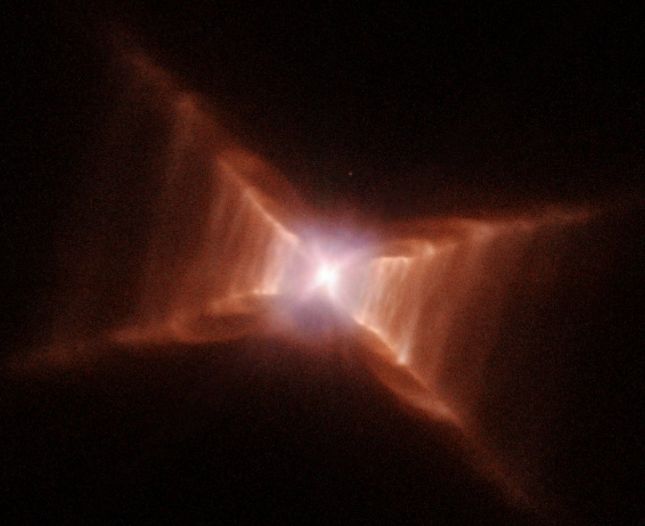
In week257 of This Week’s Finds, watch a sphere turn inside out, find out where dust came from in the early universe, and explore the Red Rectangle:
Then, learn how the integers secretly form a three-dimensional space, with prime numbers resembling knots. Read about some new work applying topos theory to quantum mechanics. Hear what Eugenia Cheng told me about monads on a train to Sheffield. And finally — watch the Tale of Groupoidification on video!
October 12, 2007
Geometric Representation Theory (Lecture 4)
Posted by John Baez
You can now watch lecture 4 of our seminar on Geometric Representation Theory. What happened to lectures 2 and 3, you ask? James Dolan gave those while I was travelling, but the videos aren’t available yet — sorry! Luckily, we’re tackling this subject from slightly different angles, so you can follow my latest lecture before watching his:
-
Lecture 4 (Oct. 9) - John Baez on categorifying and -deforming the theory of binomial coefficients — and multinomial coefficients! — using the analogy between projective geometry and set theory. Review of uncombed Young diagrams , and -flags on finite sets and finite-dimensional vector spaces over the field with elements, . When has boxes, two rows, and just one box in the first row, the set is the -dimensional projective space over , and the number of points in is the th -integer, defined by:
When has boxes, two rows, and boxes in the first row, is the Grassmannian consisting
of -dimensional subspaces of , and the number of points in is the -binomial coefficient
where the -factorial is given by
For a general uncombed Young diagram
, is a partial flag variety, and its number of points
is a ‘-multinomial coefficient’. Young subgroups versus parabolic
subgroups. Decomposing projective spaces into Schubert cells.
-
Streaming
video in QuickTime format; the URL is
http://mainstream.ucr.edu/baez_10_9_stream.mov - Downloadable video (694 megabytes)
- Lecture notes by Alex Hoffnung
-
Streaming
video in QuickTime format; the URL is
Obstructions to n-Bundle Lifts Part II: The BIG Diagram
Posted by Urs Schreiber
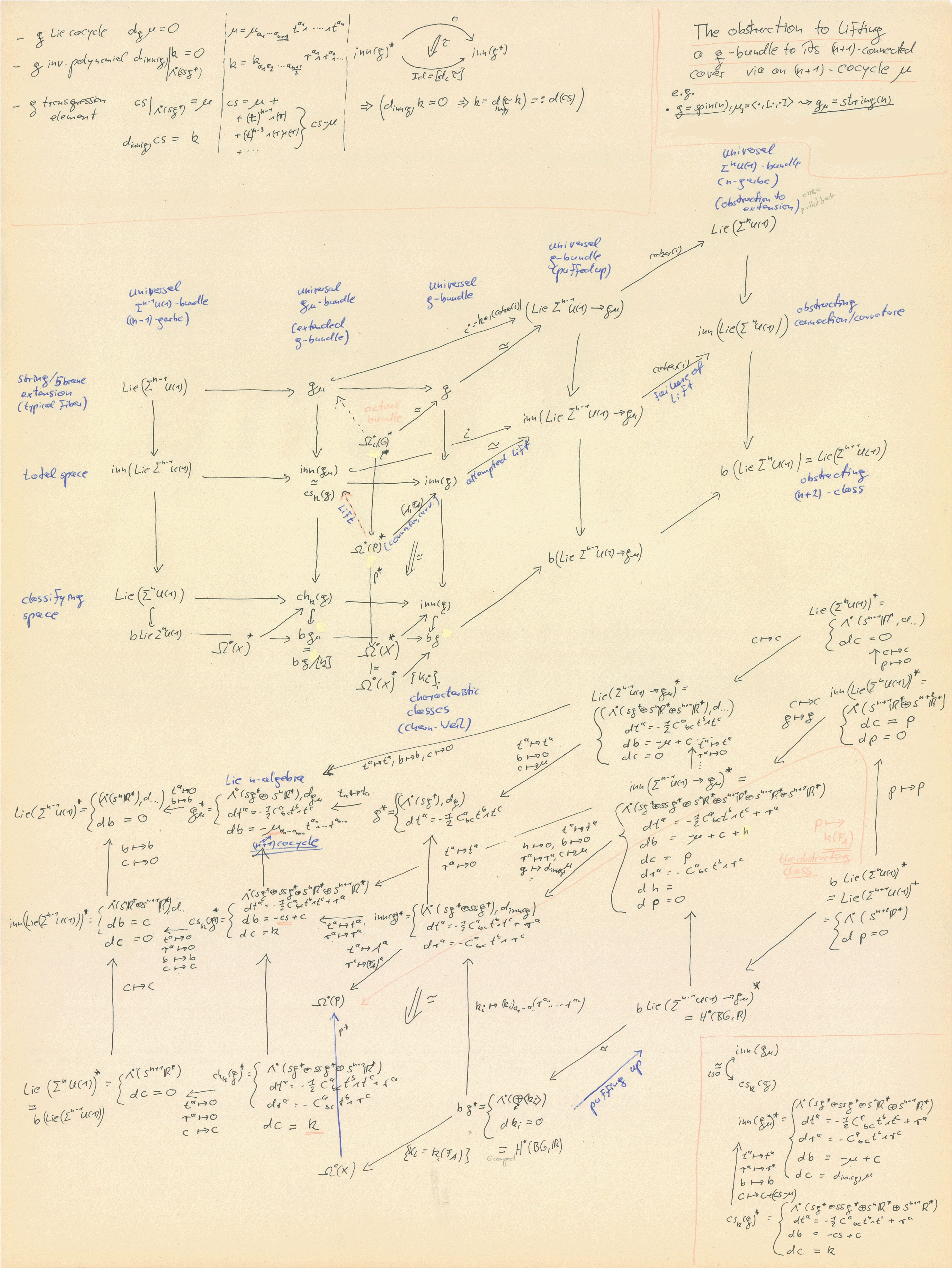
In Obstructions for -Bundle Lifts and Obstructions, Tangent Categories and Lie -tegration I mentioned some aspects of how to use the differential version of -transport in terms of “-Cartan”-connections (described first here and now with more details in the section String- and Chern-Simons -transport in the slide show of the same name) together with the usage of weak cokernels (see also this) gives a direct way to demonstrate that rationally (i.e. at the level of deRham cohomology, refining this to integral classes will take more work) the obstruction to lifting a -bundle through a String-like extension
of the Lie algebra to the Baez-Crans type Lie -algebra coming from a Lie algebra -cocylce is given (rationally) by the characteristic deRham class of the -bundle with respect to the invariant polynomial corresponding to .
So for the String Lie 2-algebra this says that the obstruction of lifting a Spin-bundle to a String-bundle is given by the Pontryagin class of that bundle. (But this argument cannot distinguish, at the moment, the torsion components and hence does not see the distinction between the Pontryagin class of the underlying -bundle and the true class of the -bundle.)
While the essential diagram can be seen in section String and Chern-Simons -Transport, subsection Obstructing -bundles: differential picture, I had mentioned a big hand-drawn diagram which also contains all the details for how to exactly evaluate all the arrows as morphisms of the Koszul-dual quasi-free differential algebras.
This here is to provide this big diagram, in case anyone is interested.
Diagram illustrating String-like lifts and their Chern-Simons-like obstructions (beware: 6 MB)
This was drawn while I visited Hisham Sati in Yale. With Danny we are working on a generalization of this statement, which however I am not allowed to mention in public for the moment.
October 11, 2007
BV-Formalism, Part IV
Posted by Urs Schreiber
Here are some further thoughts on BV-formalism and its interpretation in terms of groupoids. My main point here is to promote the slogan
What is called the “space of fields and ghosts” in BRST/BV formalism is nothing but the Lie algebroid of the action groupoid of the gauge group acting on the space of fields.
Question on Weak Pullbacks along Sequences
Posted by Urs Schreiber
Lately I have been running into the following issue, whose full meaning I am trying to better understand.
It’s about a situation where we have two composable morphisms of groupoids
with the property that the image of the left monomorphism is entirely included in the preimage under the right epimorphism of all identity morphisms in .
I’ll address this situation as a short sequence of groupoids. (Here I am not concerned with whether and how this sequence might be “exact”.)
Then with any morphism into given
I want to have a sensible notion of what it means to pull this back weakly along the sequence.
It seems that I know (motivated by my application where this arises in) what the right answer is. What I am looking for is the right question that yields this answer.
Here is what the answer is supposed to be, for which I am looking for the right question:
Answer: given the above setup, we want to complete to a diagram
with the special property that
A)
is itself a sequence of groupoids.
B)
is the identity transformation
C)
is the identity transformation.
Question: What exactly is the question that yields this answer?
October 9, 2007
Categorified Clifford Algebra and weak Lie n-Algebras
Posted by Urs Schreiber
What is a categorified Grassmann algebra?
What is a categorified Clifford algebra?
What differential algebraic structure are fully weak Lie -algebras equivalent to?
Is there a relation between these questions?
The principle of least resistance under categorification says
We understand the true nature of a concept the deeper, the more straightforwardly the definition we use to conceive it lends itself to categorification.
Hence we have a complete understanding of the true meaning of the concept of a Lie group. And therefore still a rather good understanding of the concept of Lie algebra.
But do we already, in this sense, understand the true nature of the concepts “Grassmann algebra” and “Clifford algebra”?
Of course I could try to describe a categorified Grassmann algebra as something like an abelian monoidal category equipped with a categorified version of graded-commutativity.
But it turns out that there is something even less resistive:
A Grassmann algebra over a vector space is related by Koszul duality to the abelian Lie algebra on .
(See for instance the beginning of Lie -algebra cohomology for more on how this works.)
But we said Lie algebras are nicely categorified. So we should maybe say
An -Grassmann algebra over a vector space is defined to be the Koszul dual to an abelian semistrict Lie -algebra.
That would imply that an -Grassmann algebra is the graded-commutative algebra
freely generated over a graded vector space concentrated in degrees .
One generalization of this fact is well known: as we pass from abelian to general Lie -algebras – whose bracket is strictly skew-symmetric but whose Jacobi identity holds only up to coherent equivalence – the Koszul-dual algebraic side generalizes from free graded-commutative algebras to differential graded commutative algebras.
In fact, people use precisely this kind of identification to set up their definitions: since on the side of differential graded algebras the generalization to many-objects is obvious, one defines a Lie -algebroid to be (dual to) a suitable dg-manifold.
This means we are left with two open questions:
- we still need to figure out what happens as we replace Grassmann algebras by Clifford algebras here
- we are still assuming that the skew-symmetry of the bracket functor holds strictly.
In Detecting Higher Order Necklaces I conjectured that these two items are indeed dual to each other.
If true, this would mean that
An -Clifford algebra over a vector space is defined to be the Koszul dual to an abelian fully weak Lie -algebra.
and presumeably that
Fully weak Lie -algebras are Koszul dual to differential graded Clifford algebras.
Today mankind made one further step towards checking this conjecture: Dmitry Roytenberg has now issued his thoughts on fully weak Lie 2-algebras:
Dmitry Roytenberg
On weak Lie 2-algebras
(pdf)
Exercise: Give the codifferential coalgebra description of Dmitry Roytenberg’s weak 2-term -algebras (p. 9). Then dualize to find the corresponding differential algebra. Check if it can be sensibly addressed as a differential graded Clifford algebra.
(Notice that we expect to see “graded” Clifford algebra: the anticommutator of two degree 1 elements is degree 2.)
Progic IV
Posted by David Corfield
We’ve discussed matrix mechanics over rigs in many places over the years. I remember us toying with the idea that morphisms between rigs would allow us to pass in one direction or another between the corresponding mechanics. Perhaps this might give us some link between, say, the quantum mechanics supported by a space and its topology, the latter being all about path integrals with truth values.
For an easy example, if there’s a non-zero possibility of a particle propagating from A to B within a space then there must be a path from A to B within that space. The fun would really begin if we could reach higher homotopy. Can we couch the Bohm-Aharonov effect in these terms?
But if we wanted to get probabilities in on the act, we appear to be blocked by the fact that probability theory is not matrix mechanics over a rig. On the other hand, as John points out, at least in the case of finite probability spaces, we can invoke Durov’s generalized rings or algebraic monads. So why not look at morphisms between generalized rings?
Who knows what fun might be had passing along such morphisms, given that for the generalized ring known as the field with one element, , it is claimed that
…a lot of statements in algebraic topology become statements about homological algebra over .
What is homological algebra over the other generalized rings? And if
…the higher K-theory of must be the homotopy groups of spheres (p. 1),
what of the higher K-theory of other generalized rings?
October 7, 2007
Geometric Representation Theory (Lecture 1)
Posted by John Baez
This fall, the so-called Quantum Gravity Seminar at U. C. Riverside will actually tackle geometric representation theory — the marvelous borderland where geometry, groupoid theory and logic merge into a single subject. And there are two other new things about this seminar.
First, it will be jointly run by John Baez and James Dolan. In addition to explaining well-known stuff, we’ll report on research we’ve done with Todd Trimble over the last few years. Second, we plan to offer videos as well as written notes of the seminar. We’re still working the bugs out of the technology, so please bear with us.
As usual, the seminar will meet on Tuesdays and Thursdays, and you can ask questions and discuss things here at the -Category Café.
This week, I kicked off the proceedings with a gentle introduction to a few of the main themes.
October 5, 2007
Report on AIM Workshop: Towards Relative Symplectic Field Theory
Posted by Urs Schreiber
guest post by Jim Stasheff
September 24 to September 28, 2007: AIM workshop
Towards Relative Symplectic Field Theory
at the CUNY Graduate Center, New York City
organized by
Kai Cieliebak, Tobias Ekholm, Yakov Eliashberg, Kenji Fukaya, Dennis Sullivan, and Michael Sullivan.
See this for more details about the scope of the workshop.
October 2, 2007
Cohomology of the String Lie 2-Algebra
Posted by Urs Schreiber
Unfortunately I haven’t found the time to come by the -Café a lot lately. After I returned from my travels I needed to recover a little and see my family. Then, to my considerable delight, Danny Stevenson arrived last weekend in Hamburg, where he now has a position in our department. We spent the better part of the last two days taking care of the inevitable administrative paperwork and with running around in Hamburg trying to find a nice place for him to stay.
While sitting on trains through and in Cafés in Hamburg, we had lots of time for discussion. In one of these discussions the following insight materialized, which I believe I am allowed to share. It’s rather beautiful in its simplicity, and indeed won’t be news at all to experts – except possibly for the slightly new point of view which it might offer on a well-known construction.
I will descibe how the Lie 2-algebra cohomology of the String Lie 2-algebra of Baez-Crans Lie -algebra type is governed by the twisted -graded differential
familiar from the study of twisted K-theory and obtainable for any closed 3-form , for the case where we are looking at differential forms on the underlying compact Lie group with being the canonical 3-class on that group.
It’s mostly – but not entirely – a big tautology. But possibly an enjoyable and insightful one.
October 1, 2007
Spans in Quantum Theory
Posted by John Baez
Tomorrow I’m getting up at 5 am to catch an airplane, to give this talk the following day:
- John Baez, Spans in quantum theory, lecture at Deep Beauty: Mathematical Innovation and the Search for an Underlying Intelligibility of the Quantum World, conference organized by Hans Halvorson, Princeton University, October 3, 2007.
This will be the first time I’ve been back to Princeton since my undergraduate friends all left sometime around 1984. It’ll be interesting to see how the place has grown. But, it will be strange staying at the Nassau Inn instead of the vegetarian hippie freak coop at 2 Dickinson Street.
It’s also strange that after all these years, I’m being invited by someone in the philosophy department, rather than math. But there’s a kind of poetic justice to it, since I did my senior thesis there under the supervision of John Burgess, in the philosophy department. I was a math major, and my thesis was on ‘Recursivity in Quantum Mechanics’, but I couldn’t get anyone in the math department to advise me on this project — I was young and dumb then, and didn’t realize you were supposed to let them pick you a project. Since my thesis used a lot of recursive function theory, and Burgess knows that stuff, I wound up working with him. And, he helped me a lot!