Skip to the Main Content

Note:These pages make extensive use of the latest XHTML and CSS Standards. They ought to look great in any standards-compliant modern browser. Unfortunately, they will probably look horrible in older browsers, like Netscape 4.x and IE 4.x. Moreover, many posts use MathML, which is, currently only supported in Mozilla. My best suggestion (and you will thank me when surfing an ever-increasing number of sites on the web which have been crafted to use the new standards) is to upgrade to the latest version of your browser. If that's not possible, consider moving to the Standards-compliant and open-source Mozilla browser.

August 27, 2007

This Week’s Finds in Mathematical Physics (Week 256)

Posted by John Baez

In week256, learn a bit of what happened at a conference on Poisson sigma models and Lie algebroids at the Erwin Schrödinger Institute, run by Anton Alekseev, Henrique Bursztyn and Thomas Strobl. Higher categories are finding their way into classical mechanics! Then, hear more of the Tale of Groupoidification: how to turn a span of groupoids into an operator between vector spaces.

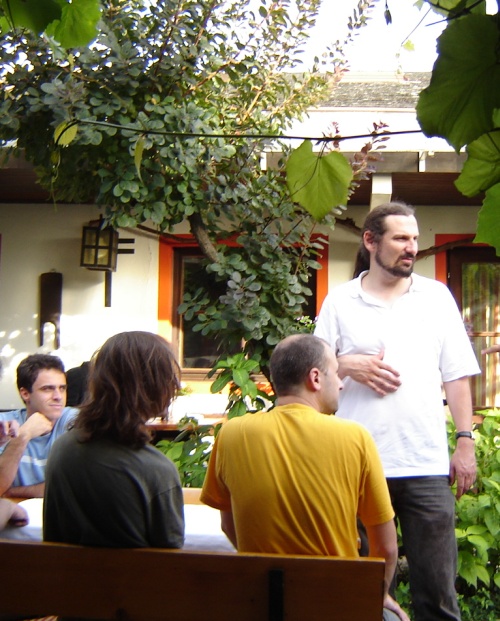
Here are Henrique Burstyn, Pavel Mnev, Dmitry Roytenberg and Thomas Strobl at a Heuriger near Vienna:


We reached this place at the end of a picturesque hike from the town of Baden bei Wien, through vineyards, past this church:


Posted at August 27, 2007 11:41 PM UTC

TrackBack URL for this Entry:   http://golem.ph.utexas.edu/cgi-bin/MT-3.0/dxy-tb.fcgi/1406

86 Comments & 3 Trackbacks

Who’s behind that final quote? Re: This Week’s Finds in Mathematical Physics (Week 256)

I usually believe (depends on mood and setting and company present) that Scientists are studying a single real universe, by various imperfect means.

Mathematicians, on the other hand, are doing something. But Philosphers of mathematics have not been able to answer the question cited by Corfield: “How do mathematicians steer their careers?”

That’s a puzzle, because they do not have feedback from “nature” the way scientists believe they have.

Here’s an intriguing quotation at the ned of the Week 2^8 blog by John Baez:

“Viewed superficially, mathematics is the result of centuries of effort by thousands of largely unconnected individuals scattered across continents, centuries and millennia. However the internal logic of its development much more closely resembles the work of a single intellect developing its thought in a continuous and systematics way - much as in an orchestra playing a symphony written by some composer the theme moves from one instrument to another, so that as soon as one performer is forced to cut short his part, it is taken up by another player, who continues with due attention to the score.”
- I. R. Shavarevich

Only who is that? Is it an alternate spelling, as Google hints to me?

In mathematics, the Golod-Shafarevich Theorem, named after the two Russian mathematicians Evgeny Golod and Igor Shafarevich, who proved it on 1964 is an important theorem in combinatorial group theory. In its most basic form, it states that if G is a finite p-group with minimal number of generators d and has r relators in a given presentation, then

r > (d^2)/4.

References

1. Johnson, D.L. (1980). Topics in the Theory of Group Presentations (1st ed.). Cambridge University Press. ISBN 0-521-23108-6. See chapter VI.

Or is it a Socialist mathematician and writer (as the strange valorization of the collective over the individual suggests) as Wikipedia begins:

Igor Rostislavovich Shafarevich (Russian: Игорь Ростиславович Шафаревич, born June 3, 1923 in Zhytomyr) is a Russian mathematician, founder of the major school of algebraic number theory and algebraic geometry in the USSR, and a political writer. He was also an important dissident figure under the Soviet regime, a public supporter of Andrei Sakharov’s Human Rights Committee from 1970. He supported the criticisms of Alexandr Solzhenitsyn of both Soviet communism and liberal proposals for the future of Russia.

Shafarevich’s 1970s book The Socialist Phenomenon was widely circulated in the West. After the Cold War, he attacked those he called “small people,” who deny the “historical achievements” of Russia, saying his homeland must have “sound democratic statehood, based on the will of the people.” His critics call him a radical, anti-Semitic, Christian nationalist.

Shafarevich’s contribution to mathematics include the theory of the Tate-Shafarevich group (usually called ‘Sha’, written ‘Ш’, his Cyrillic initial) in Galois cohomology, and the Golod-Shafarevich theorem on class field towers. He initiated a Moscow seminar on classification of algebraic surfaces that updated around 1960 the treatment of birational geometry, and was largely responsible for the early introduction of the scheme theory approach to algebraic geometry in the Soviet school.

Shafarevich was a student of Boris Delone, and his students included Evgeny Golod, S.Y. Arakelov, I.A. Kostrikin and Yuri Manin. In view of later accusations of anti-Semitism on his part, it can be noted that his research students included some identified as Jewish, and that later, during his most serious troubles in the 1970s with the Soviet authorities, he did major work in collaboration with Ilya Piatetski-Shapiro on K3 surfaces. He is a member of the Serbian Academy of Sciences and Arts in department of Mathematics, Physics and Geo Sciences.

On his 80th birthday, Russian President Vladimir Putin hailed his “fundamental research” in mathematics and his creation of “a large scientific school that is known both in Russia and abroad.

Hmmm. I’m not a big fan of Putin, or anti-Semites. However, I have read and enjoyed a lot by Sakharov and Solzhenitsyn. And the Tate-Shafarevich group is cool, and I more than half understood it after hours of effort…

Posted by: Jonathan Vos Post on August 28, 2007 3:40 AM | Permalink | Reply to this

Re: Who’s behind that final quote? Re: This Week’s Finds in Mathematical Physics (Week 256)

Sorry, “Shavarevich” was a typo for the famous algebraic geometer Shafarevich. I’ll fix that now.

Posted by: John Baez on August 28, 2007 11:11 AM | Permalink | Reply to this

Re: This Week’s Finds in Mathematical Physics (Week 256)

Re groupoidification: Very nice. I am truly enjoying this.

Two tiny quick comments:

You write:

we’ll call this vector [V]

Wouldn’t it be nicer to call this vector [v]? And in fact to call V p X instead v p X. Seems to me that would guide the eye a little better.

Actually, thinking about it, what really deserves to be called v is the morphism p.

Then, towards the end, here is a tiny, tiny typo:

as defined that paper

should probably read “as defined in that paper”.

Posted by: Urs Schreiber on August 28, 2007 11:05 AM | Permalink | Reply to this

Re: This Week’s Finds in Mathematical Physics (Week 256)

Glad you’re enjoying it, and thanks for the suggestions/corrections!

I guess a lower-case v would be nicer, so we could write [Sv] as the result of applying the span of groupoids S to v, and get

[Sv]=[S][v]

It’s also true that what really matters is the morphism p:vX, not v itself — but this notation gets a bit tricky when we apply it to a span, or matrix, which has one object and two morphisms.

Probably Jim Dolan’s approach is best: we should think of each morphism as an ‘index’, in a categorified version of Penrose’s abstract index notation. Then a groupoid over X:

i:vX

can be written as a vector with one index:

v i

Similarly, a span of groupoids:

i:SX,j:SY

can be written as a matrix with two indices:

S ij

And so on for higher-rank tensors, as David Corfield pointed out.

Summing over repeated indices is then our notation for taking weak pullbacks! And we don’t need to distinguish between upper and lower indices, due to the sneaky properties of groupoidification.

More abstractly, we can think of v as an object in [groupoidsoverX] and drop the index. Similarly, we can think of S as an object in [groupoidsoverX×Y] and drop the indices.

So, we have both the usual mathematicians’ notation and the usual physicists’ notation available to us! Everything will look quite ordinary, but it’s all been groupoidified!

Posted by: John Baez on August 28, 2007 11:29 AM | Permalink | Reply to this

Re: This Week’s Finds in Mathematical Physics (Week 256)

It might also be a good idea to emphasise the point that VX, thought of as *VX, is a generalised morphism from the point to X - just as we think of an element as a map from the terminal object via its name. Is that where Urs pulled the v from?

Posted by: David Roberts on August 30, 2007 4:22 AM | Permalink | Reply to this

Re: This Week’s Finds in Mathematical Physics (Week 256)

Is that where Urs pulled the v from?

I was simply following John’s notation, where square brackets [] denoted the morphism from the (3?-)category of spans of groupoids to that of vector spaces.

But I perfectly agree that the best way to think of those “combinatorial vectors” here is as generalized objects (you meant generalized objects, not generalized morphisms, right?).

What I don’t quite recall: is the standard notation for generalized elements?

If so, then the vector we are talking about should really be denoted [v] ;-)

Posted by: Urs Schreiber on August 30, 2007 11:24 AM | Permalink | Reply to this

Re: This Week’s Finds in Mathematical Physics (Week 256)

Urs wrote:

What I don’t quite recall: is the standard notation for generalized elements?

No, it’s the standard notation for the ‘name’ of a morphism in a closed category. In such a category, any morphism

f:XY

has a ‘name’

f:1 Hom(X,Y)

where Hom(X,Y) is the internal hom. Since a morphism from 1 is called an ‘element’, we can say that the name of f is an element of Hom(X,Y).

Clearly you skipped some classes. I’ll have to report you to the Wizard! He may punish you by making you translate Through the Looking Glass into the language of closed categories:

‘You are sad,’ the Knight said in an anxious tone: ‘let me sing you a song to comfort you.’

‘Is it very long?’ Alice asked, for she had heard a good deal of poetry that day.

‘It’s long,’ said the Knight, ‘but very, VERY beautiful. Everybody that hears me sing it–either it brings the TEARS into their eyes, or else–’

‘Or else what?’ said Alice, for the Knight had made a sudden pause.

‘Or else it doesn’t, you know. The name of the song is called “HADDOCKS’ EYES.”’

‘Oh, that’s the name of the song, is it?’ Alice said, trying to feel interested.

‘No, you don’t understand,’ the Knight said, looking a little vexed. ‘That’s what the name is CALLED. The name really IS “THE AGED AGED MAN.”’

‘Then I ought to have said “That’s what the SONG is called”?’ Alice corrected herself.

‘No, you oughtn’t: that’s quite another thing! The SONG is called “WAYS AND MEANS”: but that’s only what it’s CALLED, you know!’

‘Well, what IS the song, then?’ said Alice, who was by this time completely bewildered.

‘I was coming to that,’ the Knight said. ‘The song really IS “A-SITTING ON A GATE”: and the tune’s my own invention.’

Posted by: John Baez on August 30, 2007 1:11 PM | Permalink | Reply to this

Re: This Week’s Finds in Mathematical Physics (Week 256)

Clearly you skipped some classes. I’ll have to report you to the Wizard!

Hold on, I didn’t quite skip them. I knew somebody who was friends with someone who took notes. And I did glance over these notes.

I do remeber the concept of a name of a morphism. But I didn’t remember the floor notation.

That part from the looking glass you quote is really great. I do remember that, and my chuckling.

Posted by: Urs Schreiber on August 30, 2007 10:08 PM | Permalink | Reply to this

Re: This Week’s Finds in Mathematical Physics (Week 256)

David wrote:

It might also be a good idea to emphasise the point that VX, thought of as *VX, is a generalised morphism from the point to X

Right! In other words: what I was calling “silly spans”

                       v
                      / \
                     /   \
                    /     \
                   v       v
                  1         X

actually give operators

[v]:[1 ][X]

but since there’s a god-given isomorphism

[1 ]

these are the same as vectors [v][X]. I needed to get ahold of those vectors first, in order to define how any span gives an operator. Afterwards, we can see those vectors as a special case of operators.

So, it’s a case of developing something from scratch, and then looking back at what you’ve done and being able to see it in a more sophisticated way.

… just as we think of an element as a map from the terminal object via its name. Is that where Urs pulled the v from?

That last sentence is a joke, right? I was desperately groping for some notation for the ‘degroupoidification’ functor, when I realized that given an object x in a groupoid X, the isomorphism class [x] gave a vector in the vector space associated to Xwhich therefore deserves to be called [X]!

So, I decided to use the symbol [] for degroupoidification, and Urs did the same. No v.

Posted by: John Baez on August 30, 2007 1:11 PM | Permalink | Reply to this

Re: This Week’s Finds in Mathematical Physics (Week 256)

Wow, that’s bizzare - I think there was some kind of rendering fluke and the [ ] looked like the floor symbol yesterday, but today it’s fine.

Posted by: David Roberts on August 31, 2007 2:59 AM | Permalink | Reply to this

Re: This Week’s Finds in Mathematical Physics (Week 256)

the cardinality of the groupoid of finite sets is e=2.718281828

Since we are thinking about groupoids over other groupoids here:

I found it a useful insight that the cardinality of the groupoid of sets over the n-element set is e n.

That looks like it might be a useful fact to remember in this business. (At least it is for me. That’s why I am recalling it here, since I had trouble finding the above link.)

Posted by: Urs Schreiber on August 28, 2007 12:44 PM | Permalink | Reply to this

Re: This Week’s Finds in Mathematical Physics (Week 256)

In my 2004 course notes I mention not only the fact you cite — that the groupoid of n-colored finite sets has cardinality e n — but also that the groupoid of 1 2 -colored finite sets has cardinality e 1 /2 , and that the groupoid of finite-set-colored finite sets has cardinality e e15.154 .

These are cute examples of a more general theory, explained in those notes.

Posted by: John Baez on August 28, 2007 7:33 PM | Permalink | Reply to this

Re: This Week’s Finds in Mathematical Physics (Week 256)

In my 2004 course notes I mention not only the fact you cite

Ah, thanks, wasn’t aware of that.

Posted by: Urs Schreiber on August 28, 2007 7:46 PM | Permalink | Reply to this

Re: This Week’s Finds in Mathematical Physics (Week 256)

So Lie n-groupoids come in symplectic flavour. Do they come in other flavours à la Arnold?

Posted by: David Corfield on August 28, 2007 2:25 PM | Permalink | Reply to this

Re: This Week’s Finds in Mathematical Physics (Week 256)

So Lie n-groupoids come in symplectic flavour.

While I feel quite unsure about symplectic groupoids, I do understand symplectic Lie n-algebroids. These are just “NQP”-manifolds, i.e. graded manifolds with a nilpotent odd derivative and with a compatible graded non-degenerate Poisson structure.

We know that without the P, these NQ manifolds are nothing but Lie n-algebroids with weak Jacobi identity (partly because we really know, partly by definition).

I am still hoping that adding the “P” to these is nothing but also weakening the skew symmetry.

But maybe I should explain in more detail why I think so:

recall why it is that a Courant algebroid comes from a symplectic structure on a Lie algebroid:

consider the simple example where we live over a point, have just an ordinary Lie algebra g in degree 1, and -woth of 2-ismorphisms on each such 1-morphism (sg *ss *).

Let {t a} be a basis of sg *. Then a symplectic structure on this graded manifold is ω=ω abdt adt b, where dt a denotes the graded exterior differential of the graded “coordinate” t a.

The point is that with t a odd, dt a is even and hence this ω defines a symmetric bilinear structure on g!

Also, ω is required to be compatible with the differential (the “Q”). This makes it precisely an invariant degree 2 polynomial on the Lie algebra.

This way we find that the Courant algebroid over the point comes from a Lie algebra together with a bilinear invariant form on it.

In fact, in general, for g (n) any Lie n-algebroid, the symplectic structure should be nothing but a closed bilinear element in inn(g (n)) *, otherwise known as the odd tangent bundle.

So we have a construction precisely as for Chern Lie (2 n+1 )-algebras, only that there this bilinear piece is regarded as a higher coherence of the Jacobiator.

I expect we can just reinterpret this Jacobi failure as a skew failure. Notice that the skew-symmetrizator S:[x,y][y,x] does send two objects to an isomorphism starting at them.

So, in the dual picture, this could come from a degree -2 map S * which maps the canonical basis {b} of ss * to the “symplectic form” S *:bω abdt adt b.

Indeed, that symplectic form is usually required to be of degree -2, in the BV context.

Well, sorry if that sounds incoherent. If only I were not busy with something else, I would sit down and try to clear this up. But maybe with these hints somebody else can see the Fata Morgana that I am talking about

Posted by: Urs Schreiber on August 28, 2007 3:11 PM | Permalink | Reply to this

Re: This Week’s Finds in Mathematical Physics (Week 256)

So, I am thinking a weak Lie n-algebra, with both Jacobi and skew-symmetry weakend, should be something like this, dually:

A free graded commutative algebra g *= (sV *) generated in degrees 1 to n, together with

- a degree +1 graded differential d squaring to 0, d 2 =0

(that’s the known part, applying to strict skew symmetry)

- together with a degree +2 differential p on inn(g) *=( (sV *ssV *),d inn(g)) which commutes with d inn(g): [p,d inn(g)]=0 .

The basic example would be a skeletal Lie 2-algebra whose space of objects is just a Lie algebra g and which has a 1-dimensional space of automorphisms on each object. Everything is strict, and we have [x,y]=[y,x] but still there is a nontrivial skew-symmetrizor automorphism S x,y:[x,y][y,x]=[x,y].

In a basis {t a} of g this S has components k ab mapping the second power of the space of objects to the (1-dimensional) space of morphisms starting at the Lie bracket of these objects.

There will be some coherence conditions, which should force this k ab to be

a) symmetric

b) ad-invariant .

More concretly, dually, the graded-commutative algebra is (sg *ss *) and the dual incarnation of S is p:bk abdt adt b, which, recall, is supposed to take place in inn() of our Lie 2-algebra.

So, for {b} the canonical basis of ss, if we take db=0 , which corresponds to the statement that the Jacobiator vanishes, then we find that [p,d inn()]=0 implies that k abdt adt b is d inn()-closed, which says precisely that k ab are the components of a degree 2 invariant polynomial on g (see slides 117-140 of my talk for what’s going on here).

So, this Lie 2-algebra with strict Jacobi and weak skew symmetry happens to define precisely the same information as the Chern Lie 3-algebra (slides 151-155), which is a Lie 3-algebra with strict skew-symmetry but nontrivial coherence for the Jacobi identity in top degree.

Since the invariant polynomial k ab is necessarily transgressive, in turn the same information (this phrase “the same information” is the main thing that needs to be made precise, I think) as the corresponding weak Baez-Crans Lie 2-algebra called g k (slides 146-150) which has strict skew symmetry but where the Jacobiator is the Lie algebra cocycle built from k ab by transgression.

So, I think this goes in the right direction. But be careful, this is just a suggestion.

Posted by: Urs Schreiber on August 28, 2007 4:20 PM | Permalink | Reply to this

Re: This Week’s Finds in Mathematical Physics (Week 256)

What relations should $k_{ab}$ satisfy?

Try calling it something other than weak - since it is still strictly skew-symmetric.

Posted by: jim stasheff on August 31, 2007 2:23 PM | Permalink | Reply to this

Re: This Week’s Finds in Mathematical Physics (Week 256)

What relations should k ab satisfy?

Precisely that it be ad-invariant.

This is supposed to be the implication of imposing the obvious coherence condition which involves both the skew-symmetrizator and the Jacobiator.

This is Dmitry Roytenberg’s observation.

Unfortunately, he didn’t really go into any details in his talk in Vienna. But that’s the idea: like the weakening of the Jacobi identity gives higher antisymmetric brackets, the weakening of the skew symmetry gives higher symmetric brackets.

Try calling it something other than weak - since it is still strictly skew-symmetric.

Okay, I can try. But I am not sure what good established terminology would be.

This is related to the weakening of the Jacobi identity for the Baez-Crans type Lie n-algebras:

all of them come from Lie algebras which perfectly satisfy the Jacobi identity. Still, there is a nontrivial Jacobiator around (for n=2 ) or even a trivial Jacobiator, but with a nontrivial coherence law somewhere in degree n1 (for n>2 ).

Same here: the bracket itself is skew symmetric, and still there may be a nontrivial “skew-symmetrizator” around.

I am not sure what the best words to describe such a situation are.

Posted by: Urs Schreiber on August 31, 2007 3:01 PM | Permalink | Reply to this

Re: This Week’s Finds in Mathematical Physics (Week 256)

I hope Dmitry is keeping up with this.
In terms of relations, I was wondering about
k_ab k_bc
but also as you indicate,
even if k_ab = \pm k_ba
there is a higher order symmetrizer up to homtopy?

Posted by: jim stasheff on September 1, 2007 2:39 PM | Permalink | Reply to this

Re: This Week’s Finds in Mathematical Physics (Week 256)

but also as you indicate, even if k ab=±k ba

I should emphasize the following:

in the setup which I am thinking of here, we’d still work

- in the L picture with the ordinary graded-commutative coalgebra S c(sV)

- or dually in the qDGCA picture with the ordinary graded commutative algebra (sV *)

and hence these objects like k ab etc. would always be graded symmetric.

What is no longer strictly graded symmetric is just the Lie n-algebra encoded by the qDGCA equipped with a “graded symplectic form”, i.e. the linear n-category L and its bracket n-functor [,]:L×LL.

That was at least my idea (which may be wrong): that an n-vector space L (an n-term chain complex) together with a bracket functor [,] which satisfies a Joacobi identity up to coherent isomorphism and which is skew symmetric up to coherent ismorphism is equivalencly encoded in an “NQP”-manifold over a point.

So I am imagining the standard setup which we are thinking of all along, i.e. a graded commutative (co)algebra with (co)differential, but with one additional piece of data (the graded symplectic form “P”) on top of the odd differential.

Posted by: Urs Schreiber on September 3, 2007 4:39 PM | Permalink | Reply to this

Re: This Week’s Finds in Mathematical Physics (Week 256)

NPQ - not the most charming terminology
and shall we go on to RST? ;-)
oh, right - we already have BRST

Posted by: jim stasheff on August 31, 2007 2:19 PM | Permalink | Reply to this

Re: This Week’s Finds in Mathematical Physics (Week 256)

NPQ - not the most charming terminology

In this context, people say, with a perfectly straight face, things like

The AKSZ-BV formalism solves the BV master constraint given the data of two NPQ manifolds par and tar.

By the way, I expect in the end this should be just the differential version of

We may quantize the n-particle modeled by an n-groupoid Par and propagating on an m-groupoid Tar.

Despite your warning (which, admittedly, I didn’t really understand, maybe you could expand on it?) I am still hoping, for reasons described here, that the “P” in “NPQ” may simply be absorbed in a weakening of the skew symnmetry of Lie n-algebroid, like the “Q” is absorbed in the weakening of the Jacobi identity.

If true (I might be very wrong, but won’t give up on this idea until somebody disabuses me of it :-), this would essentially say that the kinetic part of the action is already encoded in the n-groupoid structure we put on target space.

That would nicely match with the general idea I had expressed here, here and here.

But possibly I am just hallucinating. I will try to think more about this.

Posted by: Urs Schreiber on August 31, 2007 2:50 PM | Permalink | Reply to this

Re: This Week’s Finds in Mathematical Physics (Week 256)

At some point won’t you need to find an analogue of phased sets for groupoids? Or has this been done already?

Then you could have things like spans of phased groupoids as unitary operators.

Posted by: David Corfield on September 4, 2007 12:26 PM | Permalink | Reply to this

Re: This Week’s Finds in Mathematical Physics (Week 256)

At some point won’t you need to find an analogue of phased sets for groupoids? Or has this been done already?

I was thinking that a G-phased groupoid is a groupoid over INN(G).

First of all, a discrete groupoid over INN(G) is a G-phased set. Then, if two objects in the groupoid are related by the action of gG, then their G-phase should differ by that g. That’s exactly what happens for groupoids over INN(G).

I am enjoying the following combination of things I have been thinking about in the context of tangent categories and n-curvature, and the Tale of Groupoidification:

we may start with a G-bundle with connection, presented by a functor tra:P 1 (X)ΣG. But we then realize that we rather ought to be looking at its curvature δtra:Π 2 (X)GrpΣG. This sends each point x in X to the groupoid INN(G) regarded as a groupoid over ΣG. By the Tale, I may think of this as describing a connection on a (trivial) bundle whose fibers are like a certain vector space with a G-action.

(Think for instance about G= n as an approximation to G=U(1 )).

What’s interesting now is that a section of δtra thought of as a morphism into δtra is

- over each point xX a groupoid over INN(G), hence a “G-phase groupoid”.

Again, if I translate this to the Tale using G= n it seems to say that over each point the section is (the approximation to) a complex number!

So it looks like by combining the curvature technique with the tale, we automatically turn principal U(1 )-bundles into line bundles, whose sections are, locally, complex numbers over each point.

Posted by: Urs Schreiber on September 4, 2007 12:53 PM | Permalink | Reply to this

Re: This Week’s Finds in Mathematical Physics (Week 256)

So how does the counting up go? In the case of phased sets, we add up the phases. This I guess corresponds to mapping the phased set to {{*}, 0}, and taking the cardinality of the phased groupoid (in this case phased set) in the fibre above {*}. What if the target phased set were {{*}, c} for nonzero c?

What now happens with a phased groupoid? How do we add up the phases in, say, a U(1 )-phased groupoid?

Posted by: David Corfield on September 4, 2007 9:02 PM | Permalink | Reply to this

Re: This Week’s Finds in Mathematical Physics (Week 256)

David Corfield wrote:

At some point won’t you need to find an analogue of phased sets for groupoids? Or has this been done already?

Jeffrey Morton introduced phased groupoids under the name of ‘U(1 )–groupoids’ in his paper Categorified algebra and quantum mechanics — see Section 6.1.2, page 46.

Then you could have things like spans of phased groupoids as unitary operators.

Exactly!

As you know, Jim Dolan and I introduced a theory of ‘stuff types’ generalizing Joyal’s ‘species’ so we could categorify the quantum harmonic oscillator and the theory of Feynman diagrams. The big problem with our work was that it didn’t include the phases needed to describe the unitary time evolution of the free harmonic oscillator!

This is what Jeffrey did in his paper, using ‘U(1 )-stuff types’ and ‘U(1 )-stuff operators’.

Everyone should read this paper! It explains this business very gently, with lots of pictures. I’ll give an ultra-terse summary now, but only to tempt people into reading the real story.

Now: having decided that the term ‘U(1 )-set’ is a really lousy term for a set equipped with a map to U(1 ), and having switched to calling such a thing a phased set, let’s be consistent in adopting this new style of terminology.

So: we hereby define a phased groupoid to be a groupoid equipped with a functor to the groupoid with U(1 ) as its set of objects and only identity morphisms.

In other words: a phased groupoid is a groupoid such that each object is labelled by a phase (an element of U(1 )), and isomorphic objects are labelled by the same phase.

A phased set is then a phased groupoid with only identity morphisms.

A phased stuff type is a phased groupoid whose underlying groupoid is equipped with a functor to the groupoid of finite sets.

Jeffrey shows how every phased stuff type gives a (possibly non-normalizable) state of the quantum harmonic oscillator.

A phased stuff operator is a phased groupoid whose underlying groupoid G is part of a span:

                       G
                      / \
                     /   \
                    /     \
                   v       v
                  B         B

where B is the groupoid of finite sets.

Jeffrey shows how every phased stuff operator gives a (possibly unbounded) operator on the Hilbert space for the quantum harmonic oscillator.

And using this, he shows how to categorify the theory of Feynman diagrams as a tool for computing time evolution of the perturbed quantum harmonic oscillator!

I hope you see that this is all part of the Tale of Groupoidification

So how does the counting up go? In the case of phased sets, we add up the phases.

Right — you’ll find this idea nicely explained in Feynman’s popular book QED. A set of possible ways for a quantum system to get from here to there is really a phased set. To compute the amplitude for it to get from here to there, we just compute the cardinality of the phased set — that is, add up the phases. The cardinality of a finite phased set can be any complex number.

But, this generalizes nicely to phased groupoids.

How do we add up the phases in, say, a U(1 )-phased groupoid?

I’m sure you can guess! Or, read the material in Jeff’s paper leading up to the answer in Section 6.2.1, page 50.

Posted by: John Baez on September 4, 2007 11:08 PM | Permalink | Reply to this

Re: This Week’s Finds in Mathematical Physics (Week 256)

I hadn’t noticed that part of Jeff’s paper. So what are we to make of the difference between your and Urs’ answer to my question about phased groupoids? Are they just constructions for different purposes.

Another thing, and I ought to work this out myself, but I’m not quite clear on the idea of a vector [V] in [X]. Let’s pick some examples and denote by n the cyclic group of order n, and look at some maps from n to m. Then there’s only one object in the codomain, so we’re just looking for a single coefficient.

a) 2 2, identity map.

b) 2 2, trivial map.

c) 1 2.

I should do the exercise you left:

define the morphisms in the essential preimage.

You even asked us twice to do this.

Posted by: David Corfield on September 5, 2007 11:49 AM | Permalink | Reply to this

Re: This Week’s Finds in Mathematical Physics (Week 256)

So what are we to make of the difference between your and Urs’ answer

John said: “groupoids over Disc(G)”, whereas I talked about “groupoids over G//G”.

To avoid misunderstandings let me emphasize that my reply was partly wishful thinking: I said that if a G-phased groupoid is a groupoid over G//G and if U(1 )-phased groupoids are a good substitute for complex numbers, then some puzzle pieces I am holding in my hands would beautifully fit together.

Now, John’s reply doesn’t quite support this hope. So next I am hoping that there is a subtlety, yet to be unravelled, which does justify both points of view. :-)

Posted by: Urs Schreiber on September 5, 2007 12:30 PM | Permalink | Reply to this

Re: This Week’s Finds in Mathematical Physics (Week 256)

David wrote:

I hadn’t noticed that part of Jeff’s paper.

That’s the only part that contains brand new ideas! The rest is a detailed working-out of material presented in the Fall 2003, Winter 2004, and Spring 2004 seminars at UCR.

If you didn’t notice the new stuff, I wonder if anyone else did. I know Urs did. So, the paper had at least 4 readers: Jeff, me, Urs, and the referee.

His paper is quite long, and all the truly new stuff — introducing phases into categorified quantum mechanics — comes after page 43. Maybe it should have been split into two papers.

On the other hand, even the old stuff had never been worked out in detail or published anywhere, except for a rudimentary sketch where Feynman diagrams appear briefly on the last page. So, maybe it was just your familiarity with the old stuff that made you give up before getting to the new stuff?

Writing papers is a tricky business if you actually want people to read them.

Another thing, and I ought to work this out myself, but I’m not quite clear on the idea of a vector [V] in [X].

Oh? You used to love this idea back when X was the groupoid of finite sets.

In that case, a groupoid V over X was what we called a stuff type. The vector space [X] was the algebra of polynomials

{ n0 a nz n:a n0 }

since it has one basis element z n for each isomorphism class of finite set. The vector [V][X] was called the generating function of the stuff type V.

(Pesky technical note: we should complete [X] a bit, to get the algebra of formal power series, if we want it to include the generating function of V when V is not a finite groupoid.)

So, unless I succeeded in baffling you by moving up to a higher level of generality, you should certainly still appreciate this special case!

You should also like the case where X is a symmetric group S n viewed as a one-object groupoid. Then up to equivalence we can think of X as the groupoid of n-element sets. A groupoid V over X should be thought as a groupoid of n-element sets ‘equipped with extra stuff’.

In this case [X] is 1-dimensional, and the size of [V] is proportional to the cardinality of the groupoid V.

Let’s pick some examples and denote by n the cyclic group of order n,…

Okay — now you’re taking the groupoid X=n to be the cyclic group of order n, viewed as a one-object groupoid. You could equivalently think of X as the groupoid of cyclically ordered n-element sets.

A groupoid V over X is then a groupoid of cyclically ordered n-element sets ‘equipped with extra stuff’. You give three examples of these:

a) 2 2 identity map.

b) 2 2 , trivial map.

c) 1 2

Here’s a little puzzle just to make sure our brains are oiled and running smoothly: in each case, what extra stuff do we have on our cyclically ordered 2-element set? I’ll do case a). In this case, there’s no extra stuff at all! I.e. we’re dealing with the wimpiest possible case of extra stuff, a ‘tautologously true property’.

I’ll let you — or other volunteers! — do the other two.

By the way: what’s a bit funny about ‘cyclically ordered n-element sets’ when n=2 ?

Posted by: John Baez on September 5, 2007 12:45 PM | Permalink | Reply to this

Re: This Week’s Finds in Mathematical Physics (Week 256)

Here’s a little puzzle […]

I’ll let you – or other volunteers! – do the other two.

Let me see if I understand. For case b):

First, I’ll try to recall the definitions: we say that the functor 2 2 forgets at most stuff, I hope, if it is essentially surjective and full, but not necessarily faithful. The idea being that morphisms upstairs are like morphisms downstairs plus some extra data which tells us how the extra stuff transforms.

So, then, I am now supposed to be looking at the trivial functor 2 2 . Personally I like to denote this Σ 2 Σ 2 , but that’s my problem, not yours ;-).

Anyway, since it is supposed to be trivial, I should concentrate on understanding 2 {} first. That’s clearly full. The morphisms which are being forgotten are the automorphisms of the 2-element set, or keeping the question

what’s a bit funny about ‘cyclically ordered n-element sets’ when n=2 ?

in mind, equivalently the automorphisms of the cyclically ordered 2-element set.

So I conclude: the trivial functor 2 2 describes the one-element set equipped with a two element set. The extra stuff is the two element set.

So it describes a funny shift in perspective: instead of regarding {a,b} as a two-element set, we regard it as the one-element set equipped with extra data, where the extra data is a 2-element set!

Hope that’s right.

As for c): this doesn’t forget anything, I think, hence in particular describes no extra stuff.

Posted by: Urs Schreiber on September 5, 2007 1:34 PM | Permalink | Reply to this

Re: This Week’s Finds in Mathematical Physics (Week 256)

Oh, good — a volunteer. Note how David hangs back while Urs blithely steps forward.

Urs wrote:

First, I’ll try to recall the definitions: we say that the functor 2 2 forgets at most stuff, I hope, if it is essentially surjective and full, but not necessarily faithful.

No, alas!

Every functor between categories forgets at most stuff. For mere 1-categories, stuff is the most serious thing there is to forget!

We say a functor:

  • forgets nothing if it’s faithful, full and essentially surjective;
  • forgets at most properties if it’s faithful and full;
  • forgets at most structure if it’s faithful;
  • forget at most stuff in every case.

In case a), we had the identity functor

1 :2 2

This is an equivalence — so, it’s faithful, full and essentially surjective. So, it forgets nothing.

That should seem reasonable. If we think of 2 as the groupoid of 2-element sets, this functor takes a 2-element and set and does nothing to it.

The idea being that morphisms upstairs are like morphisms downstairs plus some extra data which tells us how the extra stuff transforms.

Right. The morphisms upstairs really involve ‘extra data’ compared to the morphisms downstairs when our functor fails to be faithful. Otherwise, if our functor is faithful, we say it forgets at most structure.

Example: the forgetful functor from groups to sets forgets at most structure. But the the forgetful functor from pairs of sets to sets, which throws out the second set in the pair, forgets stuff. What stuff? The second set!

Now for example b):

So, then, I am now supposed to be looking at the trivial functor triv:2 2 .

Okay.

Anyway, since it is supposed to be trivial, I should concentrate on understanding 2 1 first. That’s clearly full.

I’ve taken the liberty of renaming the trivial groupoid 1 here, since that’s what it is.

This functor is full and essentially surjective, but not faithful. So, it forgets stuff. What stuff does it forget? Everything, basically.

So I conclude: the trivial functor triv:2 2 describes the one-element set equipped with a two element set. The extra stuff is the two element set.

I don’t like this sentence at all! In the forgetful functor game, when you’re given a functor F:XY, you’re suppose to say “an object of X is an object of Y equipped with ?????, which F forgets”. The ????? is some extra property, structure or stuff.

So for this functor:

triv:2 2

you’re supposed to say “a 2-element set is a 2-element set equipped with ?????, which triv forgets”.

I think maybe you were thinking about this functor:

2 1

the unique functor from 2 to 1 . Then it would make sense to say “a 2-element set is a 1-element set equipped with a 2-element set, which this functor forgets”.

This sounds bizarre, but it’s correct! The point is, having a 1-element set equipped with a 2-element set is just the same as having a 3-element set with one element colored black and two colored red. But, the groupoid of these is equivalent to the groupoid of 2-element sets — since the black element doesn’t have any symmetries.

It sounds less bizarre to consider

2 0

and say “a 2-element set is a 0-element set equipped with a 2-element set, which this functor forgets”. But, the groupoid of all 0-element sets is equivalent to the groupoid of 1-element sets! So, if this paragraph is true, so are the previous two.

(Answer to previous puzzle: what’s funny about a cyclically ordered n-element set for n2 is it’s just the same as a n-element set. So, let’s not worry about the cyclic ordering in this discussion — at least not until we count up to 3 .)

Posted by: John Baez on September 5, 2007 4:48 PM | Permalink | Reply to this

Re: This Week’s Finds in Mathematical Physics (Week 256)

I should concentrate on understanding 2 1 first.

[…]

I think maybe you were thinking about this functor: 2 1

Yes! :-)

I thought I could get away with understanding just this one.

I didn’t recall that

In the forgetful functor game

(which I had trouble googling the rules for – thanks for the link!)

when you’re given a functor F:XY, you’re suppose to say “an object of X is an object of Y equipped with ?????, which F forgets”.

Okay, I get it. Hence I am

supposed to say “a 2-element set is a 2-element set equipped with ?????, which triv forgets”.

I see.

Hm, the trivial F forgets that I can permute the elements of my 2-element set, since it regards all automorphisms of the 2-element set as identities.

So, somehow the functor forgets that there is more than one two-element set around.

I’ll try this statement:

A two-element set is a two-element set equipped with information about which elements it contains, which the functor 2 1 2 forgets.

Posted by: Urs Schreiber on September 5, 2007 5:59 PM | Permalink | Reply to this

Re: This Week’s Finds in Mathematical Physics (Week 256)

Urs wrote:

A two-element set is a two-element set equipped with information about which elements it contains, which the functor 2 1 2 forgets.

That’s pretty close, but I’m not completely happy. Lest you despair, let me reassure you: this is a fairly pathological degenerate case of a forgetful functor! So, the story we need to tell will sound rather odd.

Let’s tell the story one stage at a time — that’s a good strategy. First stage: 2 1 Someone hands you a 2-element set. You completely forget everything about it and pull a 1-element set out of your pocket.

Second stage: 1 2 Someone hands you a 1-element set. You completely forget everything about it and pull a 2-element set out of your pocket.

So, composing these: 2 1 2 Someone hands you a 2-element set. You throw it over your shoulder, pull a 1-element set out of your pocket, say “Whoops! Wrong pocket!” , throw it out, and pull a 2-element set of your other pocket.
Now let’s work backwards. I want you to try to describe all these functors as ‘forgetful functors’ F:XY, where a X-object is a Y-object equipped with some extra stuff (or maybe just structure (or maybe just properties (or maybe just nothing at all))), and F forgets this extra stuff.

We did it already for the first stage: F:2 1 Here we agreed how to say it:

A 2-element set is the same as a 1-element set equipped with an extra 2-element set with points colored red. The functor F throws out the red points.

Again, this is supposed to sound weird! I’m saying a 2-element set “is the same as” a 3-element set with 1 ordinary black point and 2 red points. What the hell do I mean!? Don’t worry, I’m not crazy: I mean the groupoid of 2-element sets and bijections is equivalent to 3-element sets colored this way, and color-preserving bijections.

Next, the second stage: G:1 2 Here’s how I’d say it:

A 1-element set is the same as a 2-element set equipped with a labelling of its points and an extra 1-element set with point colored pink. The functor G throws out the pink point.

Note the labelling is extra structure that ‘nails down’ the points of our 2-element set, reducing its symmetry group to the trivial group. The groupoid of 2-element labelled sets is equivalent to the trivial groupoid.

Okay! Doing F and then G, we get

GF:2 1 2

Can someone fill in the blanks here?

A 2-element set is a 2-element set equipped with ?????. The functor GF does ?????.

I think I’ve done most of the hard work… except for the hard work of understanding what I just said.

Posted by: John Baez on September 5, 2007 8:54 PM | Permalink | Reply to this

Re: This Week’s Finds in Mathematical Physics (Week 256)