This Week’s Finds in Mathematical Physics (Week 253)
Posted by John Baez
In week253, read about
mysterious relations between the Standard Model, the SU(5)
and SO(10) grand unified theories, the exceptional group
E6, the complexified octonionic projective plane…
and maybe even E8!
Here’s a lightning review of the Standard Model:
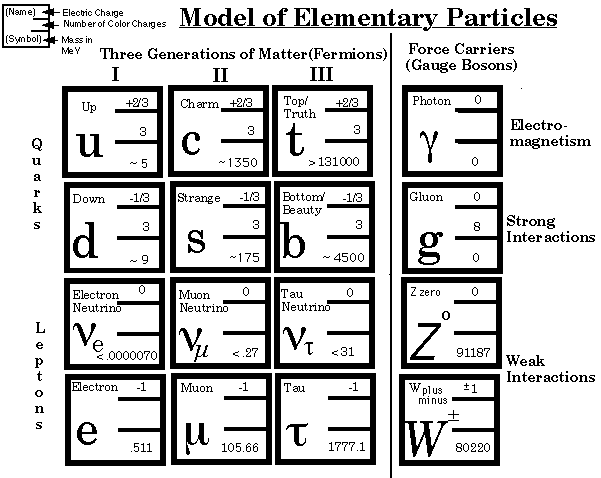
Alas, the fact that this chart looks like a square matrix seems to have no relation to any interesting physics whatsoever, except insofar as it shows that leptons and quarks come in 3 generations and the gauge bosons are something else. I know of no sense in which the , , and are like a “fourth generation”.
Also, this chart omits the Higgs.
But, it’s the best chart I could find when it came to simplicity, visual impact and actual information. It’s available at various places on the Fermi National Accelerator Laboratory website.
It’s possible to make a very nice chart of fermions in the SO(10) grand unified theory, and I believe such a chart can be found in Zee’s book Quantum Field Theory in a Nutshell. But, I couldn’t find a nice chart like this online. Maybe I’ll have to make one someday.
Posted at June 28, 2007 7:55 AM UTC
TrackBack URL for this Entry: http://golem.ph.utexas.edu/cgi-bin/MT-3.0/dxy-tb.fcgi/1340
Re: This Week’s Finds in Mathematical Physics (Week 253)
Very nice summary of standard model structure and beyond!
[..]
hints at a weird unification of bosons and fermions, something different from supersymmetry.
For those reading this who don’t know, one should maybe add, to avoid confusion here, that supersymmetry was never meant to make those bosons and fermions which have already been detected to be superpartners of each other. Rather, all their superpartners are hypothesized – in supersymmetric extensions of the standard model – to exist on top of that, but to have evaded detection so far due to their relatively high mass, which they are thought of as having acquired due to a “supersymmetry breaking mechanism” of one sort or another.
I wonder how all this magic which you mention is related to Alain Connes’ observation: that the fermions of the standard model naturally arise as
the direct sum of all inequivalent irreducible bimodules of the algebra
That’s another rather cute way to summarize all that information in one sentence!
Re: This Week’s Finds in Mathematical Physics (Week 253)
The splitting
e6 = so(10) ⊕ S10+ ⊕ u(1)
also hints at a weird unification of bosons and fermions, something different from supersymmetry. We’re seeing e6 as a Z/2-graded Lie algebra with so(10) ⊕ u(1) as its “bosonic” part and S10+ as its “fermionic” part. But, this is not a Lie superalgebra, just an ordinary Lie algebra with a Z/2 grading!
Wouldn’t the Coleman-Mandula theorem impede any such “unification”?
Re: This Week’s Finds in Mathematical Physics (Week 253)
Squark wrote:
Wouldn’t the Coleman-Mandula theorem impede any such “unification”?
If you tell me what the theorem actually says — including the exact hypotheses! — I’ll answer that question. 
Re: This Week’s Finds in Mathematical Physics (Week 253)
Toby Bartels comments via email:
John Baez wrote in part:
This gives me an excuse to say a word or two about symmetric spaces… a topic that deserves a whole week of its own!
One should know that there are a few concepts called “symmetric space”:
* this one;
* a topological space satisfying the regularity/separation axiom;
* another concept that I forget.
So it is an overloaded term.
Euclidean spaces and spheres are the most famous examples of symmetric
spaces. If an ant decides to set up residence on a sphere, any point
is just as good any other. And, if sits anywhere and looks in any
direction, the view is the same as the view in the opposite direction.
In fact, in these examples, the view is the same in ~every~ direction!
Is there a term for this? (More on that below.)
Later John wrote in part:
This gives a specially nice sort of
homogeneous space G/H, called a “symmetric space”. This is better
than your average homogeneous space.
You already used “symmetric space” and explained it a bit,
so it’s odd to see it in quotes here as if it’s a new term.
Did you misedit?
for each point p in [a symmetric space] there’s a map from [the space] to
itself called “reflection through p”, which fixes the point p and acts
as -1 on the tangent space of p.
To go back to the examples of Euclidean spaces and spheres,
here there is an -indexed family of maps from the space to itself
called “rotations about p”, each of which fixes and acts on ,
the tangent space of , as multiplication by its index in .
(Here is the dimension of the symmetric space as a manifold;
the tangent space of is isomorphic to , but this is not canonical, so it’s more fair to say that the family is indexed by .
And in fact, this must be a Riemannian manifold for this to make sense.)
This doesn’t seem to be the same as the “Riemannian symmetric spaces”;
in fact, this extension to all of seems to be independent
of the condition that the reflection (and rotations?) preserve the metric.
In any case, my point is that the examples of Euclidean spaces and spheres
are even more symmetric than (Riemannian) symmetric spaces in general.
–Toby
Re: This Week’s Finds in Mathematical Physics (Week 253)
1 - I applaud you for wanting to learn more about game theory.
While in Paris, you [and M. Mellies] may want to contact Stephane Gaubert of INRIA for information on Max-Plus Algebra and graphing with Petrie Nets as variants of game theory.
Stéphane Gaubert’s Home Page
http://amadeus.inria.fr/gaubert/
or
MaxPlus Algebra Home Page
http://www-rocq.inria.fr/MaxplusOrg/
2 - Witten received his Fields Medal in part for using Morse Theory [M?].
http://www.mathunion.org/Prizes/Fields/1990/Witten/page1.html
and
http://en.wikipedia.org/wiki/Morse_theory
Re: This Week’s Finds in Mathematical Physics (Week 253)
Very nice summary of standard model structure and beyond!
For those reading this who don’t know, one should maybe add, to avoid confusion here, that supersymmetry was never meant to make those bosons and fermions which have already been detected to be superpartners of each other. Rather, all their superpartners are hypothesized – in supersymmetric extensions of the standard model – to exist on top of that, but to have evaded detection so far due to their relatively high mass, which they are thought of as having acquired due to a “supersymmetry breaking mechanism” of one sort or another.
I wonder how all this magic which you mention is related to Alain Connes’ observation: that the fermions of the standard model naturally arise as
the direct sum of all inequivalent irreducible bimodules of the algebra
That’s another rather cute way to summarize all that information in one sentence!