Skip to the Main Content

Note:These pages make extensive use of the latest XHTML and CSS Standards. They ought to look great in any standards-compliant modern browser. Unfortunately, they will probably look horrible in older browsers, like Netscape 4.x and IE 4.x. Moreover, many posts use MathML, which is, currently only supported in Mozilla. My best suggestion (and you will thank me when surfing an ever-increasing number of sites on the web which have been crafted to use the new standards) is to upgrade to the latest version of your browser. If that's not possible, consider moving to the Standards-compliant and open-source Mozilla browser.

August 17, 2007

Higher Gauge Theory and the String Group

Posted by John Baez

Tomorrow — unless stopped by global warming demonstrations at Heathrow — I’ll go to meet Urs Schreiber in Vienna. I’ve been wanting to talk to him for quite a while now. He produces math faster than I can keep up, and I hope it’ll be easier to catch up in person. Blogs are great, but conversation is still better for many things.

We’ll be attending a Workshop on Poisson Geometry and Sigma Models organized by Anton Alekseev, Henrique Bursztyn and Thomas Strobl at the Erwin Schrödinger Institute. I’m giving this talk:

  • John Baez, Higher gauge theory and the string group.

    Abstract: Higher gauge theory is a generalization of gauge theory that describes the parallel transport not just of particles, but also strings or higher-dimensional branes. To handle strings, we categorify familiar notions from gauge theory and consider ‘principal 2-bundles’ with a given ‘structure 2-group’. These are a slight generalization of nonabelian gerbes. We focus on examples related to the 2-groups String k(G) associated to any compact simply-connected simple Lie group G. We describe how these 2-groups are built using the level-k central extension of the loop group of G, and how they are related to the ‘string group’. Finally, we discuss 2-bundles with String k(G) as structure 2-group, and pose the problem of computing characteristic classes for such 2-bundles in terms of connections.

Those of you who’ve already understood my Abel Symposium talk on Higher gauge theory and elliptic cohomology will find little really new here except a description of characteristic classes for String k(G)-bundles, and the problem of computing them in terms of connections — a problem which Urs may know the answer to already.

Indeed, everything about this new talk is nearly identical to that previous one up to page 14, where I spend more time explaining how the “nerve” construction turns a topological 2-group like String k(G) into a topological group called String k(G). A lot of topologists already know this construction; I’m not sure how many mathematical physicists do! For similar reasons I say more about the string group on page 16, and more about string structures on page 20. I decided to leave out all allusions to elliptic cohomology.

So, overall this talk is gentler and I hope clearer than the last. One feature that might interest experts is that I describe the real cohomology of the classifying space for String k(G)-2-bundles! Filling in some gaps in the work of Branislaw Jurco, Danny Stevenson and I showed this classifying space is just BString k(G)) In other words, it’s the same as the classifying space for String k(G)-bundles. So, to understand the characteristic classes for String k(G)-2-bundles, you need to understand the cohomology of BString k(G)).

I learned at the Abel symposium that if you work over the real numbers, this cohomology ring is just what you’d hope: it’s the cohomology of BG modulo the ideal generated by the ‘second Chern class’. In short: H *(BString k(G),)H *(BG,)/[c 2 ] where c 2 is some nonzero element (it doesn’t matter here which) in H 4 (BG,).

Now, given a String k(G)-2-bundle PX over a nice space X, it’s classified by some map f:XBString k(G), so any cohomology class cH *(BString k(G),) gets pulled back to a class f *cH *(X,) These elements are the ‘characteristic classes’ of our 2-bundle P. The problem, then, is to describe all these characteristic classes in terms of deRham cohomology, starting from an arbitrary connection on P.

(Note: here we can’t require that the connection satisfy the ‘fake flatness’ condition we demand of a full-fledged 2-connection with well-defined holonomies! Such 2-connections only exist on certain String k(G)-2-bundles.)

I have a vague memory that Urs and Jim Stasheff have already done most of what it takes to solve this problem — I just can’t find the relevant web page. There’s a well-known isomorphism between H *(BG,) and the algebra of invariant polynomials on the Lie algebra of G. This should somehow give a description of H *(BG,)/[c 2 ] in terms of the Lie 2-algebra of String k(G), or perhaps the closely related ‘Chern–Simons Lie 3-algebra’. Given this and the isomorphism H *(BString k(G),)H *(BG,)/[c 2 ] we should get a description of the real characteristic classes of String k(G)-2-bundles in terms of connections.

So, when I pose the ‘Nice Problem’ at the end of my talk, I expect Urs will pretend to think very hard for 20 seconds… and then solve it!

Posted at August 17, 2007 4:31 PM UTC

TrackBack URL for this Entry:   http://golem.ph.utexas.edu/cgi-bin/MT-3.0/dxy-tb.fcgi/1394

43 Comments & 1 Trackback

Re: Higher Gauge Theory and Elliptic Cohomology

Shouldn’t the real characteristic classes of a 2-bundle come from invariant expressions involving its 3-form curvature?

Is that what you have in mind?

It seems to me you either have something else in mind or I am misunderstanding you.

For a while now, ever since I understood # how ordinary Lie algebra cocycles, invariant polynomials and transgression elements give rise to higher Lie algebras (the key is to understand all of thse issues in terms simply iof the coholomogy of the qDGCA corresponding to inn(g)!), each, I was thinking about repeating this process in higher categorical dimension.

There should be a notion of Lie n-algebra cocycle, of Lie n-algebra invariant polynomial and of Lie n-algebra transgression elements, for any given Lie n-algebra.

And it’s actually pretty clear what these should be:

- a Lie n-algebra cocycle is simply a closed element in the (quasi-free) differential graded algebra which is Koszul dual to that Lie n-algebra.

- an “invariant polynomial” on a Lie n-algebra is a closed element in the qDGCA corresponding to the inner-derivation Lie (n+1 )-algebra, with a certain restriction on the degree.

And a transgression element is a potential of the latter which restricts to the former.

(I can describe this more intelligibly, if desired.)

Anyway, I was thinking that once one has defined invariant polynomials on Lie n-algebras this way, there would be an obvious way to generalize Chern classes etc, and in fact get a notion of characteristic classes of n-bundles.

This was one of the things on my “to do” list, an item with woefully small chances of being assigned a sufficiently high nice value any time soon.

But that’s not the “Nice problem” which you are referring to, it seems. (?)

Posted by: Urs Schreiber on August 17, 2007 6:42 PM | Permalink | Reply to this

Re: Higher Gauge Theory and Elliptic Cohomology

Urs wrote:

Shouldn’t the real characteristic classes of a 2-bundle come from invariant expressions involving its 3-form curvature?

That’s an obvious guess — but maybe the 2-form fake curvature plays a role too!

Anyway, I was thinking that once one has defined invariant polynomials on Lie n-algebras this way, there would be an obvious way to generalize Chern classes etc, and in fact get a notion of characteristic classes of n-bundles.

Right, that’s exactly what I’m hoping.

The new twist is that now I know for other reasons what the ring of characteristic classes should be! At least I’m pretty sure, based on what I was told in Oslo — I need to check some stuff. But, it seems very plausible that the ring of (real) characteristic classes for String k(G)-2-bundles is just the ordinary ring of characteristic classes for G-bundles, modulo the 2nd Chern class:

H *(BString k(G),)H *(BG,)/[c 2 ]

Note, this means that for G=SU(n) we’ll get a polynomial ring on generators c 3 ,,c n with c i of degree 2 i.

Now, this seems quite different from the guess you seem to be making, namely that all chacteristic classes are built from the 3-form curvature, hence have degrees that are multiples of 3.

So, I believe something interesting is going on here. Perhaps I’m just making some mistake, but I think it’s something more interesting than that. I need to pack now, but we can talk a bit about it in Vienna.

Posted by: John Baez on August 17, 2007 7:20 PM | Permalink | Reply to this

Re: Higher Gauge Theory and Elliptic Cohomology

Okay, I see. There is probably something going on at the level of characteristic classes which is a re-incarnation of the fact that G (2 )-2-bundles have the same classification as G (2 )-1-bundles.

That seems to suggest that we should expect funny relations between the ordinary characteristic classes of a G (2 )-1-bundle (and now that I reread your entry, that’s in fact what you are asking us to think about!) and the “2-charachteristic classes” (or whatever we are going to call them) of the G (2 )-2-bundle (which I was thinking of in my reply).

I’ll think about this. Right now the best I can offer is this somewhat vague observation:

From my slides 155 and 159 one sees that for k the Killing form on g and μ the corresponding 3-cocycle, it is precisely the Killing form which becomes explicitly exact in the qDGCAs of cs k(g) and ch k(g), since in these there is, by definition, a generator called c with the property that dc=k. That doesn’t really prove anything so far. But I am expecting that a computation like this will lead to k being “killed in cohomology” as we compute the 2-invariant polynomiuals of Lie(String k(G)).

Posted by: Urs Schreiber on August 17, 2007 7:29 PM | Permalink | Reply to this

Re: Higher Gauge Theory and Elliptic Cohomology

Let’s clarify the terminology:
Do you want 2-group principal bundles over an ordinary space?
so that characteristic classes would be ordinary cohomology classes of that base space?

OR

Is the base also a 2-object for whihc 2-cohomology makes sense?
that’s the only situation in which reference to 2-characterisitc might be needed.

Posted by: jim stasheff on August 19, 2007 12:10 AM | Permalink | Reply to this

Re: Higher Gauge Theory and Elliptic Cohomology

Let’s clarify the terminology:

Okay, good.

Do you want 2-group principal bundles over an ordinary space?

Yes, in fact I do.

so that characteristic classes would be ordinary cohomology classes of that base space?

Yes, I think that’s what John had in mind: we may think of a given 2-bundle over X for a 2-group G (2 ) as actually being classified by maps XBG (2 ) that classify ordinary bundles with structure group being G (2 ) (the realization of the nerve of G (2 )), so we may then just look at the ordinary characteristic classes of these ordinary bundles.

I’d still think, though, that there ought to be a useful way (when we are in characteristic 0, as you say) to express these characteristic classes in terms of differential forms which are constructed from invariant expressions using the 2- and 3-form curvature of a connection on the 2-bundle.

This should somehow encode the information that the 1-group G (2 ) arose from a 2-group G (2 ).

Posted by: Urs Schreiber on August 19, 2007 10:05 AM | Permalink | Reply to this

Re: Higher Gauge Theory and Elliptic Cohomology

but maybe the 2-form fake curvature plays a role too!

Agreed, certainly! Actually, I did implicitly give an argument for that, but apparently didn’t understand it myself:

the invariant polynomial on a Lie 2-algebra g (2 ) should be a closed element in the qDGCA corresponding to inn(g (2 )) restricted to be constructed from only those generators which inn(g (2 )) has on top of g (2 ) itself. (Okay, I will think of a better way to say this :-)

That exactly says that the corresponding characteristic class has to be an invariant expression in the 2- and 3-form curvature (hence in the “fake” and in the “true” curvature in the old “deprecated” but standard terminology).

Ah, okay. Right. So then it’s actually easy to see that k(ββ) for β the fake curvature of a Lie(String k(G))-2-connection and k the Killing form is no longer admissable.

Hm, but to turn this into a sensible argument I would now still have to say something about all possible other combinations of the 3-form and the 2-form curvature.

Hm…

Posted by: Urs Schreiber on August 17, 2007 7:39 PM | Permalink | Reply to this

Re: Higher Gauge Theory and Elliptic Cohomology

Urs wrote:

From my slides 155 and 159 one sees that for k the Killing form on g and μ the corresponding 3-cocycle, it is precisely the Killing form which becomes explicitly exact in the qDGCAs of cs k(g) and ch k(g), since in these there is, by definition, a generator called c with the property that dc=k.

Yes, it’s precisely this sort of thing that I was vaguely remembering from your earlier posts! Essentially, the 2nd Chern class should get killed off because it becomes d of something… and of course that something must be a close cousin of the Chern-Simons 3-form.

But, we need to see why this kind of ‘killing off’ takes place in the ring of ‘2-invariant polynomials’ on Lie(String k(G))… whatever that means.

But please don’t completely solve this problem before I show up in Vienna! Think about something else.

Posted by: John Baez on August 17, 2007 8:45 PM | Permalink | Reply to this

Re: Higher Gauge Theory and Elliptic Cohomology

Think about something else.

Okay. I did. ;-)

Posted by: Urs Schreiber on August 17, 2007 10:13 PM | Permalink | Reply to this

Re: Higher Gauge Theory and Elliptic Cohomology

For ordinary characteristic classes, it
follows form the functorial! definition
that in any characteristic they are given by
the cohomology of the classifying space.

It’s a THEOREM in characteristic 0
that they are given by invarinat polynomials in terms of the curvature.

Posted by: jim stasheff on August 18, 2007 4:55 PM | Permalink | Reply to this

Re: Higher Gauge Theory and Elliptic Cohomology

Coming at it from a different perspective:

arXiv:0712.2069
Title: Cohomology of Lie 2-groups
Authors: Gregory Ginot, Ping Xu

Posted by: jim stasheff on December 15, 2007 2:41 PM | Permalink | Reply to this

Re: Higher Gauge Theory and Elliptic Cohomology

Jim wrote:

For ordinary characteristic classes, it follows from the functorial definition that in any characteristic they are given by the cohomology of the classifying space.

Right, I learned this from a book by Milnor and Stasheff when I was a grad student. Danny Stevenson and I have done most of the work required to generalize this from principal bundles to principal 2-bundles.

It’s a THEOREM in characteristic 0 that they are given by invariant polynomials in terms of the curvature.

Right, I learned this from the same book — I think it’s buried in an appendix.

It’s this theorem that I’m now seeking to generalize from principal bundles to principal 2-bundles. See the ‘Nice Problem’ at the end of the talk, where I focus on a special case. With luck it’ll be true in general.

[For those not in the know — ‘Jim’ here is the same guy as the distinguished ‘Stasheff’ who helped write that book.]

Posted by: John Baez on August 19, 2007 10:48 AM | Permalink | Reply to this

Re: Higher Gauge Theory and Elliptic Cohomology

I believe I understand now what’s going on:

let g μ be a Lie n-algebra of Baez-Crans type, coming from the (n+1 )-cocycle μ on g.

Let inn(g μ) be the corresponding Lie (n+1 )-algebra of inner derivations.

The Koszul dual qDGCAs I write ( (sg μ *),d g μ) and ( (sg μ *ssg μ *),d g inn(g μ)) respectively. They sit inside the weakly short exact sequence ( (sg μ *),d g μ)( (sg μ *ssg μ *),d g inn(g μ))p * (ssg μ *) which plays the role of differential forms on the universal “G μn-bundle G μINN 0 (G μ)ΣG μ.

A characteristic class is anything in the rightmost part which is d inn(g μ)-closed once pulled back along p *, modulo things that are d inn(g μ)-exact.

That’s the setup, just to remind you all.

So, let’s see what happens in the case that g is simple and that μ=,[,] is the canonical 3-cocycle built from the Killing form ,.

Then (ssg μ *) is generated from the ordinary curvature 2-forms with values in g, together with a new generator, to be called c in degree 3 which is to be thought of as the 3-form curvature of our g μ-2-connection.

Everything behaves essentially as for just the ordinary Lie algebra cohomology for g, only that now we have on top of that the relation dc=3 C abct at br c, where I have fallen back to using bases: {t a} is a basis of sg * and {r a} (the 2-form curvature) the corresponding one on ssg *. C abc are the components of the 3-cocycle in that basis.

So the point is: c is not d inn(g μ) closed and in fact no nontrivial exterior product containing c can be closed.

This would imply that the characteristic classes of g μ are just those of g, coming from ordinary invariant polynomials k a 1 a nr a 1 r a n.

While it is true that this are all the d inn(g μ)-closed elements, the presence of c now makes some of them become exact!

Namely, it is eacy to check that with k=k abr ar b the Killing form invariant degree 2-polynomia, regarded as an element of (ssg μ *) we have k=d inn(g μ)(c+2 k abt ar b).

So, this means the Killing form is now exact and “drops out of the cohomology”. Hence F AF A is no longer a representative of a characteristic class.

I think it is also clear that the Killing form is the only form being killed (hahah…) this way.

Posted by: Urs Schreiber on August 30, 2007 5:16 PM | Permalink | Reply to this

Re: Higher Gauge Theory and Elliptic Cohomology

I believe I understand now what’s going on:

Sorry, I just notice that what I said, the way I said it, is somewhat nonsensical:

since inn(g (n)) is trivializable, every invariant polynomial is d inn(g (n))-exact.

The point is really: the second Chern class becomes d inn(g (n))-exact even in (sg μ *ssg μ *)/( (sg μ *)), i.e. it now has a potential which does vanish when restricted to just (sg μ *) instead of becoming a cocycle there.

Sorry, I need to think about this again and say it in a better way.

Posted by: Urs Schreiber on September 6, 2007 8:08 PM | Permalink | Reply to this

Re: Higher Gauge Theory and Elliptic Cohomology

Sorry, I need to think about this again and say it in a better way.

Okay, the rectified version is here.

Turns out that, done the right way, the available statements actually become more powerful (no real surprise here).

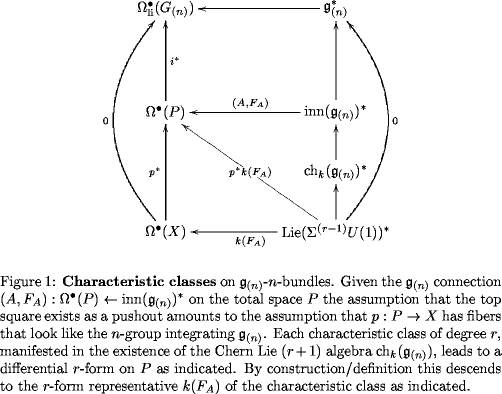
The situation we are dealing with looks like this

The point is

a) that all forms p *k(F A) coming from invariant polynomials k vanish when restricted to the fiber, and hence descend to the characteristic classes on the base

and

b) that the same is true for the coboundaries of invariant polynomials k=d inn(g (n))λ which are defined (this is the point I realized a little late) to be such that λ vanishes when restricted to the fiber.

So this means that classes of invariant polynomials descend to classes of closed r-forms on the base.

And then we get the desired statement not just for String 2-bundles, but quite generally:

for g any Lie algebra and μ k an (n+1 )-cocycle on it which is in transgression with the invariant polynomial k on g, the characteristic classes of n-bundles for the Lie n-algebra g μ k of Baez-Crans type are those of the corresponding g-bundle, modulo k.

That’s now a trivial computation.

(All these statements subject to the provision that the total space P exists as a smooth space. This is the hard technical part. As I mentioned before, I guess this needs to be circumvented with some descend constructions. But that’s not my point here. And also I need to stop working for today.)

Posted by: Urs Schreiber on September 6, 2007 9:49 PM | Permalink | Reply to this

Re: Higher Gauge Theory and Elliptic Cohomology

I wrote:

I believe I understand now what’s going on:

Lest my above ramblings remain entirely unintelligible, I have tried to write this up more cleanly in a pdf:

Lie n-Algebra Cohomology

This contains mostly the old stuff – polished(!) – and now also includes a new part (last part) which

- defines cocycles, invariant polynomials and transgression elements for arbitrary Lie n-algebras

- discusses the ring of invariant polynomials for the String Lie 2-algebra

- seems (unless I am making a mistake) to confirm exactly the thing about the classes of a String(G)-bundle being those of the underlying G-bundle modulo the second one that John Baez was talking about above.

In case you are hesitant to “leave the Café” by following the above link, here is the abstract:

Abstract: Ordinary Lie algebra cohomology of a Lie algebra g has a nice reformulation in terms of the Koszul dual differential algebra of the Lie 2-algebra of inner derivations of g. For every transgressive degree n element in g-cohomology there is a short exact sequence of Lie n-algebras. These are characterized by the fact that n-connections taking values in them come from the corresponding Chern-Simons forms and characteristic classes. A straightforward generalization of this construction yields a notion of cohomology, invariant polynomials and transgression elements for arbitrary Lie n-algebras. And in turn, each such element of degree d induces a new Lie max(n,d)-algebra. The invariant polynomials of Lie n-algebras g (n) should correspond to characteristic classes of n-bundles for Lie n-groups G (n) integrating these. While the general theory of these n-bundles is not well understood yet, we discuss that the invariant polynomials on the String Lie 2-algebra do reproduce what one expects from topological reasoning.

Posted by: Urs Schreiber on August 30, 2007 7:53 PM | Permalink | Reply to this

Re: Higher Gauge Theory and Elliptic Cohomology

I think I am making progress with understanding these characteristic classes of n-bundles in general and of String 2-bundles in particular.

I have now added a discussion of how the images of invariant polynomials on a Lie n-algebra are respected, on the nose as well as in cohomology, under morphisms of n-connections.

This crucially depends on

a) the definition of invariant polynomials of Lie n-algebras which I had given before (of course)

b) but more interestingly: on the notion of morphisms of connections of Lie n-algebras which follows from the inn-gymnastics.

My current understanding, together with a discussion of the example of the String Lie 2-bundle case, is now the very last section “Characteristic classes of n-Bundles” in

Lie n-algebra cohomology

Compare the notion of morphisms of n-connections given there with the general notion of higher morphisms of Lie n-algebras which I proposed. I indicate in a remark how all this is best understood from the point of view of tangent categories – in particular this diagram is useful to keep in mind.

Clearly, my discussion of characteristic classes of n-bundles here is not entirely complete yet. But it seems to go in the right direction.

Posted by: Urs Schreiber on September 6, 2007 2:19 PM | Permalink | Reply to this

Re: Higher Gauge Theory and Elliptic Cohomology

Do you have a catalog of such characteristic classes?
cf.
Chern classes
Pontrjagin clases
S-W classes
etc
i.e. can you compute the invariant polys?

Posted by: jim stasheff on September 6, 2007 2:37 PM | Permalink | Reply to this

Re: Higher Gauge Theory and Elliptic Cohomology

Do you have a catalog of such characteristic classes? cf. Chern classes Pontrjagin clases S-W classes etc i.e. can you compute the invariant polys?

Hm, not sure. Maybe I should have described what I actually did in other words:

The above has three ingredients:

a) the notion of g (n)-connections and their morphisms for g (n) any Lie n-algebra.

b) the notion of invariant polynomials k for any Lie n-algebra g (n)

c) an argument which shows that the image of any g (n) invariant polynomial of under a g (n)-connection is a closed differential form which is invariant under morphisms (necessarily isomorphisms) of g (n)-connections and in fact whose cohomology class is respected by these morphisms.

We still need to figure out the best way to encode the descent condition (the “Ehresmann condition”, if you wish) for these g (n)-connections (using a categorification of The second edge of the cube, probably paired with this argument), but whatever it will be like in detail, it will involve some condition involving morphisms of these n-connections. And by the above none of these should affect the cohomology classes of these classes cooked up from invariant g (n)-polynomials as above.

So, that’s why I addressed these as the “Characteristic classes” of the n-bundle. But maybe I am actually not using this term quite correctly.

Posted by: Urs Schreiber on September 6, 2007 4:06 PM | Permalink | Reply to this

Re: Higher Gauge Theory and Elliptic Cohomology

Calling them Characteristic classes is fine. It’s just that something you said sounded like: I have them! Since I don’t know any rep theory, I’d be at a loss to find them — i.e. list them all specifically that way. Compare all the different ways Milnor presents them in Das Buch.

Posted by: jim stasheff on September 6, 2007 6:29 PM | Permalink | Reply to this

Re: Higher Gauge Theory and Elliptic Cohomology

It’s just that something you said sounded like: I have them!

Ah, I see. Thanks. Right, I don’t “have them”. I cannot list them.

What I think I have is a good definition of what a characteristic class with respect to a given Lie n-algebra should be together with an argument that shows that this definition does make good sense in that the differential forms representing these classes are indeed invariant in the required sense.

But for the simplest nontrivial example of all of this I actually have these classes:

I think (as I mentioned) I have a proof that the characteristic classes of g [,]˙ are those of g modulo the second Chern class. Just as John indicated above that it should be.

As we speak, I am in the process of polishing further and adding more details to the file. I’ll send you the latest version soon.

Posted by: Urs Schreiber on September 6, 2007 7:04 PM | Permalink | Reply to this

Re: Higher Gauge Theory and Elliptic Cohomology

I am wondering if we are on the verge here of actually being able to get our hands on all these n-bundles by doing suitable pullbacks of the universal one.

Namely, it’s supposedly true that for g (n) any Lie n-algebra (even any Lie n-algebroid, but let’s not get into that for the moment), the Koszul dual qDGCA of inn(g (n)) plays the role of the differential algebra of differential forms on the total space of the universal principal G (n)-bundle.

Here I write G (n) for the Lie n-group which I imagine integrates g (n). I know that in general that integration is a tricky issue. But that’s the point here: we may not ever need to do it.

Namely, the sequence G (n)INN(G (n))ΣG (n) which would express the universal G (n)-n-bundle is supposedly represented differentially by the corresponding Koszul dual of its Lie version: ( (sg (n) *),d g (n))( (sg (n) *ssg (n) *),d inn(g (n))) (ssg (n) *).

Since, in principle, we get every G (n)-n-bundle on a space X by pulling back the former sequence along a classifying morphism Y [2 ]ΣG (n) (for YX a good covering of X and Y [2 ] the corresponding groupoid) I am thinking that we should be able to get our hands on the differential version of this.

My first, naive, idea was to say: okay, so let’s look at morphisms of free graded commutative algebras Ω (X) (ssg (n) *). These look like they should be the differential analog of the classifying maps Y [2 ]ΣG (n).

Then one could imagine pondering pushing out the second sequence above along this map.

For the simple case that the Lie n-algebra is that of the abelian Lie n-group Σ n1 U(1 ) this actually almost seems to make sense: in this case such a morphism Ω (X) (ssg (n) *) is precisely the choice of an (n+1 )-form on X, and nothing else. So, for instamce, for ordinary U(1 ), this would mean that the “classifying map is” a 2-form on X. And that’s in fact almost the right answer! (It needs to be a 2-form with integral periods.)

So maybe there is something roughly right about this, but it can’t be quite as simple.

Does anyone see what else would be the right thing to do?

One reason why the above idea sort of works for the abelian case but fails more generally is that in the abelian case the identity is an invariant polynomial. So maybe we should instead think about pushing forward along sequences built from Chern Lie n-algebras, which encode all the characteristic classes.

Here I mean something like this:

a plain Lie algebra g valued 1-form on X is a qDGCA morphism Ω (X)inn(g) *. To extract its nth class k, we precompose this simply with the canonical map inn(g) *ch k(g) *. Then the composite Ω (X)inn(g) *ch k(g) * is a Lie n-algebra valued connection, whose top level curvature form is precisely the given class of our original connection.

If we like, we can extract this even more explicitly by precomposing once more with the canonical ch k(g) *Lie(Σ nU(1 )) *. The composite Ω (X)inn(g) *ch k(g) *Lie(Σ nU(1 )) * is precisely one n-form, nothing else, and that n-form is nothing but the given class obtained from our chose connection.

So, you see, this is quite similar to having a morphism Ω (X) (ssg (n) *) as in the first naive attempt, only that it makes more invariant sense, somehow.

But now I am not sure how to contiunue from that point on.

There is something going on here which is probably important, but the meaning of which still escapes me:

it’s funny how inn(g (n)) appears crucially in all these constructions, but in fact in two different roles:

on the one hand it absorbs the curvatures of our connections, and allows them to be non-flat in the first place.

On the other hand, it plays the role of forms on the universal G (n)-bundle itself.

Somehow I feel I should somehow mix these two statements, throw in a pushout or two, cook it for a while, and get out a nice cool theory of n-bundles with connections all in terms of just qDGCAs.

I thought about this until late last night. But I still don’t see it.

Posted by: Urs Schreiber on August 31, 2007 3:44 PM | Permalink | Reply to this

Re: Higher Gauge Theory and Elliptic Cohomology

I wrote:

the meaning of which still escapes me

Maybe not anymore:

Let P be some manifold, which we want to realize as the total space of a G-bundle with connection.

Recall that, differentially, the universal G-bundle with connection “is” the middle part of the sequence ( (sg *),d g) ( (sg *ssg *),d inn(g)) ssg *,

so we should realize P as a pullback of that. In this context this means we consider a morphism ( (sg *),d g) Ω (P) A ( (sg *ssg *),d inn(g)) ssg *. This morphism A is nothing but a g-valued 1-form on P. This is going to be our Cartan connection on P.

(You see, here is where the concepts are beginning to merge: the universal G-bundle becomes, differentially, the codomain for the Cartan connection itself. If that doesn’t yet seem to make sense, read on.)

So then, we want more: we should pullback the entire sequence along our chosen map. (Which here means: push forward.)

I am glossing here over what one would naively do first: namely consider a classifying map into the bottom part ssg *. Somehow in the differential picture this is trickier when g is nonabelian, because ΣG is then no longer a 2-group, which is the reason for there being no differential on ssg *!

Anyway, so let’s concentrate on the top part of the sequence for the moment. For A to qualify as something giving P the structure of a G-bundle with connection, we at least need to demand that the pushout, Q, exists, in the world of qDGCAs: Q ( (sg *),d g) i * Ω (P) A ( (sg *ssg *),d inn(g)) ssg *. What is Q? I think it must be ( sg *,d g). But then the existence of the morphism I denoted i * means that there needs to be a restriction of the 1-form A on P such that it becomes the canonical left-invariant form on G.

But that’s nothing but the first condition on a Cartan connection on P. This says that P needs to have fibers that look like G.

Let’s look at the 2-case to see the full implication of this: consider the exact same discussion as above, but with g replaced by the weak Baez-Crans type String Lie 2-algebra g ,[,].

Then, we find that for the pushout to exist, again the fibers need to be such that they admit a g-valued 1-form which behaves like the canonical 1-form θ on G. But on top of that there is now required to be a 2-form b on these fibers with the property that db=θ,[θ,θ]. But this says that now the fibers need to look like G with the third cohomology class killed! If we assume that first and second homotpy groups already are trivial (which we do), then this means (correct me if I am wrong), that the existence of the above pushout now implies that the third homotpy group of the fibers of P also have to vanish. Hence P needs to have fibers that look like the String group!

I am oversimplyifying, since you would need to have a smooth model of the String group in order for the argument with differential forms to make direct sense. But I guess you get the point.

(I will try to spell this out more carefully when I find the time.)

Now, it would look like the most obvious thing in the world to complete the lower part of the above diagram. But this step keeps confusing me. It seems to require that the curvature of A descends from P down to base space.

The latter should be defined as the kernel of i *, I guess ( (sg *),d g) ( (sg *),d g) i * Ω (P) A ( (sg *ssg *),d inn(g)) p * Ω (X) ssg *. But then completing the last horizontal morphism would seem to imply that the curvature 2-form of A descends from P to X. But that works only for g abelian. So something is still missing here. That’s why I speculated about bringing in the Chern Lie n-algebras into this picure instead.

Posted by: Urs Schreiber on September 1, 2007 5:58 PM | Permalink | Reply to this

Re: Higher Gauge Theory and Elliptic Cohomology

Urs:
Now, it would look like the most obvious thing in the world to complete the lower part of the above diagram.
But this step keeps confusing me. It seems to require that the curvature of A descends from P down to base space.


The latter should be defined as the kernel of i *, I guess

see diagram by Urs

But then completing the last horizontal morphism would seem to imply that the curvature 2-form of A descends from P to X. But that works only for g abelian. So something is still missing here. That’s why I speculated about bringing in the Chern Lie n-algebras into this picure instead.

Here’s a bit more of the classical theory:
(Greub, Halperin, van Stone is an excellent text book for this)
For the principal bundle G –> P –> B
forms in the image of
$\Omega^*(B)$ in $\Omega^*(P)$
are called basic. They are characterized by vanishing on the canonical vector fields on P given by the G action AND being invariant under the G action on forms.

Carry this over to inn(g) = Weil algebra of g. The image of all of $\Lambda ssg^*$
obviously has the first property. Invariance is expressed homologically:
those on which $d_\inn$ vanishes.

So the diagram is completed with
$(\Lambda ssg^*)^g$.

Hopefully the ante can now raised to n=2,
but I’m confused as to how many of the ingredients should be so upgraded.

If g is now a Lie 2-algebra, then it has an internal differential whihc both $\Lambda sg^*$ and $\Lambda ssg^*$ inherit.

Posted by: jim stasheff on September 7, 2007 12:36 AM | Permalink | Reply to this

Re: Higher Gauge Theory and Elliptic Cohomology

So the diagram is completed with (Λssg *) g.

where the elements in (Λssg *) g are

those on which d inn(g) vanishes.

Ah, thanks for pointing this out. That’s good.

Hence

(Λssg *) g=inv(g) is precisely the space of invariant polynomials. So this is nicely consistent with the completion I used here

where I completed with one given invariant polynomial k, instead of with all of them.

Great, then everything comes out really nicely. I’ll try to write this up cleanly.

Maybe one more question:

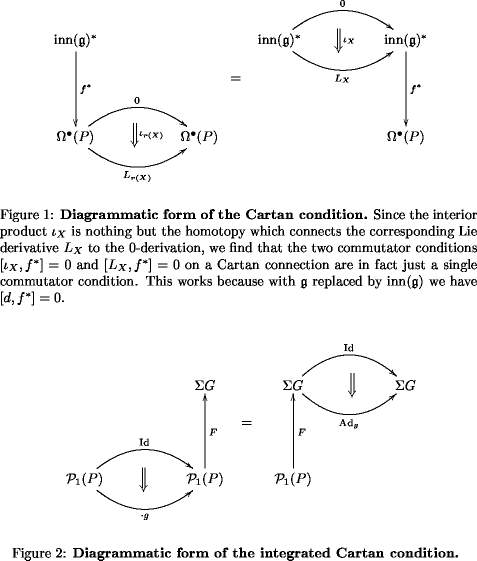
the above diagram expresses the first of the two Cartan conditions on the connection 1-form A: that it restricts to the canonical 1-form on the fibers.

I was thinking that in order to impose the second condition, that A be equivariant with respect to the g-action, still needed to be added to the above, by imposing in addition the requirement expressed by this diagram

Now I am wondering: perhaps with the right condition imposed on the first diagram, the second one is implied? Could that be true? I can’t quite see it yet. But it would seem natural that everything is already encoded in the first diagram.

Posted by: Urs Schreiber on September 7, 2007 11:32 AM | Permalink | Reply to this

Re: Higher Gauge Theory and Elliptic Cohomology

I wrote:

Ah, thanks for pointing this out. That’s good.

One more comment:

this seems to indicate that we should write

bg

for the abelian Lie n-algebra whose dual is just the algebra of invariant polynomials (bg) *:=inv(g)=ker(d inn(g)) ssg * thought of as equipped with the trivial differential.

This indeed seems to be the complete answer to what I was trying to get at above:

for X a space, we would then say that Ω (X)bg * is a classifying map, playing the role of an ordinary classifying map XBG of G bundles. Indeed, such a morphism amounts to a choices of r-forms on X, one for each characteristic class of degree r. Hence that should indeed classify a G-bundle on X, I suppose.

Then, the total space PX of that G-bundle would be characterized as a completion of

inn(g) * Ω (X) bg *

to

Ω (P) (A,F A) inn(g) * Ω (X) bg *.

Here A is a choice of connection on the total space and the commutativity of this square says that this connection must be such that it produces the character