 Posts with this logo use


July 31, 2007
Web Spamming by Academic Publishers
Posted by John Baez

A recent email from Carl Willis mentions a practice that’s been annoying me lately: a particular form of ‘web spamming’ by academic publishers, sometimes called ‘cloaking’. The publishing company gives search engine crawlers access to full-text articles — but when you try to read these articles, typically clicking on a link to a PDF file, you get a ‘doorway page’ demanding a subscription or payment.
Sometimes you’ll even be taken to a page that has nothing to do with the paper you thought you were about to see! That’s what infuriates me the most. I don’t expect free articles from these guys, but it would at least be nice to see basic bibliographical information.
Culprits include Springer, Reed Elsevier, and the Institute of Electrical and Electronic Engineers. The last one seems to have quit — but to see why they did it, check out their powerpoint presentation on this subject, courtesy of Carl Willis.
Higher Gauge Theory and Elliptic Cohomology
Posted by John Baez
After some fun in Greece, I’ve been holed up in Greenwich the last two days preparing my talk for the 2007 Abel Symposium. This is an annual get-together sponsored by the folks who put out the Abel prize, a belated attempt to create something like a Nobel prize for mathematicians.
One of the themes of this year’s symposium is “elliptic objects and quantum field theory”. So, while my true love is higher gauge theory, my talk will emphasize its relation to elliptic cohomology and related areas of math:
-
John Baez, Higher Gauge Theory and Elliptic Cohomology.
Abstract: The concept of elliptic object suggests a relation between elliptic cohomology and "higher gauge theory", a generalization of gauge theory describing the parallel transport of strings. In higher gauge theory, we categorify familiar notions from gauge theory and consider "principal 2-bundles" with a given "structure 2-group". These are a slight generalization of nonabelian gerbes. After a quick introduction to these ideas, we focus on the 2-groups associated to any compact simple Lie group . We describe how these 2-groups are built using central extensions of the loop group and how the classifying space for -2-bundles is related to the "string group" familiar in elliptic cohomology. If there is time, we shall also describe a vector 2-bundle canonically associated to any principal 2-bundle, and how this relates to the von Neumann algebra construction of Stolz and Teichner.
July 28, 2007
Algebra 1 versus Algebra 2
Posted by David Corfield
In Delphi, Colin McLarty performed some myth-busting for us. Many of you will have heard of Paul Gordan’s supposed reaction to a result of David Hilbert in the theory of invariants:
This is not Mathematics, it is Theology!
Often this is taken as one of the reactionary old guard standing in the way of the new algebra. However, Colin does a great job explaining how the true story is far more subtle.
Hilbert in 1888 said he found his proof “with the stimulating help of” this very professor Gordan.
Rather than recapping his argument, we may as wait until it appears. Here I want to know more about what happens next. In particular, I’d like to know whether Gian-Carlo Rota’s distinction between Algebra 1 and Algebra 2 holds water. He does this somewhere in English, Chapter III of Indiscrete Thoughts I believe.
Online, all I can find is in Italian. Here Rota picks out key figures in each:
Algebra 1: algebraic geometry and algebraic number theory, represented by Kronecker, Hilbert, Weil, …
Algebra 2: ‘Combinatoria Algebrica’ - algebraic combinatorics, represented by Boole, Capelli, Young, Gordan, Hall, Birkhoff, …
Does this chime with anyone?
July 27, 2007
Arrow-Theoretic Differential Theory
Posted by Urs Schreiber
Using the concept of tangent categories (derived from that of supercategories) I had indicated how to refine my previous discussion of -curvature. Here are more details.
Arrow-theoretic differential theory
Abstract: We propose and study a notion of a tangent -bundle to an arbitrary -category. Despite its simplicity, this notion turns out to be useful, as we shall indicate.
1 Introduction … 1
2 Main results … 2
2.1 Tangent -bundle … 3
2.2 Vector fields and Lie derivatives … 4
2.3 Inner automorphism n-groups … 4
2.4 Curvature and Bianchi Identity for functors … 5
2.4.1 General functors … 5
2.4.2 Parallel transport functors and differential forms … 6
2.5 Sections and covariant derivatives … 6
3 Differential arrow theory … 8
3.1 Tangent categories … 8
3.2 Differentials of functors … 11
4 Parallel transport functors and their curvature … 12
4.1 Principal parallel transport … 12
4.1.1 Trivial G-bundles with connection … 12
Introduction
Various applications of (-)categories in quantum field theory indicate that (-)categories play an important role over and above their more traditional role as mere organizing principles of the mathematical structures used to describe the world: they appear instead themselves as the very models of this world.
For instance there are various indications that thinking of configuration spaces and of physical processes taking place in these as categories, with the configurations forming the objects and the processes the morphisms, is a step of considerably deeper relevance than the tautological construction it arises from seems to indicate.
While evidence for this is visible for the attentive eye in various modern mathematical approaches to aspects of quantum field theory – for instance [FreedQuinn], [Freed] but also [Willerton] – the development of this observation is clearly impeded by the lack of understanding of its formal underpinnings.
If we ought to think of configuration spaces as categories, what does that imply for our formulation of physics involving these configuration spaces? In particular: how do the morphisms, which we introduce when refining traditional spaces from 0-categories to 1-categories, relate to existing concepts that must surely secretly encode the information contained in these morphisms. Like tangent spaces for instance.
Possibly one of the first places where this question was at all realized as such is [Isham]. That this is a piece of work which certainly most physicists currently won’t recognize as physics, while mathematicians might not recognize it as interesting mathematics, we take as further indication for the need of a refined formal analysis of the problem at hand.
Several of the things we shall have to say here may be regarded as an attempt to strictly think the approach indicated in Isham’s work to its end. Our particular goal here is to indicate how we may indeed naturally, generally and usefully relate morphisms in a category to the wider concept of tangency.
For instance his “arrow fields” on categories we identify as categorical tangents to identity functors on categories and find their relation to ordinary vector fields as well as to Lie derivatives, thereby, by the nature of arrow-theory, generalizing the latter concepts to essentially arbitrary categorical contexts.
While there is, for reasons mentioned, no real body of literature yet, which we could point the reader to, on the concrete question we are aiming at, the reader can find information on the way of thinking involved here most notably in the work of John Baez, the spiritus rector of the idea of extracting the appearance of -categories as the right model for the notion of state and process in physics. In particular the text [BaezLauda] as well as the lecture notes [Baez] should serve as good background reading.
The work that our particular developments here have grown out is described in [S1, S2]. Our discussion of the Bianchi identity for -functors should be compared with the similar but different constructions in the world of -fold categories given in [Kock].
July 26, 2007
Homotopy Theory and Higher Categories in Barcelona
Posted by John Baez
In Barcelona there will be a year-long program on homotopy theory and higher categories:
- Homotopy Theory and Higher Categories, at the Centre de Recerca Matemàtica, Barcelona, Catalonia, Spain, 2007-2008 academic year. Organized by Carles Casacuberta (Barcelona), André Joyal (Montreal), Joachim Kock (Barcelona), Amnon Neeman (Canberra) and Frank Neumann (Leicester).
July 25, 2007
Delphic Inspiration
Posted by David Corfield
I’ve returned from the sun of Delphi to the sogginess of England. John has already put up some pictures and a description of the event – Mathematics and Narrative – in his diary. I think the very best part of the meeting was the decision to have each participant be interviewed by another. The suggested length of two to three hours for this process seemed daunting, but it allowed a kind of conversation I’ve never known before. And to have two and a half hours of Barry Mazur’s undivided attention!
When it came to my turn to be interviewed, by my philosopher friend Colin McLarty, I began to see that Alasdair MacIntyre’s notion of a rational tradition of enquiry could be made to do some real work. We get rather used in the humanities to fairly loose schematic descriptions of phenomena, unlike in the hard sciences where predicted entities (such as categorified constructions) had better be found if we are not to lose faith. From the interview, we got the sense that this framework could point us easily to the difficulties other approaches face, and then explain them.
Perhaps we’ll see the Delphi meeting as one of those defining moments in getting a non-relativist practice-oriented philosophy of mathematics off the ground. Elsewhere, I interviewed a third member of this movement, Brendan Larvor, for the fourth edition of The Reasoner.
Question About Representations of Finite Groups
Posted by John Baez
Here’s the first of some questions that have been bugging me. Maybe you can help!
I want to know when we can define the representations of a finite group using not the full force of the complex numbers, but only some subfield, like or . If I knew the answer to this question, it might be important for the groupoidification program, where we’re trying to replace complex vector spaces by groupoids whenever possible.
Suppose is some subfield of the complex numbers. In what follows, ‘representation’ will mean representation on a finite-dimensional complex vector space. Suppose is some group with a representation . Let’s say is defined over if we can find some basis of our vector space such that the matrices corresponding to the linear transformations all have entries lying in .
Question 1. Is there a smallest subfield such that every representation of every finite group is definable over ? If so, what is it?
It’s not hard to see that:
- Every representation of every finite group is definable over when is the field of algebraic numbers.
- Not every representation of every finite group is definable over when . There’s an easy trick to see which ones are.
- Every representation of the symmetric group is definable over when .
- Every representation of the cyclic group is definable over when is the cyclotomic field generated by taking and throwing in a primitive th root of unity.
But what I really want to know is this:
Question 2. Is every representation of every finite group definable over when is the field generated by taking and throwing in all roots of unity? If not, what’s the simplest counterexample?
July 23, 2007
Physical Systems as Topoi, Part III
Posted by Urs Schreiber
Yesterday night I had to interrupt my transcript of Andreas Döring’s talk. Here is the continuation.
July 22, 2007
Physical Systems as Topoi, Part II
Posted by Urs Schreiber
The continuation of my transcript of Andreas Döring’s talk.
Physical Systems as Topoi, Part I
Posted by Urs Schreiber
Here at the -Café, we already had pretty detailed discussions (see A Topos Foundation for Theories of Physics and Topos Theory in the New Scientist) of Andreas Döring and Chris Isham’s recent work
A. Döring, C. Isham
A Topos Foundation for Theories of Physics
quant-ph/0703060.
I am particularly grateful to Squark, for walking us through many of the essential details. For a quick summary, see this comment.
Now today, at Recent Developments in QFT in Leipzig, I was lucky enough to hear Andreas Döring himself give a talk on this work.
Here I’ll reproduce my transcript of what he said.
Making AdS/CFT Precise
Posted by Urs Schreiber
The last session of Recent Developments in QFT in Leipzig was general discussion, which happened to be quite interesting for various reasons.
Deformation Quantization of Surjective Submersions
Posted by Urs Schreiber
I am in Leipzig, attending the last day of Recent Developments in QFT in Leipzig.
First talk this morning was by Stefan Waldman on Deformation quantization of surjective submersions.
What he described is this:
Suppse over some manifold we have a surjective submersion In applications we will want to restrict to the case that is some principal -bundle. But much of the following is independent of that restriction.
Next, suppose that we want to consider (noncommutative) deformations of the algebra of functions on . This is a popular desideratum in many approaches of quantum field theory that try to go beyond the standard model and classical gravity.
Stefan Waldman and his collaborators ask: given such a deformation of base space, what are suitably compatible deformations of the covering space over ?
The motivating idea is this:
There is that wide-spread idea in quantum field theory that theories which go beyond the energy scale currently observable by experimental means will involve noncommutative deformations of the algebra of functions on spacetime. But since physical fields are usually not just functions on spacetime, but either sections of some vector bundles, or connections on these, the question arises in which sense these bundles then have to be deformed, too.
Therefore Waldman is looking for deformations of the algebra of functions on the total space of the bundle which are, in some sense to be determined, compatible with the deformation downstairs.
The first idea is to find deformations such that the pullback extends to an algebra homomorphism of the deformed algebras But they show that in many physically interesting cases, like the Hopf fibration which in physics corresponds to the “Dirac monopole”, there are obstructions for such an extension to exist at all. Hence they reject this idea.
The next idea is to realize just as a bimodule for . But this, too, turns out to be too restrictive.
Finally, they settle for requiring that induces just a one-sided -module structure on . This turns out to be a tractable problem with interesting solutions.
They show that the module structure of , when computed order by order in the deformation parameter , is given by terms in Hochschild cohomology. Stefan Waldman emphasized the nice coincidence that these are actually explicitly solvable in the present situation.
So, in the end, they find the following nice result:
there is, up to equivalence, a unique deformation of the algebra of functions on the total space of the surjective submersion such that it becomes a right module for the given deformed algebra of functions on base space and extends the pullback .
Moreover, if the surjective submersion happened to be a principal -bundle, then, there is, up to equivalence, a unique -equivariant such deformation.
Waldman and collaborators want to understand connections on these deformed bundles eventually, but they are not there yet. One application of the existing technology is this:
a section of a vector bundle associated to the principal bundle can be understood as a -equivariant function on with values in the representation space of the rep of inducing the association. This construction can be immediately fed into the above deformation procedure and hence yields a notion of sections of noncommutatively deformed vector bundles over deformed base spaces.
July 21, 2007
Tangent Categories
Posted by Urs Schreiber
I am back from vacation. While being away, I had two seemingly unrelated things in mind:
- the desire to better understand the true nature of inner automorphism -categories and hence -curvature.
- the desire to realize the concepts of tangency and supergeometry in a purely and genuinely arrow-theoretic and -categorical way.
Then, while stunned from the Spanish sun, it occured to me how things might fit together. At nightfall I managed to rise and escape my friends to an internet Café, from where I had sent this postcard from my dreams, reproduced below.
Today I wanted to write it all up cleanly. But I didn’t get as far as I wanted to. And now I have to run once again, to get my train to Leipzig, where I want to attend at least one day of Recent Developments in QFT in Leipzig.
But never shy of sharing unfinished thoughts, I can provide at least these five pages:
Abstract: An arrow-theoretic formulation of tangency is proposed. This gives rise to a notion of tangent -bundle for any -groupoid. Properties and examples are discussed.
The notion of tangent category and tangent bundle given in the following is just a simple variation of the familiar concept of comma categories, albeit generalized to -categories. While very simple, it still seems to me that there is something interesting going on here. I present the concept in a slightly redundant fashion which is supposed to suggest to the inclined reader the more general picture which seems to be at work in the background. For more hints, see Supercategories.
July 18, 2007
Astronomical Paris
Posted by John Baez
Today is my last day in Paris. With any luck, I’ll meet David Corfield in Delphi tomorrow.
As a kind of followup to my post on mathematical Paris, here is a tour of the Paris Observatory.
July 16, 2007
Mathematical Imperatives
Posted by David Corfield
I like the way Yuri Manin generally throws a little ‘philosophy’ into his papers. In his Generalized operads and their inner cohomomorphisms with D. Borisov, they write:
One can and must approach operadic constructions from various directions and with various stocks of analogies. (p. 4)
That ‘must’ is interesting to think about. You might look to deontic logic for help, and be relieved that Kant’s Law (‘must implies can’) is satisified. But perhaps the more interesting question is ‘Must, or what will happen?’
Perhaps, something like: you’ll fail to understand operadic constructions fully, which would be failing in your duty as a mathematician.
July 14, 2007
George Mackey
Posted by David Corfield
The latest edition of the Notices of the American Mathematical Society is out, and it contains reminiscences about the life and work of George Mackey.
For a long time I’ve been attracted by big mathematical visions. While I was PhD student I’d hunt out the informal writings of people like Atiyah and MacLane. But I think my favourite author at the time was Mackey, in particular the story of maths he had told in ‘The scope and history of commutative and noncommutative harmonic analysis’.
As Caroline Series puts it
I do not know any other writer with quite his gift of sifting out the essentials and exposing the bare bones of a subject. There is no doubt that his unique ability to cut through the technicalities and draw diverse strands together into one grand story has been a hugely wide and enduring influence. (p. 21)
July 13, 2007
This Week’s Finds in Mathematical Physics (Week 254)
Posted by John Baez
In week254, learn about Witten’s new paper on 3d quantum gravity and the Monster group, mysterious relations between exceptional Lie superalgebras and the Standard Model of particle physics…
… and continue reading the Tale of Groupoidification.
Breaking Out of the Box
Posted by David Corfield
While the Café’s gone a little quiet of late – and with two of its owners tripping off to Delphi soon while the other’s still on holiday, things can only get quieter – there are some interesting things happening abroad. In fact, walking in this morning, I was thinking up something to say about a vague sense I had from reading about canopolises, but when I reached the office and tuned into the blogosphere, there’s Noah Snyder clearly articulating the thought I’d had that things could be taken further.
The larger question is why did we ever restrict ourselves to ends of boxes when we could be letting the string ends of our -categories wander about on the surfaces of spheres?
July 9, 2007
Return of the Euler Characteristic of a Category
Posted by David Corfield
Tom Leinster has a follow up to The Euler characteristic of a category, which sparked a lively conversation here last October. The new one goes by the title The Euler characteristic of a category as the sum of a divergent series.
Abstract:
The Euler characteristic of a cell complex is often thought of as the alternating sum of the number of cells of each dimension. When the complex is infinite, the sum diverges. Nevertheless, it can sometimes be evaluated; in particular, this is possible when the complex is the nerve of a finite category. This provides an alternative definition of the Euler characteristic of a category, which is in many cases equivalent to the original one
July 7, 2007
Derek Wise on Cartan Geometry and MacDowell–Mansouri Gravity
Posted by John Baez
I’m mainly here in Paris to talk about categories, logic and games with Paul-André Melliès of the Preuves, Programmes et Systèmes group at Université Paris 7. But, I was invited by Marc Lachièze-Rey of the AstroParticule et Cosmologie group to give a talk on physics.
So, I took this as an excuse to speak about the work of my student Derek Wise.
Derek just finished his thesis in June. This fall he’s going to U. C. Davis. He’s been talking to me about Cartan geometry and MacDowell–Mansouri gravity for several years now — but I’ve been keeping most of it secret, so nobody would scoop his thesis. It’s a great pleasure to finally say more about it!
Abstract and transparencies of the talk follow…
Mathematical Paris
Posted by John Baez
I’m in Paris from July 1st to 19th. Just for fun, I’ve started taking pictures of streets named after mathematicians. Can you help me find more of these streets?
July 6, 2007
Kernels in Machine Learning III
Posted by David Corfield
The use of kernel methods in machine learning often goes by the name nonparametric statistics. Sometimes this gets taken as though it’s the opposite of finite parametric statistics, but that’s not quite right. A typical piece of parametric statistics has a model like the two-parameter family of normal distributions, and the parameters of this model are then estimated from a sample.
What happens in the case of kernel methods in machine learning is that a model from a possibly infinite-dimensional family is specified by a function on the (finite) collection of training points. In other words you are necessarily restricted to a subfamily of models of dimension the size of the training set. So, in contrast to the usual parametric case, you are dealing with a data-dependent finite dimensional subfamily of models.
July 5, 2007
Multiplicative Structure of Transgressed n-Bundles
Posted by Urs Schreiber
Remember the drama of the charged -particle?
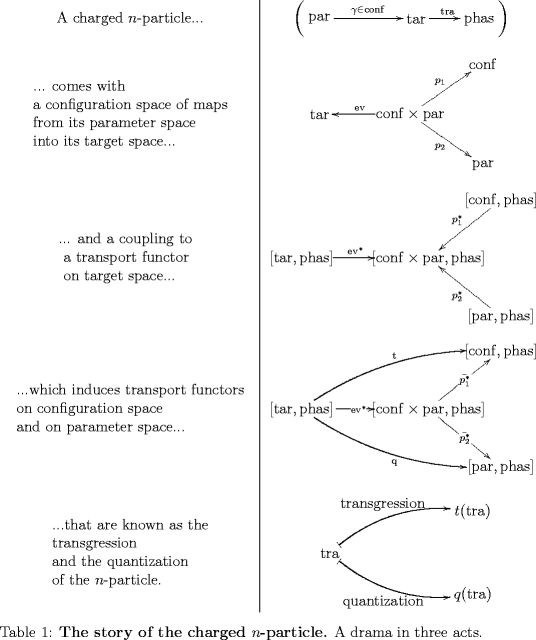
An -particle of shape propagating on target space and charged undern an -bundle with connection given by the transport functor admits two natural operations: we may either quantize it. That yields the extended -dimensional QFT of the -particle, computing the -space of its quantum states .
But we may also, instead, transgress the -bundle background field on target space to something on the particle’s configuration space.
For instance, a closed string (a 2-particle) charged under a Kalb-Ramond gerbe (a 2-bundle) gives rise to a line bundle (a 1-bundle) on loop space. I once described this in the functorial language used here in this comment.
But, and that’s the point of this entry here, these transgressed -bundles have certain special properties: they are multiplicative with respect to the obvious composition of elements of the configuration space of the -particle.
I have neither time nor energy at the moment to give a comprehensive description of that. What I do want to share is this:
With Bruce Bartlett I was talking, by private email, about the right abstract arrow-theoretic formulation to conceive multiplicative -bundles with connection obtained from transgression on configuration spaces. It turns out that a -transport functor is multiplicative if it is monoidal with respect to a certain natural variation of the concept of monoidal structure which is applicable for fibered categories.
In the file
The monoidal structure of the loop category
I spell out some key ingredients of how to conceive the situation here for the simple special case that we start with a 1-functor and transgress it to a “loop space”.
There is nothing particularly deep in there, but it did took us a little bit of thinking to extract the right structure here, simple as it may be. So I thought we might just as well share this with the rest of the world.
And, by the way, I will be on vacation in southern Spain until July 20.
July 4, 2007
Supercategories
Posted by Urs Schreiber
Motivated by general questions in supersymmetric QFT, I would like to better understand some of the “arrow-theory” behind supersymmetry, finding a formulation which gives a systematic way to internalize the concept into various contexts. For instance, people have a pretty good purely arrow-theoretic understanding of finite-group QFT, such as Dijkgraaf-Witten theory. Can we understand how to superize this systematically, in a context where many of the standard tools one finds in the literature are simply not applicable?
In order to both motivate and further introduce the problem, I might, in a followup entry, start looking into the following
Exercise (The Willertonesque super 2-particle). Simon Willerton has demonstrated (see The Baby Version of Freed-Hopkins-Teleman) that the “quantum theory of the 2-particle propagating on a finite group” has a beautiful arrow-theoretic formulation:
Take the parameter space of the 2-particle to be the fundamental groupoid of the circle Take its target space to be a finite group Then configuration space is the groupoid which plays the role of the loop group of the finite group . The fact that this 2-particle is charged gives rise to a 2-vector bundle on this configuration space, and quantum states of the 2-particle are sections of this. In the simplest case (see the above entry for the more general case), this simply means that a state here is a representation of the configuration space groupoid on vector spaces.
There is more structure here, but for the moment concentrate on this basic data. The point of this is that everything is purely combinatorial, well defined, and exhibits just the bare structure of the QFT here, stripped of all distracting technicalities.
The exercise is then: do the analogous discussion for the super 2-particle. Figure out what the super-parameter space of the super 2-particle in the above sense is, what its super-configuration space supergroupoid is and what its super-representations on supervector space are like.
Clearly the first step to make any progress at all here is to get a reasonable good understanding what supersymmetry really is, such as to apply it to this situation. So, this entry here is just about this question: What is the arrow theory of supersymmetry?
As an attempt to approach this exercise, I’ll introduce the concept of a supercategory, which is supposed to be to that of a supergroup like categories are to groups. I feel that this concept helps extracting some of essence of what is going on.
It turns out that this is closely related to another structure which has appeared in 2-dimensional QFT, that of G-equivariant categories.
It’s an exercise. I can’t be sure that I am on the right track. But I would like to share the following, as I proceed.
The Inner Automorphism 3-Group of a Strict 2-Group
Posted by Urs Schreiber
David Roberts and I would like to share the following text:
D. Roberts, U.S.
The inner automorphism 3-group of a strict 2-group
arXiv:0708.1741
Abstract
Any group gives rise to its 2-group of inner automorphisms, . The nerve of this is the universal -bundle. Similarly, for every 2-group there is a 3-group of inner automorphisms. We construct this for any strict 2-group, discuss how it can be understood as arising from the mapping cone of the identity on and show that it fits into a short exact sequence of strict 2-groupoids. We close by indicating how this makes the universal -2-bundle.