 Posts with this logo use


March 31, 2007
Some Notes on Local QFT
Posted by Urs Schreiber

I have just returned from visiting my brother in Berlin. On the train I did some reading and thinking related to fittting algebraic quantum field theory into the general picture™. Here are a couple of random notes.
By the way, we went to the zoo, but Knut was not available. Probably preparing with his manager for the time after his cuteness career. Turns out, though, that there are, for instance, little warthog puppies. Not quite as cute, but lots of fun…
March 29, 2007
This Week’s Finds in Mathematical Physics (Week 248)
Posted by John Baez
In week248 of This Week’s Finds, see movies of coronal mass ejections, auroras, and tornados on the Sun!

Then, continue reading the Tale of Groupoidification — in which we see how spans of groupoids arise naturally in geometry.
March 28, 2007
Relativity on the World-Wide Web
Posted by John Baez
Chris Hillman is back! — with a new, improved guide to online resources on general relativity:
- Chris Hillman, Relativity on the World-Wide Web.
Popular science sites, web tutorials, undergraduate and graduate-level course material online, and a detailed survey of books — everything you need to learn general relativity, no matter where you’re starting!
There are even lots of nice visualization websites, packed with eye candy like this…
March 24, 2007
Philosophising in Brussels
Posted by David Corfield
March 23, 2007
This Week’s Finds in Mathematical Physics (Week 247)
Posted by John Baez
In week247 of This Week’s Finds, read about symmetry — from the appearance of quasicrystals in medieval Islamic tile patterns:

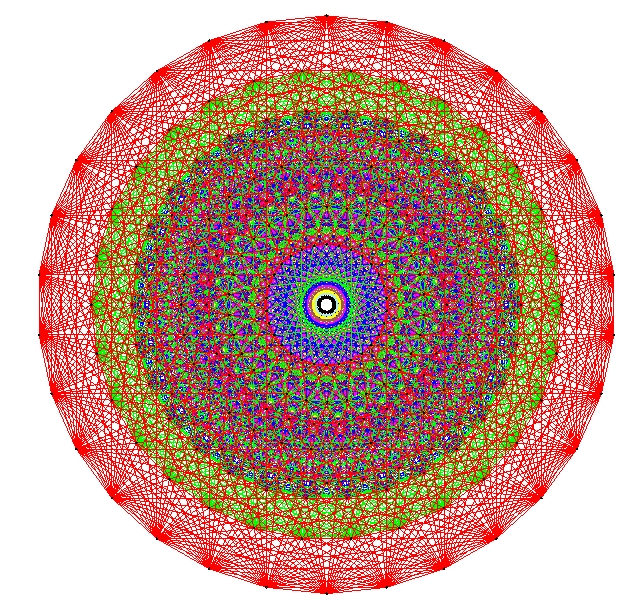
to the news about E8:
to Tale of Groupoidification.
History of Understanding Bundles with Connection using Parallel Transport around Loops
Posted by Urs Schreiber
In the process of finishing a paper, I was today busy collecting some background history literature on the development of the idea that a principal -bundle with connection may equivalently be encoded in its parallel transport around based loops.
March 22, 2007
Branes, Bi-Branes, 2-Vectors, 2-Linear Maps
Posted by Urs Schreiber
The open charged 2-particle looks like and its quantization, , assigns to it a morphism of its 2-vector space of 2-states each of which is a generalized element
When the 2-particle is charged under a line 2-bundle (a line bundle gerbe) the 2-vectors and are Chan-Paton bundles on D-branes, also known as modules for that gerbe.
The space of states is acted on 2-linearly by pull-push through spans which may encode operation like time evolution or gauge transformations like T-duality.
In a chosen 2-basis for , which is an algebra, 2-states appear as modules and 2-linear maps appear as bimodules.
The former fact harmonizes with the term “gerbe module” used for D-branes. In that sense, these bimodules could be addressed as bi-branes.
This is the language now chosen in
Fuchs, Schweigert, Waldorf
Bi-branes: Target Space Geometry for World Sheet topological Defects
Bi-branes: Target Space Geometry for World Sheet topological Defects.
March 21, 2007
Recent Developments in QFT in Leipzig
Posted by Urs Schreiber
The Max Planck Institute for Mathematics in the Sciences in Leipzig hosts a conference
Recent Developments in Quantum Field Theory
July 20 - 22, 2007
March 20, 2007
Generalising Hopf Algebras
Posted by David Corfield
To prepare for the appearance of categorified quantum groups it might be worth taking a look at Gizem Karaali’s On Hopf Algebras and Their Generalizations, in which she describes Hopf algebras and five attempts to generalise them. Much hangs on their representation categories.
Hopfish algebras are briefly touched on. As I noted in the Oct 21 entry of my old blog, according to Alan Weinstein and colleagues,
We call our new objects hopfish algebras, the suffix “oid” and prefixes like “quasi” and “pseudo” having already been appropriated for other uses. Also, our term retains a hint of the Poisson geometry which inspired some of our work.
March 19, 2007
QFT of Charged n-Particle: The Canonical 1-Particle
Posted by Urs Schreiber
A category of histories for the 1-particle, whose Leinster measure reproduces (a discretized approximation of the Euclidean version of) the path integral measure for the charged 1-particle on the real line.
News about E8
Posted by John Baez
The exceptional Lie group E8 is a marvelous 248-dimensional monster, with mysterious connections to the octonions and string theory. Here’s a nice webpage about a new calculation involving :
- American Institute of Mathematics, Mathematicians map E8.
As part of a project called the Atlas of Lie Groups and Representations, a team of mathematicians led by Jeffrey Adams have computed the Kazhdan–Lusztig–Vogan polynomials for .
You may have heard some hype about this, because it’s a really big calculation, and the American Institute of Mathematics has coaxed a lot of science reporters to write about it — in part by comparing it to the human genome project.
To see what was really done, try these:
- David Vogan, Narrative of the project to compute Kazhdan–Lusztig polynomials for E8.
- Jeffrey Adams, Technical details.
March 16, 2007
Quantum Logic, Topology and Categories at Oxford
Posted by John Baez
Café regulars tend to enjoy the analogies between computation, logic, topology, and quantum physics, since -categories are a great way to make these analogies precise. There will be a conference touching on these topics in Oxford:
- Algebraic and Topological Methods in Non-Classical Logics III, Saint Anne’s College, University of Oxford, August 5-9, 2007.
It has a number of satellite workshops, including one on Categorical Quantum Logic, August 10-12 at the Oxford University Computing Laboratory, organized by Bob Coecke. I hope to attend that.
Poisson-Sigma Models, Lie Algebroids, Deformations and Higher Analogues in Vienna
Posted by Urs Schreiber
This summer the Erwin-Schrödinger Institute in Vienna hosts a program
Poisson Sigma Models, Lie Algebroids, Deformations and Higher Analogues
Organizers: H. Bursztyn, H. Grosse and T. Strobl
August 1 to September 30, 2007
There seems to be no web page with further details yet.
The list of topics in the title are related to the stuff I was blogging about almost two years ago on the String Coffee Table:
PSM and Algebroids, Part I
PSM and Algebroids, Part II
PSM and Algebroids, Part III
PSM and Algebroids, Part IV
PSM and Algebroids, Part V.
I will spend a period of two weeks in the time Aug 1 to Sept 30 in Vienna, still having to decide which two weeks exactly. If any other -Café-reader will be there, too, we could maybe coordinate our visits. Just drop me an email, if so.
March 15, 2007
Classical vs Quantum Computation (Week 18)
Posted by John Baez
Today we had our last class on Classical vs Quantum Computation for this quarter:
-
Week 18 (Mar. 15) -
2-categories from typed λ-calculi, continued.
The Church-Rosser theorem. Surface diagrams showing
the process of computation. β-reduction as a fold
catastrophe. Thom’s ideas on catastrophe theory.
Challenge: draw the surface diagram for η-reduction.
Which catastrophe does it correspond to?
Blog entry.
Supplementary reading:
- Lucien Dujardin, Catastrophe teacher: an introduction for experimentalists.
- Barnaby P. Hilken, Towards a proof theory of rewriting: the simply-typed 2λ-calculus, Theor. Comp. Sci. 170 (1996), 407–444.
- R. A. G. Seely, Weak adjointness in proof theory in Proc. Durham Conf. on Applications of Sheaves, Springer Lecture Notes in Mathematics 753, Springer, Berlin, 1979, pp. 697–701.
- R. A. G. Seely, Modeling computations: a 2-categorical framework, in Proc. Symposium on Logic in Computer Science 1987, Computer Society of the IEEE, pp. 65–71.
- C. Barry Jay and Neil Ghani, The virtues of eta-expansion, J. Functional Programming 1 (1993), 1–19.
Last week’s notes are here; next week’s notes are here.
Star-Structures and Daggers
Posted by Urs Schreiber
A question by Bruce Bartlett:
Hi guys,
I’ve got a question about duality for 2-categories. John Baez and Laurel Langford defined what a “monoidal 2-category with duals” was in HDA IV. The basic concept is easy enough to understand. A monoidal 2-category with duals is a 2-category with duals on all levels : duals for objects, morphisms and 2-morphisms.
Thus every 2-morphism has a dual , every morphism has a dual and every object has a dual . That’s the basic picture.
For our purposes here, we can ignore the tensor product and the duals for objects side of things, so don’t worry about that.
Since this is a long post, for the experts I’ll state my question right up. Can anyone help me understand the equation
.
Manin on Mathematics
Posted by David Corfield
On the ArXiv today, Yuri Manin has one of those wide-ranging overviews of the life of mathematics: Mathematical knowledge: internal, social and cultural aspects. One comment -
When Poincaré said that there are no solved problems, there are only problems which are more or less solved, he was implying that any question formulated in a yes/no fashion is an expression of narrow-mindedness.
- put me in mind of a wonderful tirade Jim Dolan once launched on a view that would limit itself to truth values.
Manin’s article meanders over an enormous area. Café visitors may prefer his earlier Georg Cantor and his heritage where we hear (page 8) about n-categories as the new emerging ‘foundations’, in his sense of the term:
the historically variable conglomerate of rules and principles used to organize the already existing and always being created anew body of mathematical knowledge of the relevant epoch. (p. 6)
March 14, 2007
Differentiating Lie Groupoids to Lie Algebroids
Posted by Urs Schreiber
The concept of a groupoid is a rather natural one. As is that of a Lie groupoid.
Every Lie groupoid may be differentiated to yield a Lie algebroid. However, maybe somewhat surprisingly, the standard definition of a Lie algebroid has an appearence which is nowhere close to the simple elegance of the definition of a Lie groupoid.
While one may tend to accept this as a sad fact of life, it becomes increasingly annoying as one tries to categorify these concepts: passing from (Lie) groupoids to (Lie) 2-groupoids is, again, the most natural thing in the world. But the analogous step on the Lie algebroid side – which surely ought to exist – is, when using the standard definition of a Lie algebroid, quite non-obvious.
In fact, to the best of my knowledge, no direct definition of Lie 2-algebroid has ever appeared.
(What does exists is an indirect definition, using a detour through Baez-Crans Lie-2-algebras, their relation to -algebras, the relation of those to quasi-free differential algebras and finally their known relation to Lie 1-algebroids.)
I would like to try to improve on this situation by re-formulating the definition of the Lie-algebroid associated to any Lie groupoid using only canonical and natural ingredients.
In order to accomplish this, I invoke the point of view that
every Lie groupoid, , is canonically a -equivariant principal -bundle over its space of objects.
While possibly still sounding a little intricate, this is a very natural point of view, since it is, as I shall make explicit, nothing but the “integrated Yoneda embedding” of the Lie groupoid, which gives rise to the functor that sends objects to the target fibers over them and morphisms to the postcomposition with these:
The following is taken from Differentiating Lie Groupoids, which is slightly more detailed.
Quantization and Cohomology (Week 18)
Posted by John Baez
Today was the last class on Quantization and Cohomology for the winter quarter! We wrapped up with a summary of what we’d done this quarter, and a sketch of the big picture:
-
Week 18 (Mar. 13) -
The big picture. Building a Hilbert space from
a finite category C equipped with an "amplitude" functor
A: C → U(1). Example: discretized version of the free particle
on the line. Generalizing from particles to strings by categorifying everything in sight.
Building a 2-Hilbert space from a finite 2-category C
equipped with a 2-functor A: C → U(1)Tor, where
U(1)Tor is the 2-group of U(1)-torsors.
Supplementary reading:
Last week’s notes are here; next week’s notes are here.
March 10, 2007
Snowglobe Models
Posted by John Baez
Last week in my course on Classical vs Quantum Computation, James Dolan said a bit about funny nonstandard models of typed λ-theories — like the typed λ-theory for high school calculus. He calls these ‘snowglobe models’, because they live ‘inside’ the usual world of sets — but in their own self-contained miniature universe, like a snowglobe:

I’d like to talk about these a bit before I forget!
March 9, 2007
We’re Under Attack!
Posted by John Baez
Everybody listen up:
The n-Category Café is under attack by a trackback spambot. 
So, if you see an error message sort of like this:
Internal Server Error
The server encountered an internal error or misconfiguration and was unable to complete your request.
don’t assume your comment failed to go through! It probably did go through. Check before posting it over and over.
Gurski on Tricategories
Posted by John Baez
Nick Gurski’s thesis is now available! If your work takes you beyond weak 2-categories and into the land of weak 3-categories, you’ll need to read this:
- Nick Gurski, An Algebraic Theory of Tricategories.
Classical vs Quantum Computation (Week 17)
Posted by John Baez
Yay! In this week’s course on Classical vs Quantum Computation, we finally reached the promised land: surface diagrams — closely resembling string worldsheets! — illustrating ‘processes of computation’:
-
Week 17 (Mar. 8) - 2-categories from typed λ-calculi. For each type, a category of terms of that type, freely generated by rewrite rules. Example: high-school calculus. Confluence and termination. Surface diagrams showing the process of computation.
Supplementary reading:
- Joachim Lambek and Phil Scott, Introduction to Higher-Order Categorical Logic, Cambridge U. Press, 1988. Part 1, Sections 12-14: the decision problem for equality; the Church-Rosser property for bounded terms; all terms are bounded.
Last week’s notes are here; next week’s notes are here.
March 8, 2007
Canonical Measures on Configuration Spaces
Posted by Urs Schreiber
Quantum theory crucially involves - and maybe is all about - subtle summations over all “histories” – or all “configurations” – of a physical system: the path integral.
The spaces of all these histories, or these configurations, usually carry a natural category structure on them:
Distinct but physically indistinguishable configurations are related by isomorphisms addressed as gauge transformations.
Even though the categorical (or groupoid) nature of configuration spaces is often not made explicit, dealing with the path integral in the presence of such gauge isomorphisms is a topic that occupies physicists a lot, as is evidenced by the large number of surname initials that go into the names of the theories handling these: BRST, FV, BV, BFV-BRST.
The entire kinematics and dynamics of quantum theory can nicely be conceived in terms of natural push-forward or colimit operations involving the category of configurations – an observation apparently going back to Dan Freed.
Or almost. Curiously, it appears as if the highest dimensional level of a quantum theory always requires a non-canonical choice: a measure on the space of histories.
While on the one hand this measure seems to stand out from the rest of the structure in its non-canonicalness, it is at the same time the source of much of the subtlety – and the richness – of quantum theory. Not the least, the lack of a rigorous handle on this measure, in general, is what kept and keeps large parts of physics from being accessible, and being accessed, by mathematically acceptable methods.
One may try to accept this as a sad fact of life – or one might take it as a hint for a hidden structure that still needs to be properly identified.
This post here is for those daring -Café readers who are prepared to not shy away from attempting to chase and hunt down natural abstract structures that might possibly, and secretly, govern our current theories of this world. Or that might not.
I’ll try to summarize and wrap up some of the things that we talked about in the long discussion going on in Isham on Arrow Fields. It’s not that I think this discussion has reached a saturation point where everything interesting has been mentioned and just needs to be archived. Quite the opposite. I expect that there might be some really interesting aspects lurking right around the corner. But I feel that it would be helpful to draw a coherent picture of what we were discussing so far.
March 7, 2007
Quantization and Cohomology (Week 17)
Posted by John Baez
This week in our course on Quantization and Cohomology we sketched an avenue of attack for getting a Hilbert space and an operator algebra from a category equipped with a functor We think of the objects of as ‘configurations’ and the morphisms as ‘processes’ or ‘paths’; the functor assigns a real number to each morphism called its ‘action’. There are a lot of technical issues involved in getting a Hilbert space from this data, but the basic idea is simple: use path integrals!
- Week 17 (Mar. 6) - Hilbert spaces and operator algebras from categories. Under what conditions can we obtain a Hilbert space from a category equipped with an "action" functor ? The importance of time reversal: groupoids versus ∗-categories (also known as †-categories). The ‘category algebra’ of .
Last week’s notes are here; next week’s notes are here.
March 6, 2007
QFT of Charged n-Particle: Sheaves of Observables
Posted by Urs Schreiber
Given, generally, the worldvolume quantum field theory of a charged -particle (like an electromagnetically charged particle, or a string coupled to the Kalb-Ramond field), we found, in QFT of Charged n-Particle: Algebra of Observables, that we can associate to it an -monoid that plays the role of the algebra of observables.
Such algebras (“of observables”, or “of operators”) of field theories (from our point of view: in their decategorified form) are considered as living either in Haag-Kastler nets (in the axiomatic Lorentzian formulation of QFT known as AQFT), or, in Euclidean field theory, in sheaves of algebras (see this).
Here I would like to understand this conceptually from the point of view of the QFT of the charged -particle. A guiding example will be Witten’s discussion, in hep-th/0504078, of these structures in 2-dimensional conformal field theory. To remove all technical distractions and clearly extract the underlying structure, I shall try to discuss in detail the -version (quantum mechanics of the point particle), but in a way that smoothly lends itself to categorification.
The following is the result of discussion with Jens Fjelstad.
March 5, 2007
Computer Science and Physics
Posted by David Corfield
I recently came across Samson Abramsky’s What are the fundamental structures of concurrency? We still don’t know!. Abramsky forsees greater potential for computer science in interactions with physics rather than biology.
…while biological modelling will surely make new demands on process calculi, and hence lead to new developments …, I don’t believe it is likely to lead to foundational advances for the issues we are discussing. Biology’s foundational and conceptual structures are, if anything, much more plastic than those of Computer Science - for which, of course, it compensates by the exuberant richness and the sheer concrete reality of the existence proofs which it studies.
There is, perhaps, more prospect for guidance in finding fundamental notions of process, information flow, etc. from the rapidly developing interface between Computer Science and Physics, which has grown up around quantum informatics. (p. 3)
A good choice then by John for the two halves of his Quantum gravity seminar.
…the diagrammatics of our categories connect with categorical approaches to the Jones polynomial and other topological invariants, which in turn are strongly connected to quantum groups and topological quantum field theories. (p. 4 n1)
Abramsky’s paper Temperley-Lieb Algebra: From Knot Theory to Logic and Computation via Quantum Mechanics tells us more.
So will those long awaited categorified quantum groups be useful to computer science too?
QFT of Charged n-Particle: Disk Path Integral for String in trivial KR Field
Posted by Urs Schreiber
On with the discussion of quantisation on an -category (to borrow that phrase from Chris Isham):
After a little excursion into gauge theory, which was supposed to illustrate the general concept of algebra of observables of the charged -particle in a slightly exotic setup, supposed to demonstrate the versatility of the arrow-theory, I’ll come back to the (open) string.
We had seen how the push-forward quantization of the 2-particle produces the coupling of the string’s endpoints to D-branes and had found the classical phase associated with a disk-shaped trajectory of the string, which involves the Kalb-Ramond gerbe holonomy over the bulk and a vector bundle holonomy over the boundary of the disk.
Now that we know how to describe the quantum dynamics of the charged -particle, it is time to explicitly consider the path integral over the disk.
March 3, 2007
A Topos Foundation for Theories of Physics
Posted by John Baez
Here’s a big new paper:
- Andreas Döring and Chris Isham, A topos foundation for theories of physics.
March 2, 2007
Dynamics of Mathematical Reason
Posted by David Corfield
I’m having a spot of bother getting this paper published. It’s about the philosopher Michael Friedman’s treatment of mathematics in his Dynamics of Reason. I’d be grateful for any comments from the Café clientele.
As I’m writing for a philosophical audience, I have been rather brief with my description of Friedman’s views. But I hope enough is conveyed about them for you to gain a sense of his position. I’m arguing that despite Friedman’s greater sympathy for the role of mathematics in physics, greater than say an old style logical empiricist who might have seen mathematics merely as a bunch of tautologies, something important about the internal life of mathematics is still being overlooked.
Classical vs Quantum Computation (Week 16)
Posted by John Baez
This time in our class on Classical vs. Quantum Computation, we finished up the -theory of commutative rings and moved on to a more interesting example: the -theory for high school calculus!
-
Week 16 (Mar. 1) - "Models" of a typed λ-calculus are cartesian
closed functors from the cartesian closed category it generates
to Set. Models of the λ-theory of commutative rings are
commutative rings - so our guess last week was right. The λ-theory of high school calculus. Challenge: what are the models of this like? The "freshman’s paradise", in which every function is differentiable.
Supplementary reading: