This Week’s Finds in Mathematical Physics (Week 248)
Posted by John Baez
In week248 of This Week’s Finds, see movies of coronal mass ejections, auroras, and tornados on the Sun!
Then, continue reading the Tale of Groupoidification — in which we see how spans of groupoids arise naturally in geometry.
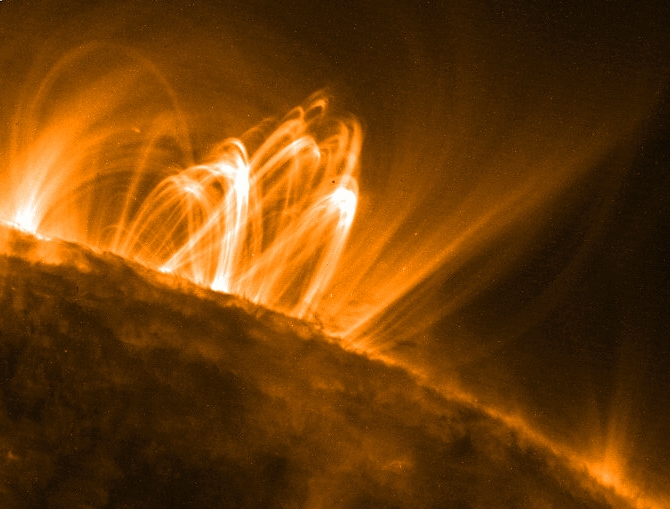
The picture above is taken by the recently launched satellite Hinode. It shows filaments of plasma moving along the magnetic field lines around a sunspot.
Here’s some more eye candy: pictures of coronal loops taken by
TRACE – the Transition Region and Coronal Explorer:
Posted at March 29, 2007 2:44 AM UTC
TrackBack URL for this Entry: http://golem.ph.utexas.edu/cgi-bin/MT-3.0/dxy-tb.fcgi/1219
Re: This Week’s Finds in Mathematical Physics (Week 248)
I’m really liking this Tale you’re spinning. Looking forward to more.
Re: This Week’s Finds in Mathematical Physics (Week 248)
I’m glad to see incidence geometry as spans has gotten off the ground. ;)
Re: This Week’s Finds in Mathematical Physics (Week 248)
Very interesting. I’m looking forward to seeing where this is going.
Hope you don’t mind my pointing out a couple of typos:
in the definition of “span of groupoids”, you have “it should preserve preserves all the structure…”
Then a few lines later in the example you have “… we can rotate the whole picture and get a new point and a new line containing a new plane”. Not sure if this one is a typo, or just my misunderstanding: shouldn’t it be “contained in a new plane” (i.e. the points of the line are a subset of the points of the plane, so the line is contained within the plane)? Or am I just misreading this sentence?
Magmas?
I am confused about the term groupoid. The name suggests something which is almost a group, and that was apparently the original definition: a group but the binary product is not everywhere defined. Wikipedia mentions both this definition and your categorical one. Are they equivalent? There was some discussion about groupoids versus magmas at WP.
Re: This Week’s Finds in Mathematical Physics (Week 248)
Presumably at some point one will need to generalise from the two-ness of spans. E.g., if you’re interested in a type of flag composed of figures in several dimensions. Is there a term for, say, a three-legged span? Then would a degroupoidification form a kind of three-dimensional matrix?
This span business doesn’t seem totally unrelated to what statisticians are doing when they study the correlation of two variables, e.g., a sample of people and a pair of maps to weights and heights. Again one can look at higher-order correlations.
Re: This Week’s Finds in Mathematical Physics (Week 248)
I’d always assumed those spectacular pictures of coronal loops as something that required billions of dollars worth of equipment to see, and indeed the pictures you show did. So I was amazed to find that you can buy a hydrogen-alpha telescope for about $500 and see them for yourself. Obviously it’s not quite the same as a view from a satellite, but through a H-α filter you can clearly see solar prominences and as often as not you can also see that they form faint wispy loops. It’s quite amazing to see these things with your own eyes!
Wilson lines
I think I got the groupoid idea. The set of open Wilson lines is a groupoid, because two Wilson lines can only be glued if they have a common endpoint. In contrast, the set of gauge transformations is a group. So one can have a group acting on a groupoid.
Re: This Week’s Finds in Mathematical Physics (Week 248)
It would have been nice if material on E8 had been covered in week 248 rather than week 247: it would have been a rather spooky coincidence, but as it was it wasn’t to be.
Re: This Week’s Finds in Mathematical Physics (Week 248)
Groupoids, functors and natural transformations form a 2-category. Presumably spans of groupoids form some sort of a weak 2-category?
If the groupoids are topological groupoids or Lie groupoids, then choosing the arrows to be functors is much too restrictive. The problem is that fully faithful and essentially surjective functors may have no continous inverses. So one has to localize at such functors (variously called essential equivalences or weak equivalences). The most common solutions seems to be: replace functors by bibundles. The price is that one loses associativity of 1-arrows. That is, groupoids, bibundles and equivariant maps are a weak 2-category… I presume this is coming up in the new installments?
Re: This Week’s Finds in Mathematical Physics (Week 248)
Incidence is very interesting indeed. I am looking forward to the relation between incidence and Hecke operators/algebra. Especially since I heard that these operators are closely related to more common objects like combinatorial laplacians (discrete laplacian operators on a graph, depending on the indidence matrix!). So while laplacians (on discrete or continuus domains) are very relevant (and understood) for graphs, physics and spectral geometry (in noncommutative geometry length is even defined using the spectrum of the Dirac operator), Hecke operators seem (to me…) to be analogous to this in arithemetic and algebraic geometry?? At least, this seems to be suggested in James Arthur: The Principle of Functoriality”, Bulletin of the AMS v.40 no. 1 October, 2002. So, if this is true I hope we might get some basic intuitive understanding of arithmetic/algebraic theories (like Langlands program, Mordell-Faltings etc.) using concepts better known to ordinary applied mathematicians (graphs, laplacians and geometry). Just posing a very naive question: in geometry/graph theory the idea of hyperbolicity (genus of the surface>1 ) is very important and it is related to the (spectrum of the) laplacian, I believe that in arithmetic/algebraic geometry (e.g. Mordell-Faltings theorem) the same phenomenon pops up? Genus>1 means a significant change in the behavior (numbers of solutions) of the algebraic solutions. Is this also related to the incidence structure and a relevant Hecke algebra? Just curious….
Read the post
The n-Café Quantum Conjecture
Weblog: The n-Category Café
Excerpt: Why it seems that quantum mechanics ought to be the de-refinement of a refined theory which lives in one categorical degree higher than usual.
Tracked: June 8, 2007 6:26 PM
Re: This Week’s Finds in Mathematical Physics (Week 248)
I’m really liking this Tale you’re spinning. Looking forward to more.