 Posts with this logo use


November 29, 2007
On BV Quantization, Part VIII
Posted by Urs Schreiber

A good way to understand the relevance and meaning of the trinity of
in the BV-formulation of quantum field theory (part I, II, III, IV, V, VI, VII) is to interpret the story of the charged -particle in the world of Lie -algebroids (as opposed to Lie -groupoids), which have a restriction on the sign of the degrees of their morphisms, but then form the configuration space of fields by taking the internal hom in the category of arbitrarily graded things.ghosts – fields – anti-fields
This is, to my mind, how to interpret one of the crucial points of AKSZ: The Geometry of the Master Equation and Topological Quantum Field Theory.
Here I start to talk about that, but it will probably take me more than one installment. Progress will be documented in On Lie -modules and the BV complex.
Geometric Representation Theory (Lecture 14)
Posted by John Baez
This time in the Geometric Representation Theory seminar I tried to state the Fundamental Theorem of Hecke Operators… and I screwed up. Luckily, I screwed up in an instructive way!
Pick a group . We’ve seen that every -invariant relation between finite -sets gives an intertwining operator between the resulting permutation representations of . These operators are called Hecke operators.
Any category theorist worth their salt should want to make this into a functor. Since there’s a category with
- finite -sets as objects
- -invariant relations as morphisms
and a category with
- finite-dimensional representations of on complex vector spaces as objects
- -invariant operators (= intertwining operators) as morphisms
one might hope the Hecke operator trick gave a functor
But, it doesn’t!
November 27, 2007
Rejecta Mathematica
Posted by John Baez
Sick of getting your papers rejected?
Tired of useless arguments with referees, like this?
In conclusion, although a good paper of this kind would be interesting, I don’t believe that the present manuscript meets the required standards for acceptance in the Journal.
You are right here. It is way too good for it! I kick myself for being nice and submitting this paper to your narrow-minded pretentious journal! It won’t happen again.
Then publish your rejected papers in Rejecta Mathematica!
November 26, 2007
This Week’s Finds in Mathematical Physics (Week 258)
Posted by John Baez
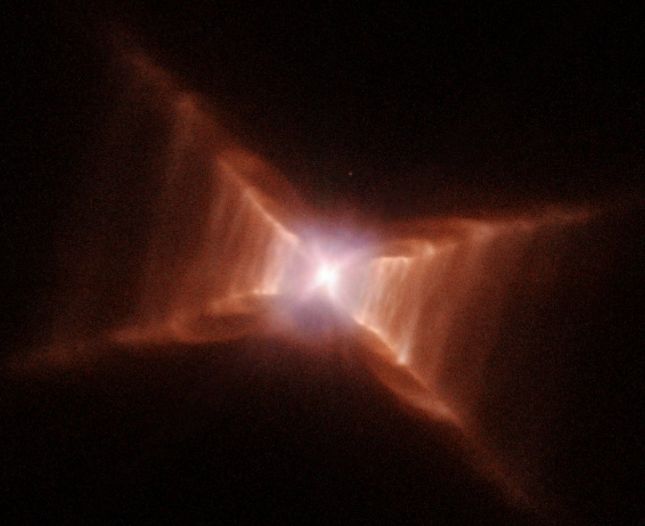
In week258 of This Week’s Finds, learn what happens when sand grains flow. Read more about dust in the Red Rectangle:
and discover why some of it looks like this:
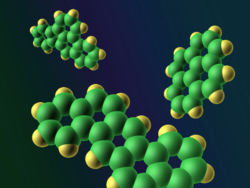
Then, find out about Deligne’s conjecture concerning Hochschild cohomology — and get a nice workout in homological algebra, categories and operads.
Poncelet’s Porism
Posted by John Baez
Gavin Wraith is a mathematician with wide-ranging interests and a fondness for mysteries. To get a sense of this, try his article on ‘Ptolemy and non-Archimedes’.
Let me whet your appetite….
Categories, Logic and Physics in London
Posted by John Baez
Category theory and logic seem to be finding more connections with physics. Bob Coecke and Andreas Döring have decided to run a series of workshops on these connections, starting with this:
- Categories, Logic and Foundations of Physics, January 9, 2008, Imperial College, London.
It’s too bad I can’t make it! I hope someone here does, and tells us what happened. Maybe Jamie Vicary? Maybe even David?
More details follow…
November 23, 2007
Concordance
Posted by Urs Schreiber
I am thinking about the notion of concordance of 2-coycles used by Baas, Bökstedt and Kro.
It seems more or less obvious how it is related to transformations of the ana-2-functors involved, but it also seems that there is a big interesting issue lurking here, once we try to get serious about thinking about -anafunctors.
Influenced by the discussion about Sjoerd Crans’s generalization of the Gray tensor product to -categories with Todd Trimble in Extended Worldvolumes, I had the following thoughts (unfinished, need to catch a train right now)
Homotopy, Concordance and Natural Transformation
Abstract. Transformations between (-)functors are like homotopies between maps of topological spaces. This statement can be given a precise meaning using the closed structure of in terms of the extension of the Gray tensor product from 2-categories to -categories given by Sjoerd Crans. The analogous construction is familar in homological algebra from categories of chain complexes.
After recalling the basics, we turn to “anafunctors” (certain spans of functors) and highlight how the general relation between transformations, homotopies and concordances appears in the study of nonabelian -cocycles classifying -bundles.
MA in Reasoning
Posted by David Corfield
- Logical reasoning, fallacies and paradoxes
- Causal and probabilistic reasoning
- Scientific and mathematical reasoning
- The advent of scientific reasoning: Galileo and Descartes to Newton and Kant
November 22, 2007
Geometric Representation Theory (Lecture 13)
Posted by John Baez
Happy Thanksgiving! Some blogs may quiet down during the holidays, but not this one. We know your desire for math, physics and philosophy doesn’t slack off just because some Americans are snoozing as they recover from gorging on turkey.
In this episode of the Geometric Representation Theory seminar, James Dolan begins to explain how the story so far is connected to knot theory — or for now, the theory of braids. Namely, he shows how decorated braids can be used to describe Hecke operators between flag representations of — or its version, the symmetric group .
He’s already described these operators using certain matrices. The braid picture is equivalent. But, I think it’s the tip of a bigger iceberg: a categorified version of the theory of quantum groups and their associated braid group representations! We’ll take a serious stab at that next quarter, once we get some more machinery in place.
November 20, 2007
Something Like Lie-Rinehart ∞-pairs and the BV-complex (BV, part VII)
Posted by Urs Schreiber
In the context of our previous discussion in Modules for Lie -algebras I am preparing some notes
On Lie -modules and the BV complex
Abstract. Some tentative remarks on generalizations of Chevalley-Eilenberg algebras from Lie algebras and their modules to Lie -algebras and their modules, with an eye towards understanding the Batalin-Vilkovisky complex.
While not finished, I thought that I would share this now as kind of a reply to some of the things Jim Stasheff, Todd Trimble, Johannes Huebschmann and others said.
Apart from getting the generalities right, like formulating everything as nicely as possible internal to the category of chain complexes, the point is to discuss the BV complex “for the (-1)-brane” which I talked about in BV for Dummies and in On Noether’s second and take it as the motivating and guiding example to obtain and check the right definition of a Lie -algebroid, such that its dual is an arbitrarily graded dg-algebra of sorts.
All comments are welcome. Especially corrections.
Previous entries in this BV series are I II III IV V VI.
By the way, a pretty good set of slides summarizing BV is
Glenn Barnich
Algebraic structure of gauge systems:
Theory and Applications
(pdf)
The toy example that I was talking about in BV for Dummies is essentially the one on slide 3 there.
November 18, 2007
Geometric Representation Theory (Lecture 12)
Posted by John Baez
In 1925, Werner Heisenberg came up with a radical new approach to physics in which processes were described using matrices of complex numbers. What makes this especially remarkable is that Heisenberg, like most physicists of his day, had not heard of matrices!
It’s hard to tell what Heisenberg was thinking, but in retrospect we might say his idea was that given a system with some set of states, say , a process would be described by a bunch of complex numbers specifying the ‘amplitude’ for any state to turn into any state . He composed processes by summing over all possible intermediate states: Later he discussed his theory with his thesis advisor, Max Born, who informed him that he had reinvented matrix multiplication!
November 16, 2007
Geometric Representation Theory (Lecture 11)
Posted by John Baez
This time in the Geometric Representation Theory seminar, Jim Dolan recalls how to describe Hecke operators between flag representations using certain matrices.
Does composition of the Hecke operators correspond to multiplying these matrices? No! — and yet, in a certain limit it does resemble matrix multiplication.
November 15, 2007
Category Theory and Biology
Posted by David Corfield
Some of us at the Centre for Reasoning here in Kent are thinking about joining forces with a bioinformatics group. Over the years I’ve caught glimpses of people trying out category theoretic ideas in biology, so naturally I’ve wanted to take a closer look. An initial foray has revealed some intriguing work: André Ehresmann and Jean-Paul Vanbremeersch on Memory Evolutive Systems and Gerhard Mack (somewhere near Urs in Hamburg) on Universal Dynamics, a Unified Theory of Complex Systems: Emergence, Life and Death. Climbing the n-category ladder, Nils Baas who has ideas on abstract matter, has worked with Ehresmann and Vanbremeersch on ‘Hyperstructures and memory evolutive systems’, and with Torbjorn Helvik on higher-order cellular automata.
November 13, 2007
Modules for Lie infinity-Algebras
Posted by Urs Schreiber
This here is mainly a question to Jim Stasheff – and possibly to his former student Lars Kjeseth in case he is reading this – concerning the general issue addressed in the article
Lars Kjeseth
Homotopy Lie Rinehard cohomology of homotopy Lie-Rinehart pairs
HHA 3, Number 1 (2001), 139-163.
which we were discussing in BV for Dummies.
The question is
What is the right -categorification of a Lie-Rinehart pair?
A Lie-Rinehart pair is a pair consisting of an associative algebra and a Lie algebra , such that acts on and acts on in a compatible way, where the two compatibility conditions are the obvious ones you find when looking at the archetypical example of the Lie-Rinehart pair obtained from the smooth functions on a smooth manifold and the vector fields on acting on these.
This example clearly encodes the same information as the tangent Lie algebroid of , and in fact it is rather manifest that whenever for some space , a Lie-Rinehart pair is precisely a Lie algebroid structure over , and vice versa.
We have discussed that people are thinking that a Lie -algebroid, whatever it is in direct terms, is dually encoded precisely in non-negatively graded dg-manifolds.
I found that disturbing. In light of the fact that non-negatively graded dg-algebras beautifully and neatly capture everything about semistrict Lie -algebras, with the latter being a very natural categorical concept, I am not prepared to accept that there should be no equally nice categorical picture for arbitrarily graded dg-manifolds.
My conjecture therefore:
- non-negatively graded dg-manifolds appear when in a Lie-Rinehart pair you categorify only the , not the .
- as we categorify both and , the categorified will give a dg structure in positive degree, whereas the gives a dg-structure in negative degree
- and together the and the fuse to form a single dg-structure, the differential on which is
- restricted to the -part just the categorified Lie bracket etc. on
- restricted to the -part essentially just the differential on a Baez-Crans type -vector space, which is essentially nothing but a chain complex.
- on the intersection of both precisely the action of on .
After mentioning this idea a couple of times on the Café, Jim Stasheff kindly pointed me to the work of Lars Kjeseth (possibly closely related to Marius Crainic’s work, but I can’t tell yet).
Now I have looked at Lars Kjeseth’s article, and have come back with the impression that it essentially supports this point of view.
Just to make sure, I’d like to ask a couple of questions about this, though. And would generally enjoy discussing this further.
The Dangers of Complex Analysis
Posted by John Baez
Todd Trimble passed on an anecdote that I can’t resist passing on to you. It’s about a dangerous habit we mathematicians have: the habit of taking everyday words and twisting their meanings to make them into technical terms.
November 12, 2007
Geometric Representation Theory (Lecture 10)
Posted by John Baez
In my last lecture, I explained that when we simultaneously wave the magic wands of -deformation and categorification over the humble binomial coefficient
it transforms into a marvelous thing: the Grassmannian of -dimensional subspaces of , where is the field with elements.
This time in the Geometric Representation Theory seminar, I sketch what happens when we work the same magic on the binomial formula
We’re soon led into deep waters: categorified quantum groups!
Pfeiffer on Modular Tensor Categories
Posted by John Baez
Modular tensor categories play an important role as a bridge from physics to topology. They arise from rational conformal field theories and quantum groups, and they give rise to 3d topological quantum field theories!
What sort of gadget has representations that form a modular tensor category? Some sort of quantum group, you might guess… but what’s the exact answer? And: can you “reconstruct” this gadget from its category of representations?
The answers are all here:
November 9, 2007
Geometric Representation Theory (Lecture 9)
Posted by John Baez
Pick some type of structure you can put on an -element set. Then the group — the group of all permutations of this -element set — acts on the set of all structures of this type. So, we get an action of on , and thus a representation of on the vector space .
My favorite type of structure on an -element set is called a ‘-flag’. Remember this? can be any -box Young diagram — that is, any list of natural numbers that add up to . A -flag on an -element set is a way of partitioning it into subsets of sizes .
If is the set of -flags on our favorite -element set, then by what I’ve said, we get a representation of on .
So, any -box Young diagram gives a representation of . These are called flag representations. They’re typically reducible — big and fat. But, just like they say every fat person has a skinny person inside, trying to get out, each of these fat representations has an irreducible representation inside, trying to get out.
This time in the Geometric Representation Theory seminar, James Dolan shows how to get these skinny representations out. The trick is to chop away at the fat ones using Hecke operators. This amounts to a categorified version of the Gram–Schmidt process, where we keep chopping off the components of a vector that point along the previous vectors in our list, until we’re left with orthogonal vectors.
By this method, we get all the irreducible representations of — one for each -box Young diagram!
Near the end of this class, Jim starts discussing Hecke operators between flag representations in more detail. He describes them using certain matrices which will eventually become known as ‘crackpot matrices’… for reasons that will be clear someday.
November 6, 2007
Geometric Representation Theory (Lecture 8)
Posted by John Baez
This week in the Geometric Representation Theory seminar we take another of my favorite things — Pascal’s triangle — and wave two magic wands over it: the wand of categorification, and the wand of -deformation! When we do this, the humble binomial coefficient
magically transforms into the Grassmannian
namely the set of all -dimensional subspaces of an -dimensional vector space over the field . And, the famous recursive formula for the binomial coefficients:
mutates into an interesting fact about Grassmannians… but one we’ll only understand fully when we bring Hecke operators into the game.
I wrote about some of this back in week188 of This Week’s Finds. But, it’s much nicer to see it as part of the grand program we’re engaged in now: systematically categorifying and -deforming huge tracts of mathematics with the help of geometric representation theory.
By the way: has anybody ever plotted the ‘-deformed Gaussian’ you’d get by graphing the -binomial coefficients in the th row of the -deformed Pascal’s triangle and then taking a suitably rescaled limit as ? I’d like to see it, but I’m too busy right now to fire up Mathematica and plot it myself. And surely someone has already done this.
November 5, 2007
2-Vectors in Trondheim
Posted by Urs Schreiber
Tomorrow early morning Konrad Waldorf and I will catch a plane to Trondheim where we have been invited to spend a couple of days with Prof. Nils Baas (known to -Café regulars from
Detecting Higher Order Necklaces
Topology in Trondheim and Kro, Baas & Bökstedt on 2-Vector Bundles
What Does the Classifying Space of a 2-Category Classify?
Seminar on 2-Vector Bundles and Elliptic Cohomology, I, II).
Konrad and I will also give a 1+1 hour talk on 2-transport, Konrad probably with an emphasis on (nonabelian) surface holonomy and WZW terms, and I probably with an emphasis on 2-vector bundles and the corresponding 2-vector transport.
You can find Konrad’s slides from previous talks along these lines here and here.
In that context I wanted to go over my notes on 2-Vector transport and Line bundle gerbes and incorporate a polished version into my slide set String- and Chern-Simons -transport today.
But then, after I spent the better part of the day with teaching, right when I wanted to get back to my office to do some real work, they were — evacuating the building! Because some stupid emergency power supply was found to be defunct and life in the presence of a defunct backup power supply regarded to be so dangerous that they decided to shut down everything.
This means no further slides and some of the links provided here temporarily broken (since linking to a shut down server…).
But here is a little blogged discussion of how a rank-1 2-vector bundle, when regarded as a transport 2-functor, is trivialized by a twisted ordinary vector bundle and has descent data given by a line bundle gerbe.
If you replace everywhere in the discussion the algebras (Morita equivalent to the ground field) appearing with Clifford algebras, you pass from line 2-bundles to more interesting 2-vector bundles and obtain the kind of phenomenon that we talked about in Higher Clifford Algebras.
November 4, 2007
Geometric Representation Theory (Lecture 7)
Posted by John Baez
Today in the Geometric Representation Theory seminar, Jim continues to explain Hecke operators.
In his last talk, he proved a wonderful but actually very easy theorem. Whenever a group acts on a set , we get a representation of that group on the vector space in an obvious way. This is called a permutation representation. And the theorem says: if is a finite group acting on finite sets and , we get a basis of intertwining operators
from atomic invariant relations between and : that is, relations that are invariant under the action of our group, and can’t be chopped into a logical ‘or’ of smaller invariant relations.
The intertwining operators we get this way are called ‘Hecke operators’. They’re very easy to get ahold of, because we see atomic invariant relations all the time in geometry: a typical example is ‘the point lies on the line ’.
So: Hecke operators link the world of geometry to the world of group representations.
This time, in lecture 7, Jim explains two nice applications of Hecke operators. In the second one, he starts using Hecke operators to grind down the permutation representations of the group into irreducible pieces, one for each -box Young diagram. This process involves thinking of the representations of as forming a ‘2-Hilbert space’ — a categorified Hilbert space. In fact, the category of representations of any compact topological group is a 2-Hilbert space. In this talk, Jim keeps the concept of 2-Hilbert space quite loose and informal. Since I’ve written a paper on this subject, I’ll include a link to that if you want a precise definition.
n-Bundle Obstructions for Bruce
Posted by Urs Schreiber
For every shifted central extension of an ordinary group by the -group (which is trivial except in top degree, where it looks like ), we can consider the problem of lifting -bundles to -bundles. The obstruction to that is itself an -bundle (-gerbe) of structure group .
I talked about that in
Obstructions to -bundle lifts
Obstructions, Tangent Categories and Lie -tegration
Obstructions to -bundle lifts part II, the BIG diagram
and in subsection: Obstruction Theory of String- and Chern-Simons -Transport.
The construction there is given mainly in terms of local data:
given a -1-cocycle we may lift it to the weak cokernel (to be thought of, I gather, as playing the role of the homotopy quotient) by postcomposing and then projecting onto the cokernel of to finally obtain the obstructing --cocycle (Here is a surjective submersion on base space, and all morphisms displayed are smooth pseudo anafunctors. Making this precise is straightforward either for all in the Lie -algebra version of this, or for low in the world of Lie -groupoids, and an obvious exercise (to be done) for higher in the world of Lie -groupoids).
In a discussion that began in What is the Fiber? and continued first by email and then in person at the conference in Sheffield, Bruce Bartlett complained that this construction relies entirely on local data and demanded an analogous construction on the total global objects.
Bruce pointed out that the construction of the lifting gerbe for an ordinary central extension in Brylinski’s book amounts to replacing the fibers of an ordinary -bundle (which are -torsors) to 2-fibers given by the groupoids of -torsors over . These happen to be -2-torsors and hence indeed form the fibers of a -2-bundle.
I promised to think about how this fits into the big picture. Here is what I think the answer is.
November 3, 2007
Concrete Groups and Axiomatic Theories II
Posted by Guest
Guest post by Todd Trimble
While we’re waiting for more videos and notes from the Geometric Representation Theory seminar, now might be a good time to fill in more of the logical background to Jim Dolan’s talks. Last time, we mentioned an amazing Galois correspondence between complete theories of structures on a set and concrete groups of transformations on . Today I’d like to explain how this correspondence works, with an eye towards discussing Jim’s orbi-simplex idea, and what this has to do with geometry (in particular, the theory of buildings).
The Galois correspondence is in the spirit of Klein’s Erlanger Programm: a structure has a group of transformations, but in a logical sense the group determines the structure. Frankly, I found this sort of surprising at first: theories of structures would seem to be something very general, and groups rather more specific. But I found out recently that the logician Alfred Tarski was also interested in applying Klein’s Erlanger Programm to logic, in his “What are Logical Notions?”