 Posts with this logo use


June 28, 2007
Kernels in Machine Learning II
Posted by David Corfield

We’ve had a slight whiff of the idea that groupoids and groupoidication might have something to do with the kernel methods we discussed last time. It would surely help if we understood better what a kernel is. First off, why is it called a ‘kernel’?
This must relate to the kernels appearing in integral transforms,
where , a function on the domain, is mapped to , a function on the domain. Examples include those used in the Fourier and Laplace transforms. Do these kernels get viewed as kinds of matrix?
In our case these two domains are the same and is symmetric. Our trained classifier has the form:
So the is . The kernel has allowed the transform of a weighted set of points in , or, more precisely, a weighted sum of delta functions at those points, to a function on .
Conference on Categories in Geometry and Physics
Posted by Urs Schreiber
In September, the following conference will take place:
Categories in Geometry and Physics
September 24-28, 2007
at MedILS, Split, Croatia,
organized by Zoran Škoda and Igor Baković.
Requests for possible attendance should be promptly emailed to zskoda at irb.hr.
This Week’s Finds in Mathematical Physics (Week 253)
Posted by John Baez
In week253, read about mysterious relations between the Standard Model, the SU(5) and SO(10) grand unified theories, the exceptional group E6, the complexified octonionic projective plane… and maybe even E8!
June 26, 2007
Colorings of Graphs
Posted by Urs Schreiber
Just heard a talk by Dmitry Kozlov on combinatorial algebraic topology, concerned mainly with the problem of coloring graphs.
I didn’t fully understand many of the points and unfortunately I didn’t have the chance of asking the speaker about more details afterwards. Hence this here is not a report of the talk, but rather a vague mentioning of some aspects and a couple of questions. It feels like much of what Kozlov had to say would be of quite some interest to an -categorical audience, if maybe just because there might be room to make that -categorical structure more explicit.
The main point is this:
given a graph , we are looking for colorings of its vertices such that no two vertices connected by an edge have the same color. What is the minimum number of colors, the chromatic number such that such a coloring exists?
If the graph is the dual of a triangulation drawn on a plane, the answer is given by the famous four color theorem to be The proof of that is not easy and in particular not elegant. This is symptomatic for the coloring problem more generally: exact answers are hard to come by. What one aims for instead are good estimates, lower bounds in particular, of .
One nice way to reformulate the problem of graph colorings, which all of Kozlov’s machinery is based on, amounts to realizing that a consistent (i.e. no equal-colored neighbours) coloring of a graph with -colors is the same as a graph morphism Here is what graph theorists apparently call the “complete” graph on vertices, which here I call the codiscrete graph on vertices: it has precisely one edge from each of its vertices to every other.
A morphism of graphs is much like a functor of the corresponding categories, but with the important constraint that every edge has to go to an edge: as opposed to the categories generated from them, the graphs have no “identity edges”. (And, by the way, I think Kozlov assumes throughout all graphs to be oriented, to have at most one edge for every ordered pair of vertices, and to have no edges from a vertex to itself.)
This is what makes the above reformulation possible: a morphism from a graph to a codiscrete graph will label each vertex of with one of the colors, and cannot assign the same color to two neighbouring vertices.
So then, the next step is to get a handle on the Hom-spaces in the category of graphs.
The crucial point of Kozlov’s work is that he realizes these Hom spaces as simplicial complexes. I don’t quite understand the precise definition in detail yet. You can find it for instance as definition 2.1.5 on p. 11 of
Dmitry N. Kozlov
Chromatic numbers, morphism complexes, and Stiefel-Whitney characteristic classes
arXiv:math/0505563v2.
So this looks like we are secretly talking about an -category of graphs now, or something like this. I don’t know.
The point is that using these simplicial complexes, the space of all possible graph colorings becomes more accessible. Kozlov proves powerful theorems using these complexes, in particular the Lovász conjecture:
For a graph , such that the complex is -connected for some integers and , we have
(Here is the graph corresponding to the -gon.)
The general strategy is to map these simplicial complexes functorially to topological spaces, and then use known obstruction theory of these spaces to determine if can be nontrivial at all.
In this context I was quite intrigued by what Kozlov said about spin structures. As described in section 3 of the above paper, there is a way to use the theory of Stiefel-Whitney characteristic classes to study the Hom-complexes of graphs. That sounds fascinating, since it seems to indicate a relation of the abstract coloring problem – which has the appearance of being “of academic interest” only (if you know what I mean) – to interesting geometric and maybe even physical questions. I’d like to better understand this.
But not right now. I need to call it a day.
June 25, 2007
Kernels in Machine Learning I
Posted by David Corfield
I keep feeling small twinges of familiarity between some of what goes on here at the Café and what I read in the machine learning literature. I’ll jot down a sketch of what’s going on and see if I can get the connection clearer in my head.
One of the most important developments in machine learning over the past 15 years has been the introduction of kernel methods. A kernel on a set is a function , which is symmetric and positive definite, in the sense that for any and any , the matrix is positive definite, i.e., for all . (Complex-valued kernels are possible.)
Another way of looking at this situation is to reformulate it as a mapping , where is a reproducing kernel Hilbert space, a function space in which pointwise evaluation is a continuous linear functional.
June 23, 2007
Some Recreational Thoughts on Super-Riemannian Cobordisms
Posted by Urs Schreiber
Recently, in the discussions about QFTs and representations of cobordisms categories, once again the following question came up:
What is the best way (the right way?) to conceive categories of Riemannian and super-Riemannian cobordisms? How is that extra metric structure best encoded?
Maybe we need to know: what is a Riemannian metric, really?
A priori, there seem to be a couple of alternative choices.
Is it an isomorphism of the tangent space with its dual? Or, more generally (also applicable to superspaces), an isomorphism of the algebra of derivations with its dual?
Or is it most naturally a spectral triple? We sure do expect to get spectral triples (for “target space”) from representations of our cobordisms (the Hilbert space coming from those over the objects, the Laplace or Dirac operato coming from the cylinder) – but do we also want to equip the cobordisms themselves with spectral triple data? How do we compose cobordisms equipped with spectral triples?
Or is it maybe less systematic? A special presciption best suitable for each dimension? A mere (super) 1-form on 1-dimensional cobordisms, for instance? A square root of the canonical line bundle in two dimensions? Something yet to be thought of in three dimensions?
Or is it maybe best thought of as a connection on the cobordisms, with values in the Poincaré Lie algebra (or one of its super versions)?
June 21, 2007
Faith and Reason
Posted by David Corfield
Back last October I mentioned a book – The Good Life in the Scientific Revolution: Descartes, Pascal, Leibniz, and the Cultivation of Virtue – which describes
how three key early modern scientists, René Descartes, Blaise Pascal, and Gottfried Leibniz, envisioned their new work as useful for cultivating virtue and for pursuing a good life. Their scientific and philosophical innovations stemmed in part from their understanding of mathematics and science as cognitive and spiritual exercises that could create a truer mental and spiritual nobility.
Someone closer to our times who considered the relationship between scientific and spiritual enquiry was the chemist turned philosopher Michael Polanyi. In Faith and Reason, The Journal of Religion, Vol. 41, No. 4 (Oct., 1961), pp. 237-247, Polanyi establishes the central concept of his epistemology:
Understanding, comprehension – this is the cognitive faculty cast aside by a positivistic theory of knowledge, which refuses to acknowledge the existence of comprehensive entities as distinct from their particulars; and this is the faculty which I recognize as the central act of knowing. For comprehension can never be absent from any process of knowing and is indeed the ultimate sanction of any such act. What is not understood cannot be said to be known. (p. 240)
June 20, 2007
Curvature, the Atiyah Sequence and Inner Automorphisms
Posted by Urs Schreiber
I am still trying to better understand -curvature and its relation to inner automorphism -groups.
A while ago David Roberts emphasized that the parallel transport functor of a principal -bundle with connection can be thought of as inducing a morphism of short exact sequences of groupoids: from the sequence of path groupoids of to the integrated Atiyah sequence of .
Here I take a fresh look at the curvature 2-functor of a parallel transport 1-functor from this point of view, emphasizing the role played by inner automorphisms in this construction.
Curvature 2-Transport, the Atiyah Sequence and Inner Automorphisms
June 19, 2007
Degeneracy
Posted by David Corfield
Eugenia Cheng and Nick Gurski have just put on the ArXiv a sequel to their
The periodic table in low dimensions I: degenerate categories and degenerate bicategories,
entitled
The periodic table of -categories for low dimensions II: degenerate tricategories.
Cohomology and Computation (Week 27)
Posted by John Baez
In the last of this year’s classes on Cohomology and Computation, we sketched a few of the simplest consequences of the bar construction:
- Week 27 (June 7) - Cohomology of algebraic gadgets. The bar construction "puffs up" any algebraic gadget, replacing equations by edges, syzygies by triangles and so on, with the result being a simplicial object with one contractible component for each element of the original gadget. Examples: Ext and Tor, group cohomology and homology, Lie algebra cohomology and homology. How Ext and Tor arise from the adjoint functors between the category of abelian groups and the category of modules of a ring. Free resolutions. Group cohomology as a special case of Ext. Group cohomology as the cohomology of the the classifying space .
Last week’s notes are here.
June 18, 2007
Waldorf on Parallel Transport Functors
Posted by Urs Schreiber
The last talk today at Principal Bundles, Gerbes and Stacks (I, II) – leading over from the word of bundles to the world of 2-bundles, to be explored tomorrow – was
Konrad Waldorf
Parallel Transport and Functors
(pdf version of the talk)
summarizing our paper and a little of the 2-transport theory beyond that.
All those fed up by my exposition style should have a look at Konrad’s very nice talk.
Generalized Geometric Langlands is False
Posted by Urs Schreiber
I am in Bad Honnef, at a conference titled
Principal Bundles, Gerbes and Stacks
which I mentioned recently.
Second talk was by C. Teleman. He introduced it by saying that he had given this talk a couple of times, but always with the wrong title. Before quitting giving the talk, he said, he now wanted to give it once with the right title, which is:
The generalised geometric Langlands conjecture is false for trivial reasons.
The talk mosly reviewed various versions of the geometric Langlands conjecture, starting with the Fourier-Mukai transformation and ending somewhere in the derived world. At the end Teleman talked about the results of an explicit computation of Ext-groups in two derived categories which the “generalized geometric Langlands conjecture” conjectures to be equivalent. But the computation shows that this cannot be the case.
In choosing the title of this post, I blindly followed the above decision. I am far from being able to judge to which extent this is supposed to be a surprise for experts or just a confirmation of a general expectation that the formulation of the conjecture needs more care.
I will try to provide the full details of the talk later. With a little luck. For the moment, here just the abstract:
Cohomology and Computation (Week 26)
Posted by John Baez
This week in our seminar on Cohomology and Computation we continued discussing the bar construction, and drew some pictures of a classic example:
- Week 26 (May 31) - The bar construction, continued. Comonads as comonoids. Given adjoint functors and , the bar construction turns an object in into a simplicial object . Example: the cohomology of groups. Given a group , the adjunction , lets us turn any -set into a simplicial -set . This is a "puffed-up" version of in which all equations have been replaced by edges, all equations between equations (syzygies) have been replaced by triangles, and so on. When is a single point, is called . It’s a contractible space on which acts freely. The "group cohomology" of is the cohomology of the space .
Last week’s notes are here; next week’s notes are here.
June 17, 2007
More Mysteries of the Number 24
Posted by John Baez
For a long time I’ve been fascinated by the mysteries of the number 24: the way it shows up in string theory, the Leech lattice and Monstrous Moonshine, the 24-element binary tetrahedral group, the 24-cell:

and so on — even the fact that
is a square number (a fact which turns out to be related to the Leech lattice). I’ve always dreamed of writing a book called My Favorite Numbers. In this book, chapter 24 would be longer than most.
Now I need your help!
June 16, 2007
Opetopes as Trees
Posted by David Corfield
How did this one slip by? Four important players in the saga of -categories, Joachim Kock, André Joyal, Michael Batanin and Jean-François Mascari have combined to write Polynomial functors and opetopes:
We give an elementary and direct combinatorial definition of opetopes in terms of trees, well-suited for graphical manipulation (e.g. drawings of opetopes of any dimension and basic operations like sources, target, and composition); a substantial part of the paper is constituted by drawings and example computations. To relate our definition to the classical definition, we recast the Baez-Dolan slice construction for operads in terms of polynomial monads: our opetopes appear naturally as types for polynomial monads obtained by iterating the Baez-Dolan construction, starting with the trivial monad. Finally we observe a suspension operation for opetopes, and define a notion of stable opetopes. Stable opetopes form a least fixpoint for the Baez-Dolan construction. The calculus of opetopes is also well-suited for machine implementation: in an appendix we show how to represent opetopes in XML, and manipulate them with simple Tcl scripts.
I see in the bibliography a reference to Notes on Polynomial Functors by Kock.
June 14, 2007
Polyvector Super-Poincaré Algebras
Posted by Urs Schreiber
Just heard a talk on the work
D. V. Alekseevsky, V. Cortés, C. Devchand, A. Van Proeyen
Polyvector Super-Poincare Algebras
arXiv:hep-th/0311107v2
which is about classification of extensions of Poincaré Lie algebras of a vector space with scalar product of signature to super Lie algebras
At least parts of this is ancient knowledge in physics, but I am being told that to get this coherent, comprehensive and rigorous form quite a bit of work was required.
One reason why these super Poincaré algebras are very interesting is the following:
as is well known, it turns out that the parts of the super extension of the Poincaré algebra called above consists of various copies of exterior powers (called “polyvector spaces”) of the underlying vector space .
Now, like ordinary Einstein gravity may be conceived as a gauge theory for , theories of supergravity come from the respective super extensions of that.
Like flat Minkowski space is a special solution to Einstein’s equations, characterized by the fact that it exhibits globally the symmetry of , supergravity theories have special solutions which globally respect parts of the super Poincaré symmetry.
Strikingly, for each power that appears in the super extension of the Poincaré algebra these solutions may feature -dimensional hypersurfaces that behave much like charged particles – only that instead of being 0-dimensional and coupling to a connection, they are -dimensional and couple to a -connection!
A review of these structures – called (solitonic/BPS)-branes – may be found for instance in
K.S. Stelle
BPS Branes in Supergravity
arXiv:hep-th/9803116v2.
Now, this is especially interesting for us, because on the other hand, as -Café-regulars have heard us say before, at least some of these -branes should really correspond to certain -functors To indicate the categorification step, I like to speak of -particles.
There is some tantalizing interaction between supersymmetrization and categorification – many of the details of which still escape me.
The most direct hint, so far, concerning what is really going on, is Castellani’s observation:
Castellani remarks (not in these words, though, but I think these words are part of the clue) that with the super Lie 3-algebra which D’Auria and Fré once found to be the structure governing 11-dimensional supergravity (as discussed at length in SuGra 3-Connection Reloaded) comes a certain Lie 1-algebra of derivations of the Lie 3-algebra, and that this is the polyvector super extension of .
So it seems that there is a close relation between
a) super Lie -algebras extending the Poincaré Lie 1-algebra
b) polyvector super Lie 1-algebras extending the Poincaré Lie 1-algebra
and apparently b) is part of the Lie -algebra .
(I am being careful with saying “part of” etc, since the derivations considered in Derivation Lie 1-Algebras of Lie n-Algebras and What is a Lie Derivative, really? are closely related but not exactly the derivations that Castellani considers.
June 13, 2007
Why Math Teachers Get Grumpy
Posted by John Baez
Did you ever have a math teacher who seemed grumpy? At least in America, schools are full of them. Why do they get that way?
Maybe it’s because they spent too long controlling rowdy students, or grading papers full of mistakes. Maybe they realized trying to force kids to think clearly was a losing proposition… but didn’t know what else to do. They may feel they’re on the front lines of a war against ignorance… a war the other side keeps steadily winning, year after year. Whatever causes this bitterness, it’s a terrible thing. Teachers like this make students hate the subject!
Teaching can be tough on the soul. For me, the hard part is grading midterms and final exams. I feel that’s when I earn my pay. Everything else about my job is lots of fun. Grading the same problem, over and over, 50 to 100 times… that’s really work! At the end my mind is reduced to jelly — I can barely total up the grades.
When things get tough, a sense of humor comes in handy. I just finished grading the finals for my undergraduate number theory course. It wears me down reading phrases like “suppose and are both distinct integers”, or “let be a unique prime.” But one proof by contradiction brought a smile to my face…
June 12, 2007
Spectral Triples and Graph Field Theory
Posted by Urs Schreiber
Had the pleasure of talking with Yan Soibelman over dinner. He mainly educated me about his old work with Kontsevich concerning 2-dimensional CFTs and their strings-collapse-to-points limit, which is described in section 2 of
Maxim Kontsevich, Yan Soibelman
Homological mirror symmetry and torus fibrations
arXiv:math/0011041v2 [math.SG]
I had mentioned aspects of this briefly in Soibelman on NCG of CFT and Mirror Symmetry, but apparently later didn’t follow quite the right literature (namely I looked only at Roggenkamp and Wendland).
Yan Soibelman is trying to paint in fuller detail a beautiful picture, in which Connes’ spectral triples are the algebraic data encoding a quantum mechanical system (called a “graph field theory” here, since it computes amplitudes of Feynman graphs) which is obtained from a 2-dimensional conformal field theory (describing a stringy object instead of a point particle) by a limiting procedure in which
a) the circumference of the string shrinks to zero
b) the volume of the target space that the string propagates in grows without bounds (“large volume limit”).
At its core, this question is an extremely old hat for physicists, in a way, since it is really the very year old motivation for looking at string theory in the first place: generalize Feynman diagrams from graphs to tubular diagrams.
But attempts to make many things here precise are scarce. And attempts doing so using Connes’ spectral geometry (what Connes calls “noncommutative geometry”) are even more scarce — but they shouldn’t be.
It seems to me that what Yan Soibelman is carrying on is the study of stringy spectral geometry (or 2-NCG / 2-spectral geometry, as I think it should ultimately amount to), which people started looking at in old work like
J. Froehlich, O. Grandjean, A. Recknagel
Supersymmetric quantum theory, non-commutative geometry, and gravitation.
arXiv:hep-th/9706132v1
(see in particular the last section, 7)
or that by Ali Chamseddine, which I mention towards the end of Connes on Spectral Geometry of the Standard Model, II.
In a way, this is all about understanding functors using only algebraic (as opposed to geometric) tools and data – and then interpreting that data geometrically.
For instance, one of the main questions Yan Soibelman said he is currently thinking about is how to conceive the notion of Ricci curvature, and in particular of bounded from below Ricci curvature, in terms of Connes’ spectral geometry. There is supposedly some deep relation between spectral triples obtained from the point particle limit of 2-dimensional CFTs and the Ricci curvature of the spectral geometry which they encode.
Two ArXiv Papers
Posted by David Corfield
Two papers of interest on the ArXiv today.
1) Framed bicategories and monoidal fibrations by Michael Shulman: what’s missing when you treat (rings, bimodules, bimodule homomorphisms) as an ordinary bicategory.
2) A universal property of the monoidal 2-category of cospans of finite linear orders and surjections by M. Menni, N. Sabadini, and R. F. C. Walters: extending the programme of capturing the universal properties of cospan-like categories to a 2-category.
More Mathematical Blogging
Posted by David Corfield
More mathematics blogging at the Secret Blogging Seminar. This time a group blog manned by five recent and future Berkeley mathematics Ph.D.’s, at least 4 of whom have contributed comments to the Café, and who promise
Commentary on our own research, other mathematics pursuits and what ever seems like writing about on any given day. Sort of like a seminar, but with more rude commentary from the audience.
I see one of their number, A J Tolland, gave a talk Categorified TQFT & Quantum Groups (notes):
There’s some emerging folk wisdom which says that there’s a connection between the “n” in n-category and the “n” in n-dimensional. In this talk, we’ll explore one of the simplest examples of this phenomenon, showing how one can recover the axioms of a (finite) quantum group from path integral rules of a “categorically enriched” version of the topological QFT known as Chern-Simons theory. The finiteness restriction is necessary in this case to make the path integral into a well-defined mathematical object.
Sounds like there may be one or two common interests between blogs.
June 10, 2007
Extended QFT and Cohomology II: Sections, States, Twists and Holography
Posted by Urs Schreiber
In the first part of my little report on our workshop on elliptic cohomology I wrote: “But what I shall do is talk about that stuff which overlapped with things I had thought about myself, and written about here before.”
Here is one of these.
Section four of my Toronto talk notes “On 2d QFT: From Arrows to Disks”, was titled
Transition gerbes, bulk fields and a kind of holography.
Now that I see that other people are, independently, arriving at the same important phenomenon indicated there, I feel like emphasizing this stuff under a more catchy headline, doing away with the humble “a kind of” and instead declaring boldly:
The holographic principle in (classically) higher gauge theory and (quantumly) extended QFT is the phenomenon that morphisms and from the tensor unit into a given transport -functors are given by component maps and which are themselves -transport and -dimensional QFTs, respectively.
This relates
- classically: -bundles (with connection) to twisted -bundles with connection
- quantumly: states of -dimensional quantum field theories to correlators of -dimensional quantum field theories (“holography”).
June 8, 2007
Quantization and Cohomology (Week 27)
Posted by John Baez
In our final class on Quantization and Cohomology I gave a summary of the trip we’d been on, and a brief description of where we could have gone next — if only there’d been time:
-
Week 27 (June 5) - Review and prospectus. Classical and quantum mechanics from categories equipped with action or phase functors. Subtleties: path integrals and anafunctors. Geometric quantization of symplectic manifolds. Categorification, to obtain the classical and quantum mechanics of strings. Categorifying the theory of connections as anafunctors.
Supplementary reading:
- John Baez and Urs Schreiber, Higher gauge theory.
- John Baez, Higher gauge theory, higher categories.
- Urs Schreiber, Talks at "Higher Categories and their Applications".
Last week’s notes are here.
Extended Quantum Field Theory and Cohomology, I
Posted by Urs Schreiber
A few minutes ago our little workshop on elliptic cohomology ended. All participants and speakers are on their way home.
I had the pleasure of helping organize this, attending it and giving a talk myself (on connections on -2-bundles). While very gratifying, as a result I hardly found time for anything else. (I have to apologize to all those who are expecting comments to emails they sent me recently. I will try to provide these comments tomorrow or over the weekend.)
We had very few scheduled talks, the rest of the time being “discussion session”. The entire workshop was one big “russian style seminar”. And this was very fruitful, useful and effective. We shall do it this way again.
It turned out that several of the new ideas that our esteemed guests, Stephan Stolz and Peter Teichner, mentioned were closely related and had quite some overlap with things I was talking about in Toronto and some of the developments that have taken place since then: it’s all about how to understand various edges of the cube, which relates classical parallel -transport with the corresponding extended -dimensional quantum field theory and the relation of that to state-sum models like the FRS-formalism.
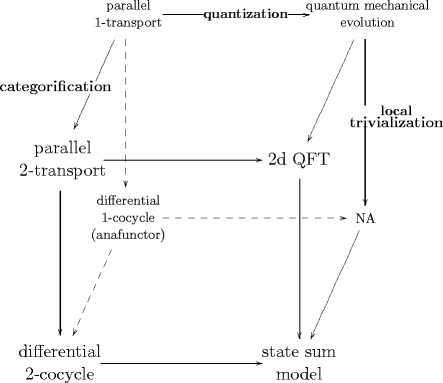
I am not entirely sure how much of the stuff which was discussed in our discussion sessions, much of which is unpublished and un-preprinted work, is supposed to be posted to a site like ours here. But what I shall do is talk about that stuff which overlapped with things I had thought about myself, and written about here before.
Large Smooth Categories
Posted by Urs Schreiber
Behind the scenes, I am having a long email discussion with Bruce Bartlett about some puzzling subtleties in the definition of smooth categories.
As Bruce rightly emphasized, we need to be careful with comparing the following two definitions
1) a category internal to the category of Chen-smooth spaces
2) a stack over manifolds – which is the same as a category fibered over manifolds.
It gets particularly subtle when the categories in question are large. I am unsure about some subtle details of that. Here are some questions.
The n-Café Quantum Conjecture
Posted by Urs Schreiber
Conjecture (roughly): Quantum mechanics, which has historically been considered as a structure internal to , has a more natural formulation as a structure internal to . This involves refining functions to “bundles of numbers” (namely fibered categories, or, dually, refining (action) functors to pseudofunctors) and it involves refining linear maps by spans of groupoids.
In this natural formulation, quantization will no longer be a mystery – but a pushforward: the quantum propagator is the pushforward to a point of the classical action (pseudo)-functor.
-Dimensional quantum field theory works the same way, but internal to .
The Curious Incident of the Dog in the Night-time
Posted by David Corfield
Why is the cyclic category failing to bark on this blog? It has a wonderful pedigree (p. 27), and it turns up in all kinds of interesting places, e.g., Jones (p. 20) and Ben-Zvi and Nadler (p. 20).
Loday has interesting things to say about it here.
Its Leinster-Euler characteristic appears to be infinite, which relates to its sharing the same classifying space as the circle.
June 7, 2007
Categorifying Quantum Mechanics
Posted by David Corfield
Compare and contrast:
1) Categorified algebra and quantum mechanics, Jeffrey Morton.
and
2) A categorical framework for the quantum harmonic oscillator, Jamie Vicary.
June 6, 2007
Cohomology and Computation (Week 25)
Posted by John Baez
In this week’s seminar on Cohomology and Computation, we put the pieces together and saw how to build simplicial objects from adjoint functors. Next time we’ll see what they’re actually like, in an example:
- Week 25 (May 24) - The bar construction, continued. The zig-zag identities for the unit and counit of an adjunction. Monads and comonads from adjunctions. Simplicial objects from adjunctions.
Last week’s notes are here; next week’s notes are here.
Whose 2-Vector Spaces?
Posted by David Corfield
Back here, Urs said:
…while it is quite interesting that the “K-theory” of Baez-Crans 2-vector bundles is and that of Kapranov-Voevodsky is BDR-2K, the original hope was that there is a kind of 2-vector bundle such that its K-theory is something more closely resembling elliptic cohomology, somehow.
This goal has not been achived yet, as far as I am aware.
And I argued that this is maybe no wonder: while the notions of 2-vector spaces used so far in these studies all have their raison d’être, they are all comparatively restricted, as compared with the most general notion of 2-vector space one would imagine.
A fuller explanation is given in this post.
Now, a paper out today, Two-vector bundles define a form of elliptic cohomology, pushes further the BDR-2K project. Does the “a form” still suggest the need to follow Urs’ advice and look towards Bim(Vect)?
June 5, 2007
June Events
Posted by David Corfield
Anyone care to tell us what’s happening at Seca4, starting tomorrow?
Then, of course, there’s CT2007 to report on.
June 4, 2007
Quadratic Reciprocity
Posted by John Baez
Next week is the last week of class here at UC Riverside! Yay!
I’m almost done teaching an undergraduate course on number theory, where the big final blaze of fireworks consists of proving Quadratic Reciprocity. I’m following a standard proof due to Eisenstein, outlined here:
- John Baez, Quadratic reciprocity: the big picture.
But, despite its pompous title, this outline doesn’t explain much. I don’t understand what makes Eisenstein’s proof tick, even after reading this play about it:
- Reinhard C. Laubenbacher and David J. Pengelley, Gauss, Eisenstein, and the “third” proof of the Quadratic Reciprocity Theorem: Ein kleines Schauspiel.
Maybe someone could explain what really makes this proof work?
June 3, 2007
Connections on String-2-Bundles
Posted by Urs Schreiber
June 1, 2007
Quantization and Cohomology (Week 26)
Posted by John Baez
In this week’s seminar on Quantization and Cohomology, we finished sketching a proof that:
- Principal -bundles over correspond to smooth anafunctors , where is the smooth category with as the space of objects, and only identity morphisms.
- Gauge transformations between principal -bundles over correspond to smooth ananatural transformations between such anafunctors.
We began by giving the definition of ‘smooth ananatural transformation’:
- Week 26 (May 29) - The definition of smooth anafunctor (review), and the definition of smooth ananatural transformation (new). Why the first Cech cohomology of a smooth space with coefficients in a smooth group is isomorphic to the set of smooth anafunctors mod smooth ananatural isomorphisms. Generalization: the first Cech cohomology of a smooth category. Dreams of further generalizations.
Last week’s notes are here; next week’s note are here. Next week is the last week of this year-long seminar!
The Woodstock of the Mind
Posted by David Corfield
This was Bill Clinton’s description of the wonderful Hay Festival. It’s held every year in the tiny Welsh town of Hay-on-Wye, packed with the kind of excellent second-hand bookshop that used to be so common 30 years ago.
Just like at Woodstock, heavy rain had turned the fields to mud. Fortunately, to keep our minds dry all the events took place under canvas. Darian Leader and I spoke about our book to an audience of around 700 people for about an hour with questions. An excellent event. And we got to stay in the same hotel as Tony Benn and Peter Falk!
Quantization and Cohomology (Week 25)
Posted by John Baez
In this week’s seminar on Quantization and Cohomology, we looked at a simplified version of a claim made last week:
- Week 25 (May 22) - Bundles, connections, cohomology and anafunctors. A simplified version of the claim made last week: principal -bundles over correspond to smooth anafunctors , where is the smooth category with points of as objects and only identity morphisms. Bundle isomorphisms correspond to smooth ananatural transformations between these. To prove this, use Cech 1-cocycles to describe principal -bundles, and Cech 0-cochains to describe isomorphisms between these. Claim: the first Cech cohomology consists of smooth anafunctors modulo smooth ananatural transformations.
Last week’s notes are here; next week’s notes are here.
Quantization and Cohomology (Week 24)
Posted by John Baez
In this week’s seminar on Quantization and Cohomology, we drew a big chart comparing three approaches to connections and gauge transformations. The most sophisticated uses the idea of “smooth anafunctor” developed by Toby Bartels. A smooth anafunctor is something that looks locally, but perhaps not globally like a smooth functor!
-
Week 24 (May 15) - Connections and smooth anafunctors: review and prospectus.
Connections on the trivial principal -bundle over are smooth functors
; gauge transformations are smooth natural
transformations between these. Connections on a fixed principal G-bundle are smooth functors ; gauge transformations are smooth natural transformations
between these. Connections on an arbitrary, or variable principal
-bundle over are smooth anafunctors ;
gauge transformations are smooth ananatural transformations between
these. The definition of smooth anafunctor.
Supplementary reading:
-
Toby Bartels, Higher
gauge theory I: 2-bundles. Section 2.2.2, on "2-maps",
describes smooth anafunctors between smooth categories. Section 2.2.3
describes what I’m calling smooth ananatural transformations.
- Urs Schreiber and Konrad Waldorf, Parallel transport and functors. This develops some closely related ideas, including a more flexible notion of “-local -trivialization” for a functor, which generalizes the concept of smooth anafunctor in a useful way.
-
Toby Bartels, Higher
gauge theory I: 2-bundles. Section 2.2.2, on "2-maps",
describes smooth anafunctors between smooth categories. Section 2.2.3
describes what I’m calling smooth ananatural transformations.
Last week’s notes are here; next week’s notes are here.