 Posts with this logo use


May 31, 2007
On the Bar Construction
Posted by Urs Schreiber

– guest post by Todd Trimble –
Here is a comment about the bar construction which I wanted to mention, since John told me that his course is ending soon and he might not get around to mentioning it himself.
I’d like to thank Urs for suggesting this be made a guest post, and all three hosts for the hard work they put into making the Café such a great success.
The Second Edge of the Cube
Posted by Urs Schreiber
What is a Cartan-Ehresmann connection, really?
If we know what a Cartan-Ehresmann connection with values in a Lie algebra really is, we should immediately know what an -Cartan-Ehresmann connection with values in any Lie -algebra is.
Kock on Higher Connections
Posted by Urs Schreiber
Building on his synthetic description of parallel transport, which I mentioned a while ago in Kock on 1-Transport, Anders Kock has now worked out a notion of higher order connections using synthetic differential geometry:
Anders Kock
Infinitesimal cubical structure, and higher connections
arXiv:0705.4406v1
This is rooted in the world of strict -fold groupoids: an -connection here is an -fold functor from cubical -paths in a space to an -fold groupoid :
Smoothness of this functor is described using synthetic differential reasoning (described in detail in his book).
In the strict cubical context, Anders Kock finds precisely the relation between parallel transport, curvature, and Bianchi identity which I describe in -Curvature:
For any given parallel -transport, the corresponding curvature is an -transport. The latter is necessarily flat, meaning that its curvature -transport is trivial. This flatness of the curvature -transport is the (higher order) Bianchi identity.
What is a Lie Derivative, really?
Posted by Urs Schreiber
For solving the problem that I am currently working on, it turned out I need to understand
What is a Lie derivative, really?
By which I mean
What is a Lie derivative, arrow-theoretically?
By which I mean
How can I think of a Lie derivative in an implementation-independent way, such that the concept may be a) internalized and, in particular, b) be categorified without effort (read: without running into problems that require thinking).
As David Corfield has put it in The Two Cultures of Mathematics Revisited:
“[…] for any worthwhile idea there is a story about it which gets to the heart of what it really is, and I’ll know when I’ve reached that point by the ease with which it categorifies.”
And this may be necessary for understanding what’s going on.
So here is my current take at the answer to “What is a Lie derivative, really?”. It’s maybe not quite the final answer yet, but the applications that I am looking at suggest that this is on the right track.
Let me know what you think!
May 28, 2007
This Week’s Finds in Mathematical Physics (Week 252)
Posted by John Baez
In week252 hear about the possibility of oceans on Neptune billions of years from now:
Learn the latest about hot Neptunes in other solar systems. See the electromagnetic snake at the center of the Galaxy. And, continue reading the Tale of Groupoidification! In this episode, with a nod to the work of Georg Frobenius and William Burnside, we begin to tackle the theme of "Hecke operators".
May 26, 2007
Link Homology and Categorification in Kyoto
Posted by John Baez
Aaron Lauda points out an interesting conference:
- Link Homology and Categorification, Kyoto University, May 10-25, 2007.
You can see notes for some of the talks!
May 25, 2007
Congratulations to David!
Posted by John Baez
Hurrah!
David Corfield just got a permanent job in the Philosophy Department of the University of Kent at Canterbury!

Derivation Lie 1-Algebras of Lie n-Algebras
Posted by Urs Schreiber
Here is a fact which should be important, but whose true meaning is not entirely clear to me at the moment:
To every Lie -algebra is canonically associated an ordinary Lie algebra .
This Lie 1-algebra is, in some sense, a Lie 1-algebra of derivations of the Lie -algebra. But it is not the derivation Lie -algebra .
What is , conceptually?
Why does it exist, as an ordinary Lie algebra?
What is its analog at the level of Lie -groups?
Below I give the detailed description and mention applications where this is relevant.
For more details see section 3.3.1 of
and section 5.3 of
(which has grown out of the original zoo).
Going Hi-Tech
Posted by David Corfield
Perhaps we should be going more hi-tech at the Café. If you enjoy a bit of fancy PowerPoint, try out Chris Schommer-Pries’ slides for a talk ‘What is an N-category?’.
Chris is a student of Peter Teichner at Berkeley.
May 24, 2007
Cohomology and Computation (Week 24)
Posted by John Baez
In the 1950s, Cartan, Eilenberg, Mac Lane and others systematically studied the cohomology of many different algebraic gadgets — groups, associative algebras, Lie algebras, and so on. It was later realized that underlying all these different cohomology theories there’s a marvelous unifying idea: the bar construction. In this week’s seminar on Cohomology and Computation, we began trying to understand what makes the bar construction tick:
-
Week 24 (May 17) - The bar construction. Why do adjoint functors give simplicial objects? First, is the free monoidal category on a monoid object — or "the walking monoid", for short. Second, adjoint functors give certain monoids, called "monads".
Supplementary reading:
- Todd Trimble, On the bar construction.
- Todd Trimble, Bar constructions.
Last week’s notes are here; next week’s notes are here.
May 22, 2007
The Two Cultures of Mathematics Revisited
Posted by David Corfield
Where did we get to in our discussion of the two cultures of mathematics? To explore the possibility that interaction may be possible between what Gowers called ‘combinatorics’ and our Café subculture we were set the challenge of categorifying instances of the Cauchy–Schwarz inequality, which, unless I missed something, didn’t result in any noticeable success.
Now, an extreme wing of our subculture would take Urs’ remark
One knows one is getting to the heart of the matter when the definitions in terms of which one conceives the objects under consideration categorify effortlessly.
and replace the when by when and only when.
May 21, 2007
Questions on n-Categories and Topology
Posted by John Baez
Here are some questions on n-categories and topology from Bruce Westbury. I’ll post a reply later — but why don’t some of you take a crack at them first?
May 19, 2007
Chern Lie (2n+1)-Algebras
Posted by Urs Schreiber
I mentioned Lie -algebras coming from invariant symmetric polynomials of degree on some Lie algebra in Zoo of Lie -Algebras.
Since it is a really simple and short computation, I want to give here all the details needed to understand it.
May 18, 2007
Calculations Inside Semisimple Categories
Posted by Urs Schreiber
– guest post by Bruce Bartlett –
Hi guys,
I’ve got a question regarding performing calculations inside semisimple categories.
I posted a version of it back in March. I’ve made quite a lot of progress, but I’m still missing some vital ingredient which I can’t put my fingers on. John hinted (rather sneakily!) in one of his TWF comments that he had made some progress on it too. Since everyone has been working so diligently on it, I thought it’s time to reconvene the homework group and compare notes.
Recall that the problem is about defining adjoints (or ‘daggers’) of natural transformations. There are two ways to define them : a left-handed way and a right-handed way, and we’d like to check they are the same.
Don’t worry about the specific problem. Just think : we have some calculation to perform inside a semisimple category. What are we going to do?
Linear Algebra Done Right
Posted by David Corfield
– guest post by Tom Leinster –
One of the best things about the n-Category Café is the willingness of its clientele to re-examine notions that are usually thought of as too basic to bother with — things that you might think were beneath your dignity.
Another great thing about the n-Café is the generosity of its proprietors in letting me post here! Thanks to them.
I’m not going to talk about fancy linear algebra: just the good old theory of finite-dimensional vector spaces, like you probably met when you were an undergraduate. Or rather, not quite like what you met…
The inspiration is Sheldon Axler’s textbook Linear Algebra Done Right. Unfortunately you can’t download it, but you can download an earlier article making the same main points, Down with determinants!.
Penrose on Angular Momentum: An Approach to Combinatorial Space-Time
Posted by John Baez
Georg Beyerle has created an electronic version of a classic paper on spin networks that was previously available only in an out-of-print book:
- Roger Penrose, Angular momentum: an approach to combinatorial space-time.
Roger Penrose has given me permission to put it on my website. Take a copy! If you spot typos, please let me know.
May 16, 2007
Two Physics Papers Involving Categorification
Posted by David Corfield
Two papers dealing with the categorification of knot invariants:
Sergei Gukov, Amer Iqbal, Can Kozcaz, Cumrun Vafa, Link Homologies and the Refined Topological Vertex.
R. Dijkgraaf, D. Orlando, S. Reffert, Dimer Models, Free Fermions and Super Quantum Mechanics.
Guess what the latter’s suggestion is for an “easy to read introduction to the concept of categorification” (p. 18)?
May 12, 2007
People Who May or May Not Actually Exist
Posted by John Baez
There are a lot of important people we know little about. Some might not even exist!
A couple of years ago James Dolan and Toby Bartels played a game where they took a long list of famous people and estimated the probabilities that they really existed. I’m curious about your opinions.
To get the game rolling, I’ll give a list of name and my own estimates. I haven’t thought hard about these numbers — they’re just instant shoot-from-the-hip guesses. I haven’t even bothered defining what it means for one of these people to exist! I’m not claiming they did everything attributed to them — just enough to make them count as themselves, whatever that means.
(For example: did you know Homer didn’t write the Odyssey and Illiad? They were actually composed by another guy with the same name!)
Arguing about the existence of some of these people could lead to nasty quarrels. If you’re the slightest bit rude, I’ll delete your comment. What I really want, most of all, is lists of probabilities.
Here’s mine! Try your own hand at it…
Puzzle #12
Posted by John Baez
Here’s one of my favorite puzzles, perhaps not rendered too easy by Google (unless you cheat and look on my website):
What is the size of New Jersey, shaped like a dog bone, and named after a famous woman?
May 11, 2007
Cohomology and Computation (Week 23)
Posted by John Baez
In this week’s seminar on Cohomology and Computation, we finally came within sight of the promised land. We began sketching how to get simplicial sets from quite arbitrary algebraic gadgets, using the mind-bogglingly beautiful ‘bar construction’:
- Week 23 (May 10) - Simplicial sets from algebraic gadgets. Algebraic gadgets and adjoint functors. The unit and counit of an adjunction: the unit ‘includes the generators’, while the counit ‘evaluates formal expressions’. The canonical presentation of an algebraic gadget. Simplicial objects from adjunctions: the bar construction. 1-simplices as proofs.
Last week’s notes are here; next week’s notes are here.
May 10, 2007
Zoo of Lie n-Algebras
Posted by Urs Schreiber
We would like to share the following:
Jim Stasheff & U. S.
Zoo of Lie -Algebras
(pdf)
Abstract:
Higher order generalizations of Lie algebras have equivalently been conceived as Lie -algebras, as -algebras, or, dually, as quasi-free differential graded commutative algebras (quasi-“FDA”s, of “qfDGCA”s).
Here we present a menagerie of examples concentrated in low degrees, study their morphisms and discuss applications to higher order connections, in particular String 2-connections and Chern-Simons 3-connections.
I’d be grateful for comments.
Quantization and Cohomology (Week 23)
Posted by John Baez
This week in our seminar on Quantization and Cohomology, we tackled connections on bundles from a modern viewpoint:
- Week 23 (May 7) - Principal bundles. The transport groupoid of a principal -bundle over a smooth space . Connections as smooth functors where is the path groupoid of . Proof that connections are described locally by smooth functors where is a neighborhood in . Theorem: smooth functors are in 1-1 correspondence with -valued 1-forms on .
Last week’s notes are here; next week’s notes are here.
May 9, 2007
Workshop on Elliptic Cohomology in Hamburg
Posted by Urs Schreiber
There will be a little
Workshop on Elliptic Cohomology
June 5 - June 7, 2007
Math Department Hamburg
(poster).
Invited speakers are Stephan Stolz, Peter Teichner and Gerd Laures. Space is limited to some extent, but if anyone is really interested in participating, please send me an email.
Report from “Workshop on Higher Gauge Theory”
Posted by Urs Schreiber
Some comments concerning the little Workshop on “Higher Gauge Theory” that took place at the AEI in Golm yesterday.
May 8, 2007
Cohomology and Computation (Week 22)
Posted by John Baez
This week in our seminar on Cohomology and Computation, we explained how homology ‘counts holes’:
- Week 22 (May 3) - Cohomology and chain complexes. The functor from simplicial sets to simplicial abelian groups. The functor from simplicial abelian groups to chain complexes. The homology of a chain complex as a general method of ‘counting holes’. Some examples: the hollow triangle has because it has a ‘1-dimensional hole’. The twice filled triangle (a triangulated 2-sphere) has but because it has a ‘2-dimensional hole’.
Last week’s notes are here; next week’s notes are here.
Quantization and Cohomology (Week 22)
Posted by John Baez
This week our class on Quantization and Cohomology was a bit slow-paced, in part because I was jet-lagged, but also because Derek Wise and Jeffrey Morton were gone, attending the Ottawa conference on traces. So, nobody taking the class knew much about principal bundles. Review time!
- Week 22 (Apr. 30) - Smooth functors and beyond. Review of what we’ve done so far. Principal bundles and phases in quantum mechanics. The need for nontrivial principal bundles in geometric quantization. Torsors.
Last week’s notes are here; next week’s notes are here.
Support the Banff Protocol!
Posted by John Baez
The senior writer for the Notices of the American Mathematical Society has an article about how the whole board of Topology resigned to protest Reed–Elsevier’s high prices:
- Allyn Jackson, Jumping ship: Topology board resigns.
She points out the Banff Protocol, in which mathematicians agree “neither to submit to, referee for, nor participate in the operation of any journal that charges an excessively high per page subscription fee, as compared to the average of the 25 highest impact journals in pure mathematics”:
At the time she wrote her article, only about 40 people had signed onto this protocol. I bet this is mainly because few people have heard about it. So, if you’re a mathematician, please consider clicking on the above link and supporting the Banff Protocol! I did it today. It only takes a couple of minutes.
May 7, 2007
Klein 2-Geometry VIIIS
Posted by David Corfield
Some odd remarks about Klein 2-geometry which occurred to me in slack moments in Amsterdam. (The ‘S’ of the title represents a half.)
2-groups measure the symmetry of a category. Perhaps the simplest type of non-trivial, non-discrete category have a finite number of objects, and a copy of an identical group, , of arrows at each object, and no other arrows. The 2-group of symmetries for this is disc() (AUT(, where AUT() will have as 2-arrows the natural transformations which correspond to relevant conjugacy relations, and ‘’ is a kind of (semi-direct) product.
We can also restrict the symmetries of the objects. We might have as objects the vertices of a cube. We might also restrict the symmetry of the arrows. Rather like the symmetry of a tangent bundle is determined by symmetries of the base, whereas this is not the case for a trivial bundle, we might consider three elements fibred above each vertex of a cube whose behaviour corresponds to the way the three adjacent faces of a vertex transform under motions of the cube.
May 6, 2007
This Week’s Finds in Mathematical Physics (Week 251)
Posted by John Baez
In week251 of This Week’s Finds, hear some of what I learned at Les Treilles. First, Spekkens’ theory of "toy bits" — one of several "foils for quantum mechanics". Then, Howard Barnum on the convex set approach to general physical systems, and Lucien Hardy on the mysteries of real and quaternionic quantum mechanics.
May 4, 2007
The First Edge of the Cube
Posted by Urs Schreiber
One knows one is getting to the heart of the matter when the definitions in terms of which one conceives the objects under consideration categorify effortlessly.
Take the ordinary definition of a smooth fibre bundle with connection. Write it out in full detail. Stare at that page for a while and try to categorify everything in sight.
Then, when sufficiently frustrated – to increase the effect – notice that the connection on the bundle gives rise to a parallel transport functor from paths in base space, , to the category of fibers.
For a principal bundle this is for a vector bundle this is This are nothing but representations of the path groupoid.
Now categorify this. This is so trivial that trying to avoid it is like trying to avoid to breathe. Here is a parallel -transport on a principal -bundle with connection: Here is a parallel transport on an -vector bundle with connection Here is a parallel transport on an -bundle whose fibers are objects in the -category of your choice: We are just looking at representations of the path -groupoid of a space .
Not all of these -bundles with connection will be useful in applications. Most will be badly pathological. The useful ones will be locally trivial with respect to a predefined local structure.
Again, we want to say this in a way that it’s a breeze to categorify. This means we draw arrows.
A little contemplation reveals that a local structure on an -functor is a square
where is epi and is mono.
If we can complete the -functor to such a square, it makes sense to say that (-)locally the functor has -structure.
All that remains is to choose the that describes your application.
In fact, it was the observation that plenty of intricate-looking structures that people consider in the literature on gerbes and other higher gauge theory (notice that the term is catching on slowly but steadily) all follow from nothing but a square as above, for various choices of .
In particular, every such square naturally produces an object in a category of descent data, just by itself. All that is required is playing Lego with these squares: two of them paste together to give a transition function. Six to give a triangle. Twelve a tetrahedron – these shapes are the differential cocycle representing the differential cohomology class of the -transport.
And a morphism of squares gives a morphism of differential cocycles in the obvious way, so we have an -functor which extracts from an -transport with -local -trivialization this cocycle information.
All this is god-given. The first point where one actually has to do work comes when we ask if may be inverted.
Notice that two, six, twelve, etc. are even numbers. So the descent data can only know about pairs of squares (1). Can we take the square root?
If we can, and in examples we can, we get a weak inverse -functor which reconstructs an -bundle with connection from its differential cocycle data.
Thus showing that locally -trivializable -functors form an -stack, as they should.
One aspect of the power of this formulation of differential cohomology is that I haven’t even had to mention the word differentiable yet. Nor the word continuous.
While nice, this is a tad more general than what one would be willing to deal with on a normal day: we will want to be able to say that an -transport functor is not just locally trivializable – but also that its descent data has extra structure, like topological, or smooth structure.
For satisfying this demand, essentially no additional work is required beyond translating this demand into arrow-theory. It will take care of itself then.
As John Baez teaches (and as his students have written up here and here – the lore of stuff, structure and property) extra structure (on sets, here) is a faithful functor Extra structure on our -categories requires that admits enough pullbacks.
So if we want continuous transport, we choose . If we want smooth transport, we choose , the category of Chen-smooth spaces.
Given that, realize the local domain and the local codomain internal to . (For instance, let be a Lie groupoid, a groupoid internal to smooth spaces. This will enforce that -trivial transport functors locally take values in objects and morphisms of that Lie groupoid.) Then denote by the -category of descent data as before, now with everything internal to . Define to be the pre-image of that under : this are those -transport functors whose local can be lifted through , i.e. those whose descent data has -structure. Check that this restricts to an equivalence and thus obtain a notion of -transport -functor equipped with a local- -trivialization. Such a gadget is what really deserves to be called “transport” (as opposed to being an arbitrary functor). And if so, we have the urge to forget the choice of local trivialization and call the image of the forgetful morphism the -category of transport functors (locally -trivializable with -structure)
While this, again, is all given to us, the second point where we may want to do real work is in checking if an -functor in admits a unique (up to equivalence) -trivialization with -structure.
If so, we arrive at one of the main goals of the entire exercise: an equivalence which tells us that given any old -functor all we need is the guarantee that there is some locally- -trivialization of it – but we don’t need to carry it around.
All you ever want to do with such an -functor, like taking its sections or forming its curvature (which corresponds to things like finding gerbe modules or quantizing the -particle coupled to this ) you’ll do as for plain ordinary -functors .
This is, all in all, what the first edge of the cube is about: local trivialization of -functors.
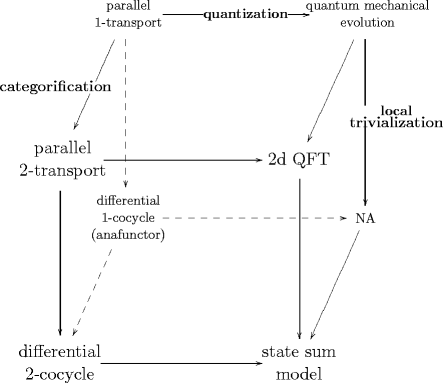
And for it has now finally been written up:
K. Waldorf & U. S.
Parallel Transport and Functors
arXiv:0705.0452
May 2, 2007
Grandis on Collared Cobordisms and TQFT
Posted by Urs Schreiber
Marco Grandis has a new preprint
Marco Grandis
Collared cospans, cohomotopy and TQFT (Cospans in
Algebraic Topology, II)
Dip. Mat. Univ. Genova, Preprint 555 (2007).
(pdf,ps)
As we know, quantum field theory is the study of representations of cobordism categories.
In most cases, in order to set up decent categories of cobordisms one needs to equip these with collars. A collar on a cobordism is certain extra data associated with its boundary which helps to avoid pathological gluing of cobordisms along their boundary components.
Grandis sets up the theory of cobordisms in full generality by considering categories of cospans.
A cospan models a cobordism with its “incoming” and “outgoing” boundary components injected into it. (This way of putting it is much less general that what Grandis actually considers).
These cospans are naturally composed using pushouts, which models the idea of gluing along common boundary components. Grandis proposes a way how to incorporate the notion of a collared cobordism into his category-theoretic setup. Then he uses this to study 2-dimensional topological field theory.
Cobordism cospans, as well as their dual spans of configuration spaces of maps from these into some “target space”, have been discussed at the -Café previously for instance in Slides for Freed’s Andrejewski Lecture or in QFT of charged -Particle: Dynamics.
In Hopkins Lecture on TFT: Infinity-Category Definition I had begun listing some relevant literature, like
Cheng/Gurski: Towards an -category of cobordisms
and
Jeffrey Morton: A double bicategory of cobordisms with corners.
Symposium on “Higher Gauge Theory” in Golm
Posted by Urs Schreiber
I just learned that the AEI in Potsdam-Golm hosts a workshop
Symposium on Higher Gauge Theory (poster)
8th May 2007, 10:00 am - 6:15 pm
May 1, 2007
Probability in Amsterdam
Posted by David Corfield
I’m off to Amsterdam today to attend the FotFS VI conference. I’m going to be speaking on what I’ve learned from my time amongst machine learning researchers (slides). It occurred to me that my entry into statistical learning theory has been slowed by its largely belonging to the culture of mathematics with which I am less familiar. E.g., the PAC theorem mentioned on slide 5 (page 4) derives from the ‘combinatorics’ culture, see also this related guest post on Tao’s blog. Perhaps this explains why I keep finding myself wanting to find more geometry about the place, as information geometry offers.
By the way, while I’m mentioning Tao’s blog, take a look at his post on a Fields Medalist Symposium held at UCLA. Café members may be especially interested in Tao’s descriptions of Vaughan Jones’ and Richard Borcherd’s talks. Do we have anything to say here about Borcherds’ Levels 0 to 4?