 Posts with this logo use


September 30, 2006
Dimensional Analysis and Coordinate Systems
Posted by John Baez

We had a nice conversation on dimensional analysis. Here are some things I learned.
September 28, 2006
Puzzle Pieces Falling Into Place
Posted by Urs Schreiber
There should be a 3-group governing Chern-Simons theory for gauge group . Which one is it?
I would like to present evidence that it should be the strict 3-group #
which is a sub-3-group of the non-strict automorphism 3-group #
Moreover, the canonical lax 2-representation #
for should extend canonically to a lax 3-representation
on endomorphisms of #.
Unless I am mixed up - which is your task to find out - this suggests to relate the correspondence
to higher Schreier theory #.
2-Groups and Algebras
Posted by Urs Schreiber
In another thread #, I am talking with Jim Stasheff and David Roberts about the question how to reconstruct a 2-bundle with connection from its local transition data #.
There are examples where I have some idea at least about certain aspects of the answer.
And there seems to be a pattern:
Example 1 is this: start with transition data on some space with respect to the 2-group coming from the crossed module (characterizing an abelian gerbe #). It is well known that this is equivalent to a -bundle on . happens to be the automorphism group of the algebra of compact operators on . Hence we can find the associated algebra bundle. Regarding each fiber not as a mere algebra, but as the category of modules of that algebra, we do obtain a 2-bundle of sorts. I think one can show that this is the 2-bundle whose local trivializations yields the 3-cocycle we started with #.
Example 2 is the string bundle with string connection by Stolz & Teichner #.
In both cases one can, I think, understand the algebra that the nerve acts on by automorphisms as the 2-vector space on which the 2-group is represented by its canonical 2-representation #.
So, clearly, there is some general mechanism at work which should generalize the above table from and to any strict 2-group. Which mechanism is that?
September 27, 2006
Toleration
Posted by David Corfield
One of the goals of our activity in this joint blog is to further the ends of mathematics and physics through our public conversations. Likewise for philosophy, if not directly through the refinement of -categorical thinking, then indirectly by observation of what it is to partake in an enterprise such as the furthering of mathematics or physics by -categorical means. Naturally, in terms of helping ourselves achieve those ends, we have to consider the question of what we are prepared to tolerate, both in terms of the content and the spirit of any contributions.
Bulk Fields and Induced Bimodules
Posted by Urs Schreiber
As I mentioned recently, Fjelstad, Fuchs, Runkel & Schweigert know how to describe 2-dimensional (rational) conformal field theory in terms of tangle diagrams in modular tensor categories .
There are various hints # that one can understand this formalism from the point of view of 2-transport # with values in .
Notice how this is rather analogous to principal 2-transport #, with values in a 2-group .
Instead of a 2-group, is just a 2-monoid. But the look and feel of both is rather similar: being modular tensor, in particular has left and right duals for all objects.
Many aspects of the diagrams drawn onto the worldsheet in the FRS formalism can be understood # from locally trivializing a 2-transport
which sends pieces of worldsheet to morphisms in .
One aspect of this is however a little troubling: only sees the 2-dimensional parameter space. However, FRS show that bulk field insertions in 2D CFT are represented diagrammatically by insertion points on the worldsheet at which ribbons emanate perpendicular to the worldsheet, into a third dimension.
In fact, this leads to a big story where the entire 2-dimensional field theory is described as the boundary part of a 3-dimensional topological field theory, generalizing the old observation by Witten on the relation between Chern-Simons theory and the Wess-Zumino model. I used to be puzzled about how to capture this 3-dimensional aspect of 2-dimensional CFT in terms of 2-dimensional transport.
But, remember, I also used to be puzzled about how to describe non fake-flat # principal 2-transport. There, the solution is # to pass from a 2-functor
with values in the the 2-group to the pseudo functor (a 3-functor, really!)
with values in the 3-group of automorphisms of .
Given what I said so far, there is really one question one should ask:
What happens if we consider weak 2-functors that send pieces of worldsheet not to a modular tensor category , but to the 3-monoid
of endomorphisms of ?
September 26, 2006
Fahrenberg and Raussen on Continuous Paths
Posted by Urs Schreiber
Suppose you want to transport something along some path through a space . Before you do so, you need to know what a path in is.
If is a smooth space, we tend to demand a path to be a smooth map
up to reparameterization. ( is the standard interval.)
What exactly is the analog of dividing out by reparameterization of paths in the case that is just a topological space?
Jim Stasheff, being interested in topological notions #, wondered why I kept going on about smooth paths # without ever talking about continuous paths. He was so kind to point me to the work
Ulrich Fahrenberg & Martin Raussen
Reparametrizations of Continuous Paths
Dept. of Mathematical Sciences, Aalborg University
Technical Report R-2006-22
(pdf)
where exactly this issue is investigated.
Our Raison D’être
Posted by David Corfield
Marni Sheppeard reports from the AustMS2006 conference, which, as anyone who knows about Australian mathematics might expect, is holding a category theory session. Dominic Verity is giving one of the talks, in which he considers the raison d’être for higher category theory, and so by extension that of the Café. Of course, we also come here for the coffee.
September 23, 2006
Mathematical Kinds
Posted by David Corfield
I’ve just sent off a paper Mathematical Kinds, or Being Kind to Mathematics to appear in the journal Philosophica. The idea of the paper is to explore the extent to which the language of laws and natural kinds, so much a part of the philosophy of science, is also appropriate to mathematics. To give a fresh example of this phenomenon, let’s consider the classification of finite simple groups.
September 21, 2006
Dimensional Analysis
Posted by John Baez
With your help, I would like to start amassing a collection of wisdom on gnarly issues in physics. Let’s start with dimensional analysis. I thought I had this pretty much figured out, until Kehrli pointed out a couple of things that surprised me:
- Dimensionless constants can depend on our choice of units.
- Dimensionful constants often don’t depend on our choice of units.
Categorification in Uppsala
Posted by David Corfield
Earlier this month the Mathematics Institute at Uppsala University hosted a conference called Categorification in Algebra and Topology, clearly a theme close to our collective heart. As yet there are only a handful of participants’ notes available (Scott Morrison’s are particularly well rendered), although the abstracts refer you to one or two others. What I’d like to have found out is whether there are differences in people’s conception of the scope of categorification.
The Why and Wherefore of History
Posted by David Corfield
Here are some notes for my talk at the Berlin workshop. Fortunately I was upgraded to a 45-minute talk. Even so, I didn’t manage to reach the last part where I discuss David Carr’s ideas.
I would be interested in a discussion here about practitioners’ histories. A couple of examples we might consider are Baez and Lauda’s draft History of n-categorical physics and Ronald Solomon’s A Brief History of the Classification of Finite Simple Groups, BAMS 38(3) 315-382.
September 20, 2006
Differential n-Geometry
Posted by Urs Schreiber
I need it all the time - and yet, I still don’t have it:
a nice arrow-theoretic way to talk about differential -geometry.
I know that greater minds than me have thought about this thoroughly before #. That I still don’t feel like having the satisfactory tools at my disposal probably has two reasons:
a) I am ignorant of what has been done already;
b) I feel the need for something somewhat different than what has been done already.
In order to find out which of the two it is, I want to start going through some gymnastics here in the -Café.
I am thoroughly (maybe hopelessly) motivated by
i) quantum physics
and
ii) the belief that -dimensional QFT lives in .
Maybe this explains point b) above. As far as I am aware, previous work in arrow-theoretic differential geometry was motivated by classical physics and the belief that suffices.
For instance, I believe that we want a notion of differential -forms that take values in -categories, like -functors do.
This belief is a consequence of particular physics applications that I have in mind, which I roughly know how to do already, but which need a more systematic underpinning. In particular, one of my goals is to give a good arrow-theoretic description of an -Dirac operator twisted by an -vector bundle with -connection. Unless I am confused, such a concept is at the heart of -dimensional supersymmetric quantum field theory (at least for and ).
Okay. The gymnastics starts below.
September 19, 2006
A Plea to Save New Scientist
Posted by John Baez
The SF writer Greg Egan has issued the following public plea to save the magazine New Scientist. Please take a look, and consider sending them an email.
September 18, 2006
Searching for a New Epistemology in Berlin
Posted by David Corfield
I’m back from a 48 hour workshop - Towards a New Epistemology of Mathematics. This provided the opportunity to meet up with some old friends, and form some new acquaintances. I met fellow blogger Kenny Easwaran for the first time, and heard him talk about The Role of Axioms in Mathematics. Dirk Schlimm made us think about why Jordan only thought to show that all composition series of a finite group, as feature in the Jordan-Hölder Theorem, have the same collection of numerical values of the orders of quotients of successive terms, while Hölder later gave the stronger result that it was true of the isomorphism classes of such quotients. While you might think that Hölder was enabled to do so having moved on to consider abstract groups instead of the substitution groups treated by Jordan, Dirk showed that Jordan did in fact have the technical resources to prove the stronger result. Something higher-level inspires you to pose the richer question.
September 14, 2006
Quantum n-Transport
Posted by Urs Schreiber
September 13, 2006
Higher Categories and their Applications
Posted by John Baez
As part of the Fields Institute program on Geometric Applications of Homotopy Theory, there there will be a workshop on:
- Higher Categories and their Applications, January 9-13, 2007.
There will be a strong emphasis on applications to homotopy theory and physics. Speakers include John Baez, Julie Bergner, Eugenia Cheng, Alissa Crans, Nick Gurski, Andre Henriques, André Joyal, Steve Lack, Aaron Lauda, Tom Leinster, Peter May, Joshua Nichols-Barrer, Simona Paoli, Urs Schreiber, Mike Shulman and Danny Stevenson.
For talk titles, abstracts and other information, see this blog entry.
The program also features some other interesting workshops (listed here) and courses, listed below.
Groupoids and Stacks in Physics and Geometry
Posted by John Baez
From January 8th to April 6th of 2007, the Institut Henri Poincaré will be running a program on:
This will include a workshop on Higher Structures in Geometry and Physics from January 15th to 19th, in honor of Murray Gerstenhaber’s 80th and Jim Stasheff’s 70th birthdays.
If you don’t know about groupoids and stacks, or even if you do, try this overview of the subject.
September 12, 2006
Freed on Higher Structures in QFT, I
Posted by Urs Schreiber
I would like to talk about things related to 3-dimensional topological field theories, along the lines of what John mentioned a while ago.
Before doing so, however, I want to better understand a general phenomenon, which has originally been identified by Dan Freed and is more recently being pursued by Simon Willerton and Bruce Bartlett. It also appears in recent work by Sergei Gukov.
The observation is, roughly, that what physicists call an action functional for a -dimensional quantum field theory is really just one component of something that looks a little like an -functor, which assigns to -dimensional volumes -Hilbert spaces.
I’ll briefly summarize what Freed and others have to say about this. What I would like to discuss then are some details of this concept. For instance, how to turn the above “looks a little like” into an “is”.
September 11, 2006
Wirth and Stasheff on Homotopy Transition Cocycles
Posted by Urs Schreiber
Way back in 1965, James Wirth wrote a PhD thesis on the description of fibrations
in terms of transition data
Here are elements of a good covering of by open sets, is the typical fiber, is a chosen trivialization of the fibration over , and its inverse, up to homotopy.
A new arXiv entry now recalls the main idea of this old work in modern language:
James Wirth & Jim Stasheff
Homotopy Transition Cocycles
math.AT/0609220.
September 9, 2006
Mathematics and Virtual Reality
Posted by David Corfield
If we consider the obstacles which stand in the way of certain actions, by and large they fall into two classes. Physical laws prevent us from tossing up a ton weight boulder into the air unaided, while social laws prevent us from going around murdering people. In the latter case, we may be able to perform the act physically, but are prevented by our obedience to the law which proscribes it. One tradition, whose history is far too complex to begin to describe here, has sought to make of these two classes one, arguing that some social laws, such as that forbidding murder, are natural laws, that is, are drafted in accordance with the nature of man, and, for many in that tradition, in accordance with the nature of his Creator.
September 8, 2006
Kock on 1-Transport
Posted by Urs Schreiber
A few months ago, I had a very inspiring e-mail conversation with Anders Kock on the concepts of connection, parallel transport and holonomy.
Connes on Spectral Geometry of the Standard Model, IV
Posted by Urs Schreiber
With some background material in place # # # I’ll now try to indicate how we can get something like the standard model as the effective target space theory of our “superparticle”.
(I’ll stick to this superparticle imagery #, but you should remember that this is my prose around Connes et al.’s formulas.).
This Week’s Finds in Mathematical Physics (Week 239)
Posted by John Baez
In week239 of This Week’s Finds, read about the n-Category Café, the resignation of the editorial board of Topology, the open access movement, Freeman Dyson’s 1951 lecture notes, the origins of mathematics in little clay figures called “tokens”:
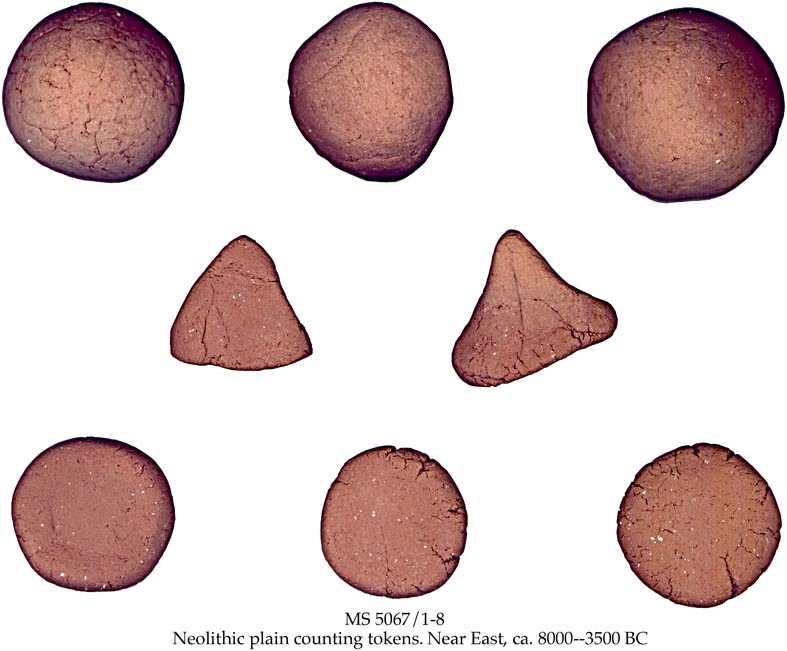
and - leaping straight from 8000 BC to the twentieth century - Koszul duality for L∞-algebras!
Category Theory and Philosophy
Posted by David Corfield
Bob Coecke wrote:
I strongly believe that the categorical approach provides the appropriate framework for a profound structural analysis for quantum theory, a currently lacking prerequisite for a decent philosophical analysis.
A couple of comments earlier, I had written:
Perhaps good things in the interpretation of Quantum mechanics are at last beginning to happen. It would be interesting to know what posterity had to say about the long period between its first appearance and its proper interpretation. There’s a philosopher of science, Michael Friedman, whose work I like very much, who sees advances in philosophy and mathematical science happening hand-in-hand. Whereas Newton led to Kant, and Einstein to the Vienna Circle, he feels that QM has never been philosophically worked over properly. For more on this see my paper.
Putting Bob and Friedman together, you could hardly miss the idea that the next revolution in philosophy should see category theory take a central place, just as logic did for the Vienna Circle in the 1920s and 30s.
But I’ve always been rather wary of the idea that some or other formal apparatus is going to act as a magic tool in the resolution of philosophical problems. Throughout my career as a philosopher I have frequently had the thought “I don’t see why you think a formal treatment of X is the right way to talk about X, but if you are going to do so why not use a proper formalism like category theory.” Presumably none of us here think category theory will help us much with a theory of justice or of history. On the other hand, as well as the ontology of physics, Mike Johnson’s category theoretic approach to databases give us a sense of what it can achieve at the level of everyday ontology. And I’d imagine it could help in statistics and probability. (For a recent attempt in statistics, see Peter McCullagh What is a statistical model? Ann. Stat. 30(5), 2002.)
So category theory is to feature prominently in the new philosophy, but, as Friedman’s examples make clear, it’s not just the taking on of a new mathematical language that constitutes a radical shift in philosophy. I’m not looking for an analytic philosophy Mark II.
September 7, 2006
Connes on Spectral Geometry of the Standard Model, III
Posted by Urs Schreiber
I’ll try to outline the main technical ingredients that are involved in the computation of a spectral action # from a given spectral triple #.
On n-Transport: 2-Vector Transport and Line Bundle Gerbes
Posted by Urs Schreiber
My first examples for the general concept of -transport # had been local transitions of principal 2-transport ##, taking values in some Lie 2-group.
For many applications in physics, one needs to have associated -transport, taking values in -vector spaces on which some -group is represented.
Here I present some notes which contain
- a working definition of associated -transport;
- an identification of a class of 2-representations of Lie 2-groups on bimodules # #;
- a description of (torsion) -gerbes with connection as associated 2-transport with respect to the above representation of the 2-group ;
- a demonstration that the transition data of such a 2-transport is precisely the data of a line bundle gerbe with connection and curving (and that in fact the 2-category of these transiton tetrahedra is equivalent to that of line bundle gerbes with connection).
Apart from being interesting in its own right, this is supposed to be a warm-up for describing more sophisticated 2-vector transport.
In particular, one can see that by replacing the 2-group in the above setup with the strict 2-group #, one obtains – up to technical subteties related to the fact that is infinite-dimensional – something very similar (maybe identical) to the the notion of string-connection that Stolz&Teichner defined #.
I conjecture that
A string connection as defined by Stolz&Teichner is the 2-vector 2-transport associated to a principal -2-transport by way of the 2-representation defined in the above notes.
I think that in as far as this conjecture is false it is just due to technicalities that can be fixed – like the fact that in the above notes I use the ordinary tensor product of bimodules, while for the -application we need “Connes fusion” #.
(I was waiting with posting this entry until I had tied up some lose ends in the above notes. But since we are now discussing this already in the comment sections #, I thought I’d just ahead and post it.)
Mathematical Circuit Components
Posted by David Corfield
From the post The Downward Spiral of Physics on the excellent new blog of Alexandre Borovik, we read Feynman lamenting the passing of the days when:
Radio circuits were much easier to understand in those days because everything was out in the open. After you took the set apart (it was a big problem to find the right screws), you could see this was a resistor, that’s a condenser, here’s a this, there’s a that; they were all labeled. And if wax had been dripping from the condenser, it was too hot and you could tell that the condenser was burned out. If there was charcoal on one of the resistors you knew where the trouble was. Or, if you couldn’t tell what was the matter by looking at it, you’d test it with your voltmeter and see whether voltage was coming through. The sets were simple, the circuits were not complicated. The voltage on the grids was always about one and a half or two volts and the voltages on the plates were one hundred or two hundred, DC. So it wasn’t hard for me to fix a radio by understanding what was going on inside, noticing that something wasn’t working right, and fixing it.
Borovik then comments:
Alas, similar cultural changes affect (and mostly negatively) the position of mathematics in modern culture. I leave it to the reader to come up with examples - they are abundant.
Might it be that n-categories, at least, as presented to us by John, offer us a form of mathematics closer to Feynman’s radio circuits? Working on Kleinian 2-geometry feels a little like that to me. “If your sub 2-space has features not invariant under equivalence, you know where the trouble is.”
September 6, 2006
Connes on Spectral Geometry of the Standard Model, II
Posted by Urs Schreiber
Last time I made some general remarks on the idea of spectral triples and of action functionals obtained from them.
Here I make some general remarks on the nature and the implication of the results found by Connes, in his search for the spectral triple describing our world.
Connes on Spectral Geometry of the Standard Model, I
Posted by Urs Schreiber
Alain Connes has a new report on recent progress in his old program of identifying the spectral geometry of the standard model coupled to gravity.
Alain Connes
Noncommutative Geometry and the standard model with neutrino mixing
hep-th/0608226.
Similar results have simultaneously found in
John W. Barrett
A Lorentzian version of the non-commutative geometry of the standard model of particle physics
hep-th/0608221.
In this first entry I’ll provide some background material. A followup will look at some of the details of the recent paper.
September 5, 2006
n-Transport and Higher Schreier Theory
Posted by Urs Schreiber
We are interested in categorifying the notion of parallel transport in a fiber bundle with connection.
There are several ways to define an ordinary connection on an ordinary bundle. Depending on which of these we start with, we end up with categorifications that may differ.
One definition goes like this:
Given a principal -bundle , let
- be the transport groupoid of , whose objects are the fibers of and whose morphisms are the torsor morphisms between these;
- be the groupoid of thin homotopy classes of paths in (meaning that we divide out by orientation-preserving diffeomorphisms and let orientation-reversing diffeos send a path to its inverse class).
Then a connection on is a smooth functor
This definition has an obvious categorification. Working it out (, ), one finds a notion of 2-connection with a special property that has been termed “fake flatness”.
There are a couple of applications where precisely this fake flatness is required (). For others, however, fake flatness is too restrictive (, ).
Now, there have been several indications that in order to get a slightly more general categorification we need a definition of connection with parallel transport which somehow involves not just the gauge group, but its automorphism 2-group ().
In fact, Danny Stevenson has developed a rather beautiful theory of connections - without an explicit description of parallel transport - and their categorification, by using not transport along finite paths, but infinitesimal/differential transport. He sees essentially this automorphism-extension appearing there and does get around fake flatness.
Danny Stevenson
Lie 2-Algebras and the
Geometry of Gerbes
Chicago Lectures on Higher Gauge Theory, April 7-11, 2006
(pdf).
This is directly inspired by
Lawrence Breen
Théorie de Schreier supérieure
Annales Scientifiques de l’École Normale Supérieure Sér.
4, 25 no. 5 (1992), p. 465-514
(pdf).
In this entry here I want to understand the integrated, finite version of Danny’s theory. Where he uses morphisms of Lie algebroids, I would like to see morphisms of Lie groupoids (smooth functors between smooth groupoids) along the lines of the first definition of connection with parallel transport stated above.
I had begun making comments on that over in the comment section of the 10D supergravity thread (). But it does deserve an entry of its own.
September 4, 2006
The History of n-Categories
Posted by David Corfield
Klein 2-Geometry V
Posted by David Corfield
I had hoped to mark my first appearance in the Café with a striking new contribution to our Klein 2-geometry project. The project began on my old blog back in May, and you can follow it through its twists and turns over the next 3 monthly instalments. I have enjoyed both participating in a mathematical dialogue and, as a philosopher, thinking about what such participation has to do with a theory of enquiry. The obvious comparison for me is with the fictional dialogue Proofs and Refutations written by the philosopher Imre Lakatos in the early 1960s. The clearest difference between these two dialogues is that Lakatos takes the engine of conceptual development to be a process of
conjectured result (perhaps imprecisely worded) - proposed (sketched) proof - suggested counterexample - analysis of proof for hidden assumptions - revised definitions, conjecture, and improved proof,
whereas John, I and other contributors look largely to other considerations to get the concepts ‘right’. For instance, it is clear that one cannot get very far without a heavy dose of analogical reasoning, something Lakatos ought to have learned more about from Polya, both in person and through his books.
September 3, 2006
Doctrines
Posted by John Baez
Universal algebra began as an attempt to deal with lots of familiar algebraic gadgets simultaneously: groups, rings, lattices, vector spaces, Lie algebras, and so on. A bunch of the same theorems hold for all of these - so why not prove them all at once and be done with it? It turns out to be possible!
In his famous 1963 thesis, Bill Lawvere showed how universal algebra can be formulated using categories:
- F. William Lawvere, Functorial Semantics of Algebraic Theories.
He saw that universal algebra was all about algebraic gadgets that make sense in any category with finite products. Shockingly, every such category can be seen as the “theory” of some such gadget. If is some other category with finite products, a product-preserving functor then gives such a gadget in . We call this a model of in .
However, besides categories with finite products, there are also other kinds of categories, which support other kinds of algebraic gadgets. So, around 1969, Lawvere massively generalized universal algebra - so much that he required a precise definition of “a kind of category”! He called such a thing a “doctrine”:
- F. William Lawvere, Ordinal sums and equational doctrines, Springer Lecture Notes in Mathematics No. 80, Springer-Verlag (1969), pp. 141-155.
This is a startling leap in abstraction, typical of Lawvere’s work.
Let’s talk about doctrines here. I’ll start by answering a question Urs Schreiber asked in another thread… and after I get some guesses, I’ll give the precise definition of a doctrine.
September 2, 2006
TeXnical Issues
Posted by John Baez
As with any sufficiently advanced technology, you can waste a lot of time trying to figure out why the hell it isn’t working.
Here you can read a little FAQ, followed by 400 questions and answers in the form of blog comments. I have disabled further comments because this particular entry is a favorite target of spammers. So, if your question is not answered in what you see below, please email me.
(Figuring out how to do this is a little intelligence test to weed out spammers.)
Ringoids
Posted by John Baez
Just as a “group with many objects” is a groupoid, a “ring with many objects” is called a ringoid.
Gregory Muller has emailed me a question about ringoids. I don’t want to get into the habit of posting emailed questions on this blog, because I already burnt myself out years ago helping moderate a newsgroup. But just this once, I will.
(Famous last words…)