


 Posts with this logo use


January 29, 2005
Linear Deficit

I’m teaching advanced mechanics, for juniors and seniors, this semester. And, once again, I’m driven bonkers by one of those educational peculiarities of UT (at least, I think it’s peculiar to UT).
I’m lecturing about damped, coupled harmonic oscillators (surely, the most basic problem in all of advanced mechanics), and I say, “OK, by introducing the velocities as independent dynamical variables, we can write Newton’s 2nd Law as a system of coupled 1st-order linear differential equations.” We can cast those equations in matrix form
where
and is a certain matrix. The solution is
and I then go on to explain that we can compute the exponential of a matrix if we know how to diagonalize it. Blank stares. And we can diagonalize , if we know its eigenvectors and eigenvalues. Uncomfortable rustling. “OK,” I ask this collection of junior and senior physics majors, “who knows how to find the eigenvectors and eigenvalues of a matrix?”
Slightly less than half the class raises their hands.
Whoa!
The problem, you see, is that, unlike most places, where linear algebra is bundled into 2nd-year calculus, the UT Math Department has unbundled it into a separate course. And, nowhere in the curriculum of the UT Physics Department is that course listed as a prerequisite. Thus students can hit my course or, G-d forbid, the Quantum Mechanics course, without so much as a passing acquaintance with linear algebra.
Having taught both courses before, I was prepared for this debacle. A brief review of finding the eigenvectors and eigenvalues of a matrix ensued. And then we exponentiated and found the general solution to the coupled harmonic oscillator problem.
Finally, we got to case where some of the eigenvalues of coincide. In this case (called “critical damping” in the case of the 1D harmonic oscillator), I explained that cannot be diagonalized. Instead, the best we can do (but still good enough for exponentiating it) is to put in Jordan Canonical Form.
“So, who knows what Jordan Canonical Form is?”
No one raised their hand …
January 27, 2005
Can’t Complain About the Weather
As you may have noticed, I now sport the local weather forecast on my sidebar. This is partly a technical “because it’s there,” and partly an artifact of the fact that my former office did not have a window.
The forecast is powered by NOAA’s XML service that I blogged about previously. One of the cool things about the internet is that, in response to my complaints, NOAA’s Director of Internet Services, Bob Bunge, chimed in to say that they were working on my issues. I’d like to thank Bob and especially John Schattel for working with me to iron out the bugs in their service.
Some were quite amusing:
The trouble revolves around our decision to calculate the sunrise and sunset times and base the decision to use “night” when the data time occurs after the sun has set. This logic does not return the correct result in the central time zone at this time of year [mid-winter].
Anyway, it took a while, but it looks like the bugs in their service are mostly squashed. So, despite having moved offices in the interim, I now sport the local forecast on my sidebar.
I’ve gotten a couple of emails asking me how I deal with NOAA’s XML service, so here’s a brief summary.
- NOAA updates the current conditions hourly, at 20 past the hour. I use a (completely trivial) script to retrieve the current conditions and cache them locally.
- The forecasts are updated hourly, at 50 past the hour. The forecast data is retrieved via SOAP and cached using the script described previously.
- To put things together, I run yet another script twice an hour, i.e. after each NOAA update. It parses the aforementioned XML files, using
XML::Simple, and spits out a file containing an XHTML fragment which I can include in my sidebar. Up to 7 days of forecasts can be produced. I settled for two.
Note that after haranguing NOAA for not using XML tools to assemble their XML, I copped out and generate my XHTML with a few simple-minded print statements as well. Using XML::Simple to assemble the desired XHTML document from the data would have been kinda painful. And, hey, nothing else in this sprawling expanse of blogging software does it “right” either.
January 25, 2005
Another MT Mail Exploit.
The MovableType Comment/Trackback/… system (which uses email to notify the blog owner of newly posted comments/trackbacks) is vulnerable to being exploited by spammers. (Surprised?)
Update now, before the spammers get around to your blog.
January 22, 2005
rel=”nofollow”
By now, you’ve surely heard about the announcement. Google (and other leading search engines) will now respect a new attribute to hyperlinks. There has been a deluge of comment, both pro and con. Phil Ringnalda has a nice list of links in his piece. I’m too lazy to add more links, but I bet you know how you could find some.
I also don’t think I have anything clever or original to add to the discussion, but want to explain what we’re doing here at Musings and why.
January 20, 2005
A Brief History of Golem
When I came to UT, I decided that
- I was going to be my own system manager.
- My machine name was not going to change, even though the hardware surely would.
- I was going to run a decent operating system (NeXTStep, and later MacOSX).
- Someday, I would get an office with a window.
| Purchased | CPU | RAM | Hard Drive | |
|---|---|---|---|---|
| HP 9000/712 | Feb, 1995 | 80 MHz PA/RISC | 64 MB | 2 GB |
| Macintosh G4 | Feb, 2001 | 466 MHz G4 | 1 GB | 30 GB |
| Macintosh G5 | Jan, 2005 | dual 2.5 GHz G5’s | 250 GB |
Today, generation III arrived.
- I unpacked the box.
- Hooked the FireWire cable up to Golem II, and booted into FireWire Target Disk Mode.
- Reformatted and partitioned the hard drive.
- Used CarbonCopyCloner to clone Golem II’s hard drive onto the new one1.
- After dinner and putting the kids to bed, returned to the office to swap out the old machine and replace it with the new. (It takes a while to copy 25 GB of files, even over FireWire.)
First impressions are that it’s a lot quieter than Golem II, in addition to being alarmingly faster.
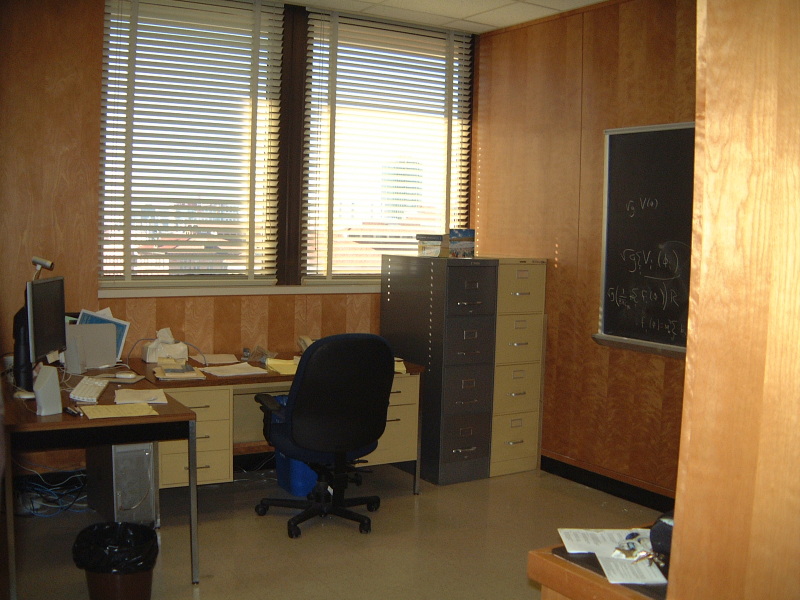
Oh, and all of this took place in my new office. The one with the window.
Update (1/25/2005):
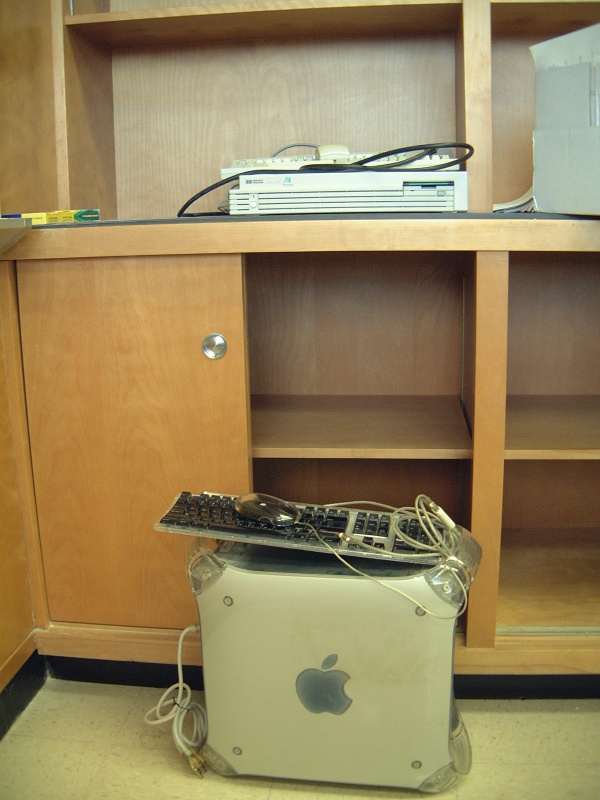
At Srijith’s request, some pictures of the new office.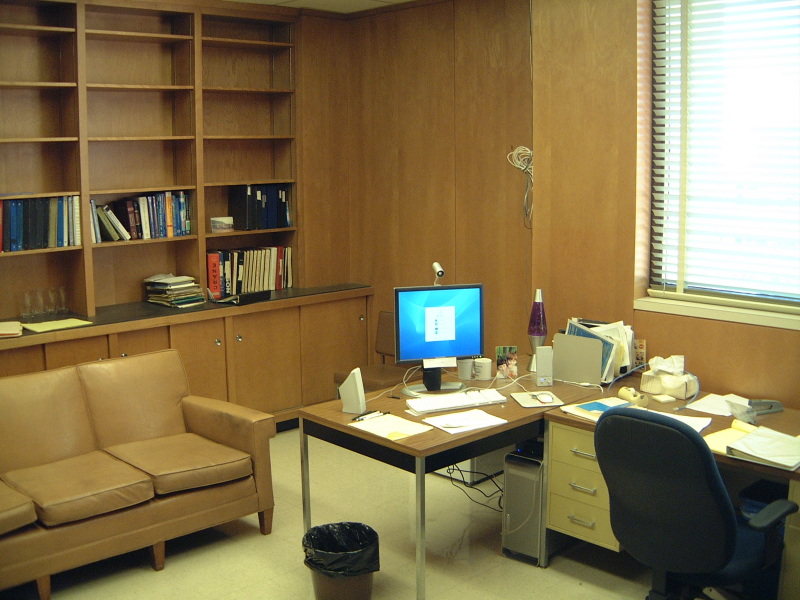
1 My friend at Apple, who write the scripts used by their Phone Support people, turns white as a sheet and starts to stammer when she hears about my method for upgrading machines. But I can attest that it works flawlessly.
January 17, 2005
Unbesmirched
Via Luboš Motl, I learn that Bill O’Reilly says he’s a Harvard alumnus
Take it from this Harvard alum. We’re not exactly talking the Mardi Gras up there in Cambridge. However, I did have some fun at Harvard, mostly at other people’s expense, which, of course, may have been ridiculous.
The thought that such a first-class nitwit might have graduated from my beloved alma mater was somewhat … unsettling.
Fortunately, alumnæ of Harvard College can breath a sigh of relief. None of the “William O’Reilly”s in the Harvard Alumni Directory graduated from Harvard College. There is, however, a certain “William J. O’Reilly” of Manhasset NY, who spent the 1995/96 academic year obtaining a Masters of Public Administration from the Kennedy School of Government.
KSG graduates will have to live with the ignominy.
Loop Review
Nicolai, Peeters and Zamaklar have done a yeoman’s job of reviewing Loop Quantum Gravity for the unitiated. As Luboš recounts, they find lots of things to be sceptical about. My brief encounter with the true believers certainly left me scratching my head.
Still, if you want to talk intelligently about the subject (if only to mount a withering critique), you need to know what they’re on about. And Nicolai, et al provide a fair-minded and very readable summary.
January 14, 2005
A Model for the Landscape
Arkani-Hamed, Dimopoulos and Kachru have a very nice paper in which they provide a simple field-theoretic model for Landscape-ish questions. In the context of this field theory, with a large number, , of vacua one can actually make quantitative statements about the statistical distribution of effective couplings.
They want to argue that, whereas the cosmological constant and electroweak scale can be effectively tuned for sufficiently large , the other couplings do not vary significantly from their central values as one samples the large number of vacua. The point is important because any attempt to obtain an anthropic bound on one coupling (say, the cosmological constant) usually assumes that one can freeze the values of the other couplings. If they vary, too, as one samples the ensemble of values of the cosmological constant, one obtains a much weaker bound (or no bound at all).
January 9, 2005
Confession
For the past 10 months, I’ve been serving up ill-formed XML, and nobody’s complained. Probably, no one even noticed.
How did I manage to keep up the charade for so long? By encoding the goop and passing it along as a string.
January 8, 2005
Reconnection
Well, seems we’re on a bit of a Cosmic Strings kick. Koji Hashimoto, who commented at some length on my last post on the subject, has a lovely new paper out with Ami Hanany.
In it, they take up the question of why the reconnection probability for colliding D-strings is so much smaller than for vortex strings. (For fundamental strings, the reconnection probability, at weak string coupling, is even more suppressed because it’s essentially a perturbative string effect.)
January 3, 2005
Santy Worm
Recently, golem has been peppered with attacks by the Santy Worm, which exploits a vulnerability in phpBB 2.x.
Those who are interested in such things, can read the actual exploit code (four Perl scripts fetched by the worm via HTTP, and then executed on the victim’s webserver). I’m curious how long that site will stay up. Even if the site’s owner were uncooperative, I would have thought that his upstream would have blackholed it by now.