


 Posts with this logo use


July 28, 2003
Leave the Country, Lose Your Songs?
I haven’t yet succumbed to the allure of the iTunes Music Store.
While nice in theory, I’ve been wondering how their DRM works in the “real world.” Sean Yeager recently posted a note to the effect that, having moved to Canada, iTunes refused to reauthorize the music he had purchased while living in the US. It appears that this was merely a glitch in the iTMS server software (compounded by misinformation from Apple Customer Support), rather than a deliberate restriction. But it’s just another reminder that you don’t really “own” the music you just purchased.
This kind of nonsense is why I held off for years from buying a DVD player. When I finally did buy one, I made sure it could be rendered Region-Free and that MacroVision could be disabled.
July 27, 2003
Brad’s Epiphany
I’ve lamented before the sad spectacle that Andrew Sullivan has become in recent years. But Brad DeLong nails it: Andrew Sullivan has become Noam Chomsky.
A sorrier fate for a self-described gay Thatcherite one can hardly imagine.
July 25, 2003
Not So Smart
Despite my entreaties in the past, Jon Gruber’s SmartyPants still attempts to process MathML elements (with the predictable disastrous results). The patch is so trivial, you’d think Gruber would have no objection to folding it into his distribution.
Whatever…
Location, Location, Location

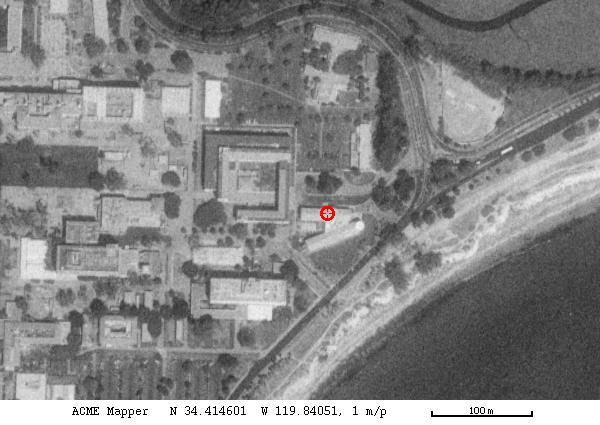
Here’s my office at the KITP (on a less foggy day and minus the construction, which is currently causing the building to shake).
Ron Donagi gave a great talk this morning about a version of Dijkgraaf-Vafa and large-N duality for compact Calabi-Yau’s. DV’s setup can be thought of as a noncompact Calabi-Yau
which, generically, has isolated singularities at . If , these can be smoothed by adding
The salient feature, according to Ron is that this degenerates to a curve (the plane ) when the parameters .
Their compact example is the intersection of a quadric and a quartic in . When the quadric has rank 3, one has a genus-3 curve of singularities, while the generic quadric gives a smooth Calabi-Yau. To first order in the deformation, they compute the corresponding integrable system and solve for the open-string invariants.
It’s quite a tour de force, made all the more remarkable by the fact that it’s not clear what they are calculating. Since the Calabi-Yau is compact, the total D-brane charge must vanish. So they need to put in both and antibranes (on the open string side). In a supersymmetric theory, the quantity they calculate would be the related to the glueball superpotential. In this non-supersymmetric gauge theory, I’m not sure what the interpretation should be. But it’s pretty exciting if there’s something exact that you can calculate in this nonsupersymmetric theory.
Greg Moore also gave a great talk about the C-field in M-theory. Yup, it’s an element of differential cohomology, . Mike Hopkins gave a series of lectures last week touching on this, which went way over my head. But these guys actually have a concrete model one can wrap one’s head around.
The idea is that, up to 15-skeletons, the classifying space of bundles is an Eilenberg-MacLane space
So an isomorphism class of bundle on an 11-manifold is equivalent to a choice of cohomology class . Their concrete model for the C-field is a pair , consisting of connection on an principal bundle, , and an honest-to-God, globally-defined, 3-form . They can write explicit formulas for the bosonic part of the 11D supergravity action in terms of and the field strength,
which are invariant under gauge transformations
where . Naively, the gauge group is , with the composition law
Now, Greg says this is too naive, and one should really take the gauge group to be which is a nontrivial extension
That means I still have to understand differential , understand how to compose two such guys, etc.
Rats!
July 21, 2003
When Metadata Goes Bad
Metadata is one of those buzzwords that cause some people to swoon, and others to grit their teeth whenever it is mentioned. But the subject of this post is prosaic, not ideological.
My online photo album runs on metadata. Digital photos contain two types of embedded metadata: EXIF data set by the camera (date/time the photo was taken, exposure settings, etc.), and IPTC info (caption, keywords, copyright info, etc.). My photo album is run by a set of perl scripts which create thumbnails, grab dates and captions from the embedded metadata and use these to build web pages. The whole setup is nice, but assumes that the metadata is “good”.
A few days ago, I got, via email, some pictures of my son at preschool. The pictures were lovely. Unfortunately, the embedded EXIF date/time data was bogus. And that would have fouled up my photo album.
Though many allow you to view it, none of the usual image manipulation tools would allow me to edit the EXIF data. That’s because the camera is machine and, unlike people, can be presumed to produce reliable metadata. Except … when it doesn’t.
I ended up editing the JPEG files in vi to set the date/time by hand. I later found out that there’s a commandline utilty called jhead that lets you modify the "DateTimeOriginal" field (tag 0x9003) in a somewhat more user-friendly way.
Evidently, this is not an uncommonly-needed feature…
Update (8/1/2003): GraphicConverter 4.8 (my digital photo manipulation program of choice) has been released. It now lets you set the EXIF date via a context menu.
July 16, 2003
Defence Department
The larger point is, and the fundamental question is, did Saddam Hussein have a weapons program? And the answer is, absolutely. And we gave him a chance to allow the inspectors in, and he wouldn’t let them in.
(Remarks by the President in Photo Opportunity, The Oval Office, 7/14/2003.)
Hello?
At first I thought this was simply a case of someone letting the Dauphin wander out of the Palace unsupervised. On reflection, I have come to the conclusion that this was a more calculated attempt to lay the groundwork for the “Stupid Defence”.
July 15, 2003
KITP
I’m at the KITP for the Geometry, Topology and Strings program. This week’s lecture lineup consists of Mike Hopkins and Emanuel Diaconescu. The first two talks were pretty heavy-duty. The topics are really interesting, so I’m hoping the subsequent lectures get a wee bit more accessible. Otherwise, it’ll be quite a slog.
One note I can’t resist: since my last visit, the ITP has replace its network of Sun thin clients (glorified X-terminals, IMHO) with 17" iMac’s running MacOSX in the visitor offices. Cool!
July 11, 2003
Let Sail
Several times in the past, I’ve gotten emails from Paul Ginsparg, demanding to know who “X” at UT Austin was, along with a link to a crackpot paper submitted by “X” to the archives. As if I were somehow responsible, not just for my fellow faculty, but for every last graduate student and postdoc at UT.
I suppose it’s only fair to ask, “Who the heck is Thomas Gold?”
Thanks to Sébastien Paquet for pointing out this little gem (by way of Dave Harris).
Dave Harris frets that the reporting on this in New Scientist is a black mark on science journalism. But, much as I respect Dave and others who try to make an honest job of it, my impression is that this is par for the course in science journalism. Most science reporters seem to check their journalistic scepticism at the door. This particular fellow was just extraordinarily unlucky, this time around …
P.S.: The New Scientist article mentions Crooke’s Radiometer. For those unfamiliar with the device, here’s an explanation of how it works.
July 10, 2003
Hacks
Feeling mischievous?
Let the boys from MIT inspire you.
Not in Kyoto
Scheduling prevents me from being at the Strings Conference in Kyoto this week. But I can live vicariously over the web.
Here are some of the talks that struck me.
July 6, 2003
Hack the ScreenSaver, Zap the PMU
Apparently, the password-protection of the MacOSX screensaver is vulnerable to a buffer overflow. Presumably, this is a flaw in the Cocoa Frameworks, because no one programming the password-entry field of a security module would be dumb enough to allow an extra-long password to crash the module.
Anyway, I hope Apple fixes this soon. (Update: Security Update 2003-07-14 has the fix.)
In other news, my practically brand-new (a month old) iBook battery started acting wonky. When plugged-in, the “time to recharge” would always say “Calculating …”. When on batteries, it would give reasonable “time remaining” readings, but the percentage readings would be totally off (e. g. “2%” remaining, when I purportedly had “2:58” of time left).
So I followed Apple’s advice to recalibrate the battery — let it drain down fully till the machine goes to sleep, then plug it into the AC and let it recharge fully. Big mistake! The battery drained down to 0%, but then it would not recharge. I tried following the instructions to reset the PMU, to no avail.
I was getting a bit frantic. These batteries are expensive suckers, and I’d just bought this one.
In desperation, I turned to the Apple Discussion Boards. These are typically useless, containing endlessly repetitive post whining about this or that problem (there are lots of iBook battery posts), or Apple Support’s response to same, with nary a piece of useful advice to be found. [There are, it should be said, no Apple employees contributing to the Discussion Boards. Apple’s only role, aside from hosting the site, is to delete the occasional post for violating a set of extremely arcane rules about what is permissible.]
Anyway, after reading through several hundred mind-numbing posts, I finally found one which offered a glimmer of hope. One guy with a similar problem had found that the solution was to reset the PMU, not of the iBook, but the one onboard the battery. The technique, apparently, is to briefly short-out the two outermost terminals of the battery. This did not sound like a great idea — I was a kid the last time I deliberately stuck a wire between the two terminal of a battery to watch the sparks fly — but since I had nothing to lose and about $180 to gain, I did as he suggested, reinserted the battery and lo and behold! it began to charge.
July 4, 2003
Accessibility
I decided to see if this blog could pass some basic accessibility tests. Since 1998, Federal Agencies have been required to adhere to certain web accessibility guidelines, called Section 508. Now, I’m not a Federal employee, but I do get funding from the NSF, and so I figured I ought to at least take a stab at it.
There’s a very good tutorial on building web sites which meet the guidelines. Another invaluable resource is Mark Pilgrim’s Dive Into Accessibility site, which covers almost all of the bases for Section 508 Accessibility.
Given Mark’s fame, it’s not surprising that his recommendations (and hence most of the things required to pass the Section 508 Accessibility tests) are already incorporated into the default MT templates.
My own previous cleanup had cleared up most of the remaining things which would cause accessibility problems. I really only had three classes of problems to fix.
- I had to ensure that all my images had real
altattributes.alt=""may pass the W3C Validator, but it still isn’t accessible. MT’s default Search Template does not define
<label>s for each of the form elements. One needs to replace things like<input type="checkbox" name="CaseSearch" /> Match casewith
<input type="checkbox" id="CaseSearch" name="CaseSearch" /> <label for="CaseSearch">Match case</label>- You must include
scopeattributes for table headers (that’s not the only accessible solution, but it’s the easiest). Each column header should say<th scope="col">...</th>and each row header should say<th scope="row">...</th>
Having read through the above-cited tutorials and made the requisite changes in my templates, it was time to run my pages past Bobby and Cynthia. Both require a certain amount of “manual” checking, over and above the automated tests, but in good conscience I think I can now display some new badges in my sidebar. [Well, almost good conscience. I doubt there are any screen readers out there that grock MathML. Even so, that’s still more accessible than using GIFs for equations.]
Update (8/13/2003): One point not flagged by Bobby or Cynthia was the need to explicitly indicate any use of foreign language words or phrases by using the xml:lang="" attribute. So, eg, I need to write
<span xml:lang="fr">plus ça change</span>
when I slip in a phrase in French. Screen readers need to know this to pronounce the text appropriately.
Update (8/19/2003): JAWS 4.51 claims to support both <abbr> and <acronym> tags. So I am now using them both. The distinction is important because a screenreader should read an acronym but spell out an abbreviation. I’ve also added an aural stylesheet, not that JAWS gives a hoot about such Standards-based niceties.
July 2, 2003
Photoproduction of Exotic Baryons
Interesting news out of Jefferson Lab (better known as the home of CEBAF). There’s a report of the existence of a relatively narrow bound state with an invariant mass of , and a width, .
The experiment collides multi-GeV photons on a deuterium target. The hypothetical exotic is produced in the interaction . It decays into , so it has the flavour quantum numbers of .
To the untutored eye, the graph looks impressive, and is claimed to be a effect. But we’ll have to wait for the PRL …

Update (10/8/2003): For more background, see this post.