The E6 Root Polytope
Posted by John Baez

I’ve been thinking about the exceptional Lie algebra E6, as a spinoff of my project on E7, so I want to get a good mental picture of the E6 root polytope. This is 6-dimensional polytope with remarkable symmetry.
Let’s climb up to the E6 root polytope starting with some of its 4-dimensional faces, which are called 4-demicubes because you get them by taking a 4-dimensional cube, or tesseract, and removing every other corner. The 3-demicube is just a tetrahedron, since you can fit two tetrahedra in a 3-dimensional cube like this:

The 4-demicube builds on this fact in a surprising way.
I’m going to use the technology of Dynkin diagrams, or technically Coxeter diagrams: they’re closely related, and the difference is invisible here. I won’t explain them, just use them. I explained them here:
• Symmetry and the fourth dimension: part 3, part 4, part 5, part 6.
Let’s dive in!
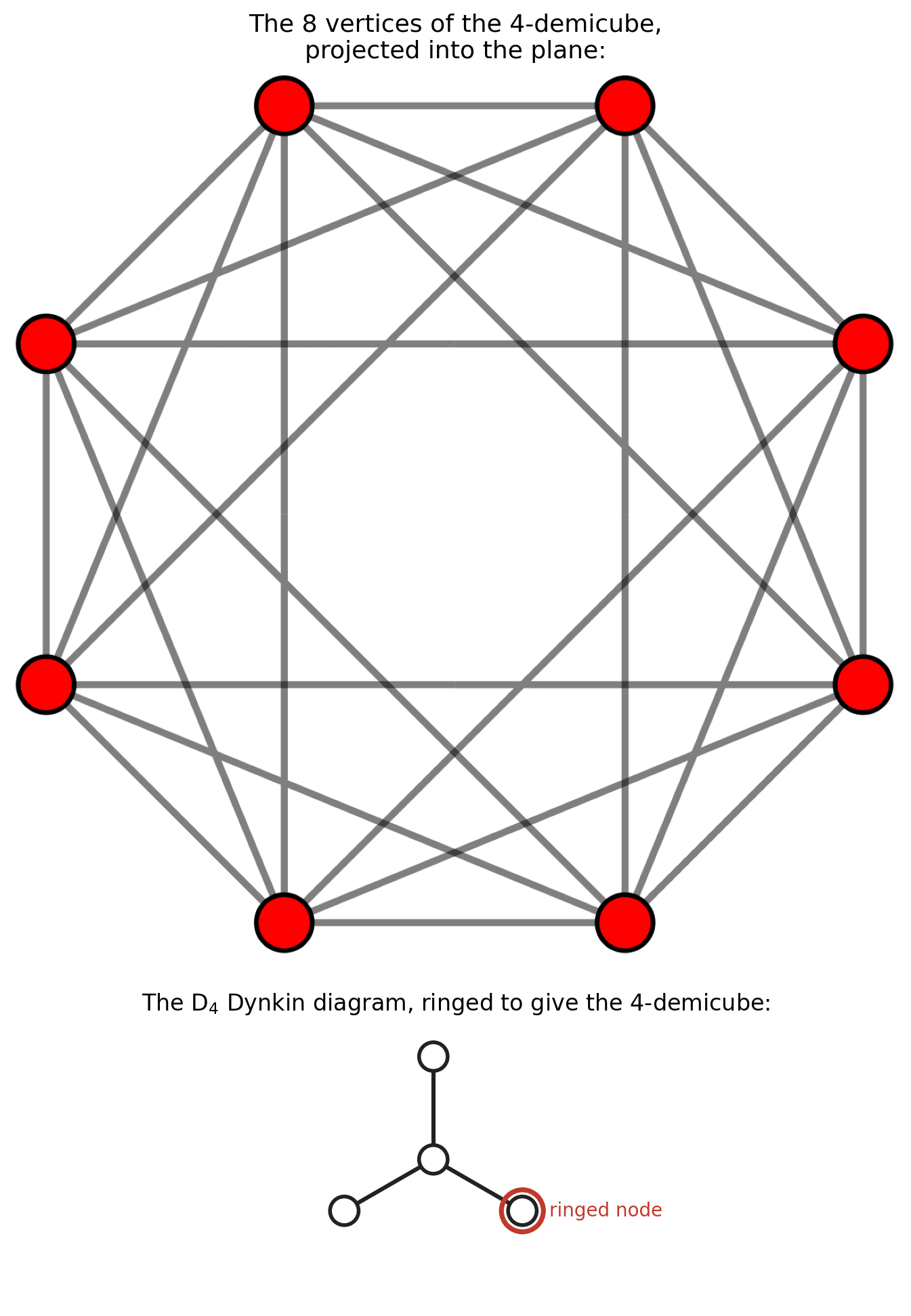
The 4-demicube lives in 4 dimensions. It has 8 vertices.
You get it from a 4-dimensional cube, which has 24 = 16 vertices, by keeping every other vertex, throwing away half. That leaves 8.
What are its top-dimensional faces, aka ‘facets’? Surprise: there’s only one kind! All of them are regular tetrahedra.
In higher dimensions the demicube has two kinds of facet. You get a simplex-shaped facet from every other vertex, formed when you remove it. And you get a demicube-shaped facet from each of the cube’s facets. But in 4 dimensions the two kinds happen to be the same shape!
Eight of them are tetrahedra. These appear at the 8 corners you sliced off: one per removed corner.
Eight more come from the 8 faces of the 4-dimensional cube. These are 3-demicubes. But as we’ve seen, the 3-demicube is also a tetrahedron!
So the 4-demicube is especially symmetric: it has 16 tetrahedral facets. You can find coordinates where its vertices are
It’s actually one of the 4-dimensional regular polytopes, sometimes called the 4-orthoplex. It’s also called the 16-cell because it has 16 facets. It’s the 4-dimensional cousin of the octahedron, which has 8 triangular facets.
You can read some of these facts off the D4 Dynkin diagram, if you know what you’re doing. As you can see above, this diagram has a central node with three arms, each just 1 edge long: a perfectly symmetric three-pronged star. To get the 4-demicube, you ring the tip of any one arm.
To get the facets of the 4-demicube, delete an unringed node so the piece still holding the ring stays connected, and see what diagram survives. There are two choices: you can delete the tip of either other arm. But either way, what’s left is a straight chain of 3 nodes—the so-called A3 diagram—with a ring at one node at the end. This gives the tetrahedron.
Both choices give the same shape of facet, a tetrahedron, because all three arms of the D4 Dynkin diagram are interchangeable. That ceases to be true in higher dimensions!
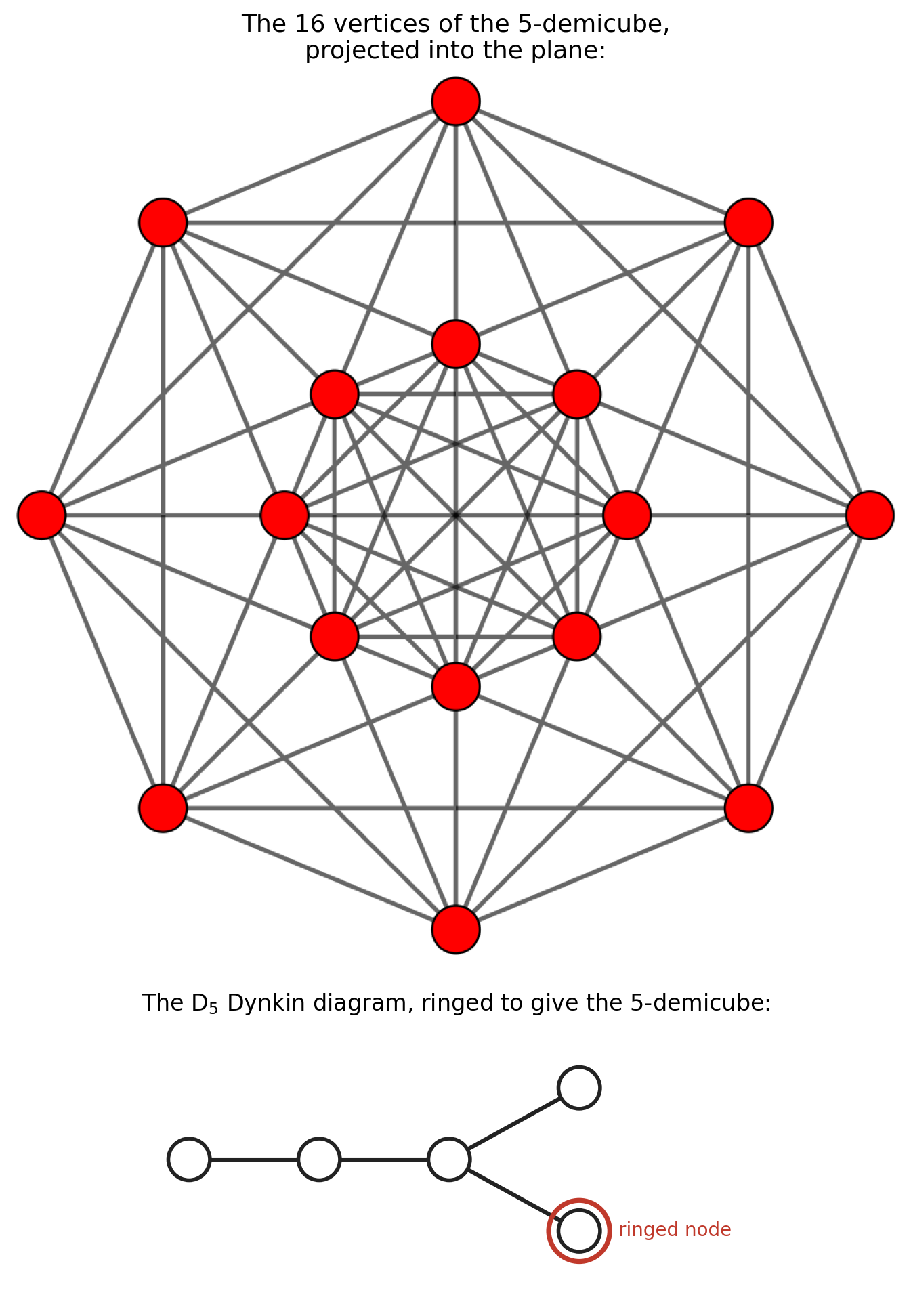
Next, the 5-demicube. This lives in 5 dimensions and has 16 vertices.
You get it from a 5-dimensional cube—which has 25 = 32 vertices—by keeping every other vertex, throwing away half. That leaves 16.
What are its top-dimensional faces, or ‘facets’? There are two kinds!
Sixteen of them are 4-dimensional analogues of the regular tetrahedron, called 4-simplexes. These appear at the corners you sliced off: one per removed corner.
The other ten come from the ten faces of the 5-dimensional cube. After you take every other vertex, they become 4-demicubes. These are precisely the 4-demicubes we saw in the last section!
You can also read these two kinds of facets from the D5 Dynkin diagram. As you can see above, this diagram has three arms of lengths 2, 1, 1 (edges from the central branch node). To get the 5-demicube, you ring the tip of either length-1 arm. That ringed diagram encodes the whole polytope.
To get the facets, delete an unringed node so the piece still holding the ring stays connected, and see what diagram survives.
There are two choices.
If you delete the tip of the other length-1 arm, what’s left is a straight chain of 4 nodes—the diagram whose polytope is the 4-simplex. That gives the 4-simplex faces.
Or you can delete the tip of the length-2 arm. Then what’s left is a shorter branching diagram, the one I showed you in my last post! That gives the 4-demicube faces.
So the 5-demicube has both 4-simplex and 4-demicube faces.
Next let’s go up to the 6th dimension, which was my goal all along.
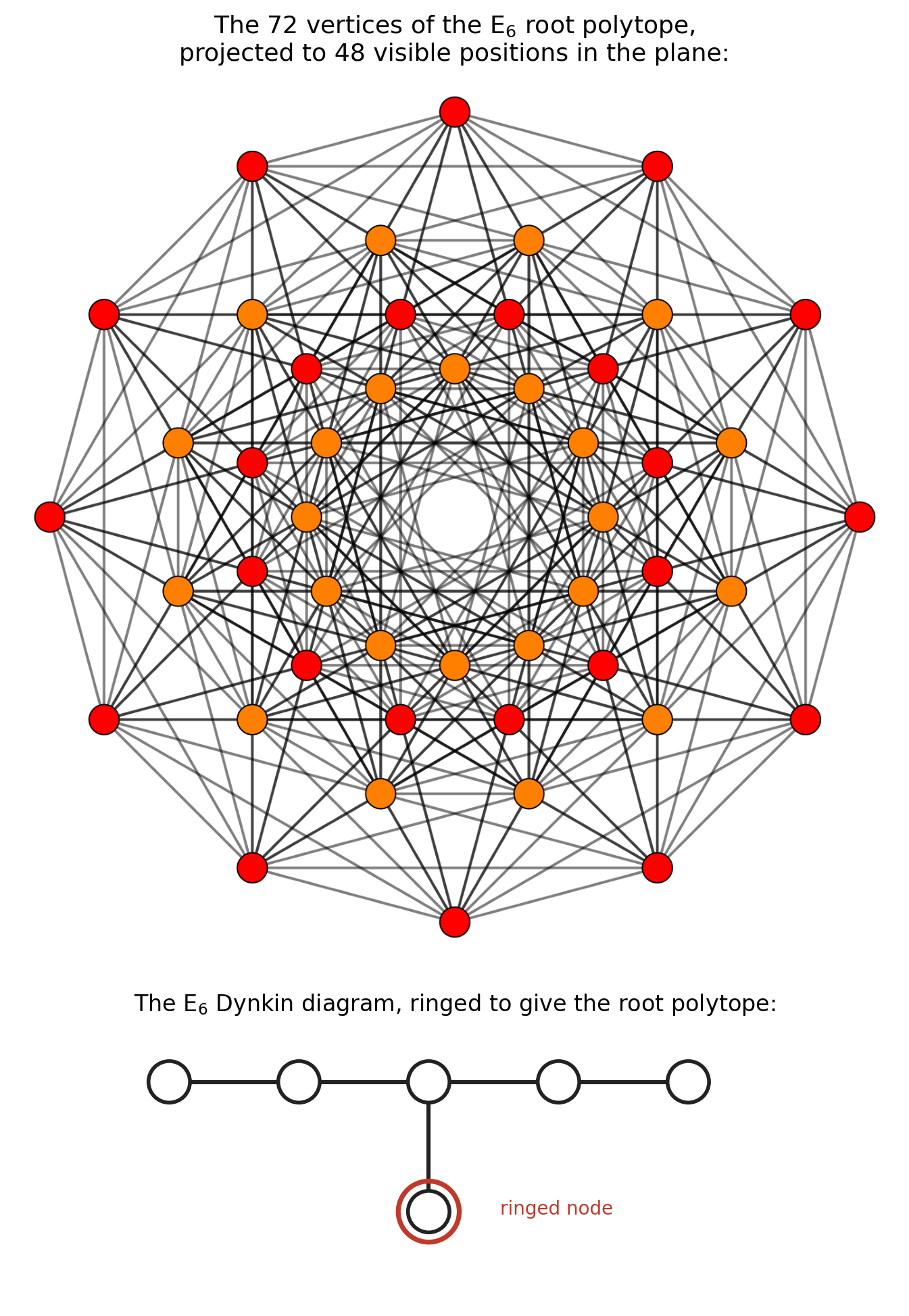
The E6 root polytope lives in 6 dimensions. It has 72 vertices.
What are its facets? You can read them straight off the E6 Dynkin diagram, using the same procedure we’ve been using so far.
As you can see, the E6 Dynkin diagram has three arms of lengths 2, 2, 1 (edges from the central branch node). To get the root polytope, you ring the node that’s the tip of a length-1 arm. That fact is not obvious, but let’s go ahead and do that.
Then, to get the facets, delete any unringed node such that the piece still holding the ring stays connected, and see what diagram survives.
There are two choices: the two other nodes at tips of the Dynkin diagram.
However, deleting either of these nodes leave a D5 diagram with a ring on one node, and this gives the 5-demicube we saw last time: a 5-cube with alternate vertices removed.
So the facets of the E6 root polytope are all the same shape: 5-demicubes!
With more work, we can count the facets of the polytopes we’ve been studying:
• The E6 root polytope has 54 facets, all 5-demicubes. They come in two kinds, because we had two choices of which node to delete, so there are really 27 ‘positive’ 5-demicube facets and 27 ‘negative’ 5-demicube facets.
• The 5-demicube has 16 4-simplex facets, one for each vertex that we removed from the 5-cube to create this demicube, and 10 4-demicube facets, one for each facet of that 5-cube.
• The 4-demicube has 8 3-simplex facets, one for each vertex that we removed from the 4-cube to create this demicube, and 8 3-demicube facets, one for each facet of that 4-cube. But both the 3-simplex and the 3-demicube are the familiar tetrahedron. So in fact the 4-demicube has 16 tetrahedral facets. Indeed, the 4-demicube is the 4-dimensional analogue of an octahedron: the so-called 4-orthoplex, or 16-cell.
Using some fancier math I explained here, we can count all the faces of the E6 root polytope:
| dim | faces | count |
|---|---|---|
| 5 | 5-demicubes | 54 = 27 + 27 |
| 4 | 4-demicubes = 4-orthoplexes | 270 |
| 4 | 4-simplexes | 432 |
| 3 | 3-demicubes = 3-simplexes = tetrahedra | 2160 = 1080 + 1080 |
| 2 | 2-simplexes = triangles | 2160 |
| 1 | 1-simplexes = edges | 720 |
| 0 | 0-simplexes = vertices | 72 |
If you’re curious about how to count these things, see how some of us counted all the faces of the E8 root polytope here:
- John Baez, Integral octonions (part 5), The n-Category Café, September 3, 2013.