Skip to the Main Content

Note:These pages make extensive use of the latest XHTML and CSS Standards. They ought to look great in any standards-compliant modern browser. Unfortunately, they will probably look horrible in older browsers, like Netscape 4.x and IE 4.x. Moreover, many posts use MathML, which is, currently only supported in Mozilla. My best suggestion (and you will thank me when surfing an ever-increasing number of sites on the web which have been crafted to use the new standards) is to upgrade to the latest version of your browser. If that's not possible, consider moving to the Standards-compliant and open-source Mozilla browser.

April 26, 2007

This Week’s Finds in Mathematical Physics (Week 250)

Posted by John Baez

In week250 of This Week’s Finds, start with a little puzzle about a game of flipping coins. Then learn about Popescu-Rohrlich game, which involves flipping coins and quantum entanglement!

Then, continue reading the Tale of Groupoidification — in which we start by recalling the history of special relativity, and use an example from relativity to ponder "atomic invariant relations". We’ll see these are just what mathematicians normally call "double cosets" — but we’ll see they’re also spans of groupoids equipped with extra stuff.

Posted at April 26, 2007 4:50 PM UTC

TrackBack URL for this Entry:   http://golem.ph.utexas.edu/cgi-bin/MT-3.0/dxy-tb.fcgi/1253

77 Comments & 2 Trackbacks

Re: This Week’s Finds in Mathematical Physics (Week 250)

You might emphasize, in the description of the coin-toss game, that you and your friend are required to blurt out your guesses at the same time. Otherwise guesser #1 could say “(My coin is) heads” so guesser #2 is guaranteed to be correct.

Also, a hint for the game: there exists a perfect losing strategy!

Posted by: Allen Knutson on April 26, 2007 5:31 PM | Permalink | Reply to this

Re: This Week’s Finds in Mathematical Physics (Week 250)

An email correspondent wrote:

About the coin flip coincidence — in order for the strategy to work the two friends must exchange one piece of information, in violation of the rules.

They need to initially agree to choose heads if heads or otherwise. If the experiment isn’t ‘prepared’ you are back to a ‘classical’ case.

To which I replied:

I understand what you mean, but:

They can adopt a strategy before the game starts; that’s not against the rules. Indeed it seems difficult to formulate a precise rule against ‘picking a strategy beforehand’.

Posted by: John Baez on April 30, 2007 9:35 PM | Permalink | Reply to this

Coin-tossing (contains spoiler)

Here’s another way to arrive at the best (and worst) strategies for the coin game.

It’s clearly equivalent to the following game: you each flip a coin, look at the result, then declare (simultaneously) whether you think the results are the same (HH or TT) or different. And it’s clear what the best strategy for that is!

Here’s another game that can be analyzed in a similar way, i.e. by observing that it’s isomorphic to a game whose solution is obvious. I have an ordinary deck of cards, face down. I turn them face up one by one. At some point you have to say “stop”, at which point I deal the next card; you win if it’s red. (You can say stop before the first card is dealt, but you must say stop at some point before the last card is dealt.) What’s your best strategy?

I don’t actually like this sort of problem very much. But I do like the solution.

Posted by: Tom Leinster on April 26, 2007 6:07 PM | Permalink | Reply to this

Re: This Week’s Finds in Mathematical Physics (Week 250)

Someone recently posed to our group the following problem, which resembles somewhat your coin-tossing game.

100 Bayesian inference people are imprisoned in a room. The guy who has imprisoned them is mad and wants to kill everybody, but as he is really completely mad he also wants to give them a tiny chance to survive all together. In another room are 100 boxes in a row. The name of each person is in one box (and reciprocally, each box contains the name of one person). The guard takes one person (say Mr A) from the first room and sends him to the second one. Mr A has to find the box which contains his name. For this, he is allowed to open 50 boxes. After these 50 attempts, if he has not found his name then everybody (the 100 people) is killed. If he has succeeded in finding his name, then he is sent to another room, and the boxes are put once again in exactly the same state as they were at the beginning, so that no information can be left by Mr A to the following persons. Then the guard takes another person from the first room and asks them the same thing (50 attempts to find your name). If this new person fails, then everybody (including Mr A) is killed, else a third person comes, and so on.

The aim: to survive.

The 100 people can discuss between them the strategy to adopt before the guard comes and takes the first person. There is no cheat (the guard knows every name) and really NO INFORMATION can be left from one person to the following one, except the fact that they are all still alive.

Intuitively, if one person chooses 50 boxes randomly, then the chances that the group is still alive after that decrease by 50%. So that if 4 persons (among the 100) choose randomly, then the expectation to survive is already less than 10%.

There does exist a strategy for which the probability that the whole group survives is more than 30%. Find it !

Posted by: David Corfield on April 26, 2007 6:17 PM | Permalink | Reply to this

Re: This Week’s Finds in Mathematical Physics (Week 250)

By the Law of Conservation of Sneaky Hints, and assuming that 100 is chosen as an approximation of infinity, then “more than 30%” is most probably 1 / e = 0.367879441.

“Derangement” is my follow-up clue. Which, if I’m right, proves that I know the solution, and if I’m wrong, identifies my mental state.

Posted by: Jonathan Vos Post on April 26, 2007 8:53 PM | Permalink | Reply to this

Re: This Week’s Finds in Mathematical Physics (Week 250)

100 as an approximation of infinity is right.

1 ln2 is approximately 30%.

Derangement belongs to the right branch of mathematics, but isn’t quite what’s wanted.

Posted by: David Corfield on April 26, 2007 10:04 PM | Permalink | Reply to this

Newton-Mercator series; Re: This Week’s Finds in Mathematical Physics (Week 250)

Having used what hackers call “social engineering’ to verify that 100 is approximately infinity, and the combinatorics – one can now reverse engineer a solution based on the Alternating Harmonic Series, a.k.a. the Merctaor series, a.k.a. the Newton-Mercator series, a.k.a. the Dirichlet eta function of 1.

ln 2 = SUM[for k = 1 to infinity] [(-1)^(k-1)]/k

That is, set x = 1 in the Mercator series:

ln(1+x) = SUM[for k = 1 to infinity] (x^k)[(-1)^(k-1)]/k
= x - (1/2)x^2 + (1/3)x^3 - (1/4)x^4…

It takes an infinity (or in our case 100) steps to apply the alternating series appropriately to the boxes. I’m assuming that, though no information is passed between bayesians with the boxes, they can agree to an assignment of integers in [1,100] to themselves, and assignment of numbers say from left to right on the boxes, and then all apply the same algorithm, i.e. the one I’m hinting at which has this generating function…

Posted by: Jonathan Vos Post on April 27, 2007 5:27 PM | Permalink | Reply to this

Re: Newton-Mercator series; Re: This Week’s Finds in Mathematical Physics (Week 250)

Dr. George Hockney emailed me as follows:

Well, I think Jonathan’s right but I’m not sure.
Here’s a strategy that might be best, but I don’t
need no stinking Bayesian inference:

1) Assume the 100 boxes in a row are arranged so
we can all agree on how to number them without
having seen them first. (I think this is implied)

2) Assume each person can decide which box to
open next based on the names in the previously
opened boxes. If the person has to point to 50
boxes first and then open them, we’re hosed.

3) Assume each person can remember each other
person’s name and the number we agree to assign
to that name. If not, assume we can trick the
mad guy into further humiliating us by assigning
us numbers and using the numbers in the boxes.
That way each person only has to remember his or
her own number.

Then do this: Each person opens the box with his
or her number. If that box contains that number,
we’ve won and can open other boxes at random –
it doesn’t matter. If that box contains any
other number, open that box number next. That
is, if I am number 2 and box 2 contains 17, open
box 17 next.

If everyone does this, then the probability we
all live is the same as the probability that the
longest loop is length 50 or less. In the large
N limit I think this is 1/e but I don’t know.
It’s certainly greater than 1/4.


Notice the first person always has a 50/50
chance. If the first person opened the box with
his number last, that means there is a chain of
50 boxes in a loop. Therefore, if the second
person is in that loop, she has a 100% chance of
living. If not, she also has a 100% chance
because the loop she is in can’t be longer than
50 since that’s all that’s left.

The bad case is when the first person finds his
number in the first box he tries. Then the
second person only has a 50/99 chance of living,
but this is good for our side since the first
person lived.


If assumption (2) is violated I think we can do
better than 1/2^n but not better than 1/2^(n/2).

I don’t make any use of the fact that the
previous people live in this strategy. There
might be a way to adapt given the numbers of the
people who went before me, but this strategy is
already good (it gets better as N gets smaller:
for N=1, it’s 1; N=2, 1/2; N=4, 3/8, and so
forth).

This may limit to 1/4 instead of 1/e or 1/3.

I suppose we can also try entangled quantum
strategies, but I don’t see how we can ever do
better than 1/2.

– George

Posted by: Jonathan Vos Post on April 27, 2007 6:09 PM | Permalink | Reply to this

Re: Newton-Mercator series; Re: This Week’s Finds in Mathematical Physics (Week 250)

George is certainly right about the strategy. Everyone receives a number from 1 to 100. Person N enters the room, opens box N, then follows the trail.

The analysis usually runs by seeing that what the people are hoping for is that the permutation on 100 symbols represented by the way the slips of paper are contained in the boxes has no cycle of length greater than 50. Then you need to find the probability that a random permutation on 100 letters has this property.

The details are here.

The resemblance to John’s problem is that the prisoners are managing to correlate their strategies so that if 1 fails at least 50 others will too.

Posted by: David Corfield on April 27, 2007 6:57 PM | Permalink | Reply to this

Re: Newton-Mercator series; Re: This Week’s Finds in Mathematical Physics (Week 250)

Looking at the Wikipedia article you linked, I don’t think you need to be nearly that clever to find the harmonic series formula!

How many permutations are there of 100 elements which have a cycle of length 51? To construct such a permutation you choose a cycle of length 51 and any permutation of the remaining 49 elements. The number of 51-cycles is 100 ××50 51 , and the number of permutations of the remaining 49 is 49 !. So there are 100 !51 such permutations. In other words, 1 /51 of the permutations contain a 51-cycle.

The same reasoning shows that 1 /52 of the permutations have a 52-cycle, and so on. So the bad permutations, the ones that result in us all being killed, are

(1) i=51 100 1 /i

of the possible permutations. (We can just add the proportions because the possibilities are mutually exclusive: if there’s a 55-cycle then there isn’t a 73-cycle, etc.)

Interesting puzzle!

Posted by: Robin on April 27, 2007 7:50 PM | Permalink | Reply to this

Re: Newton-Mercator series; Re: This Week’s Finds in Mathematical Physics (Week 250)

Well now that that’s run its course, maybe another one? Similar setup, but different mathematics (I think).

100 people are lined up, all facing the same direction along the line. Then everyone is given a red or a blue hat. Each person can see all the hats of all the people in front of them, but can’t see their own or that of anyone behind them.

The Madman starts at the back of the line. Each person he comes to must yell out the color they think their hat is (everyone hears the guesses) and if they guess wrong they’ll be shot (everyone hears the shots). What is the average number of people to survive with the best possible strategy?

Posted by: John Armstrong on April 27, 2007 9:45 PM | Permalink | Reply to this

Re: Newton-Mercator series; Re: This Week’s Finds in Mathematical Physics (Week 250)

99.5

Posted by: Aaron Bergman on April 27, 2007 9:47 PM | Permalink | Reply to this

Re: This Week’s Finds in Mathematical Physics (Week 250)

Say hi to Dr. Bub for me. I remember pushing for a lot of quantum computation in his quantum philosophy course my last semester at Maryland, especially after we’d met at the quantum computation short course at that January’s AMS meeting.

Unfortunately I can’t seem to find my copy of Interpreting the Quantum World anymore. I must not have gotten it back after one of the many times I’ve lent it out.

Posted by: John Armstrong on April 26, 2007 11:07 PM | Permalink | Reply to this

Re: This Week’s Finds in Mathematical Physics (Week 250)

Darn! He walked out the door to leave just after I read this — didn’t get a chance to catch him.

It’s the last night of the conference. The chef here had a nice telescope and after dinner we all went out and looked at the rings of Saturn, mountains on the Moon, and the phase of Venus.

Posted by: John Baez on April 27, 2007 10:34 PM | Permalink | Reply to this

Re: This Week’s Finds in Mathematical Physics (Week 250)

John Baez wrote:

Finally, if you lock yourself in a cellar and think about this for a few minutes (or months), you’ll realize that this weird-looking set is isomorphic to

H\G/K

For people like me who don’t have cellars, I’ll attempt a simple way to see what’s going on here, and hope that JB strikes me with lightning if I say anything misleading.

The quotient spaces G/H and G/K are the sets of right cosets of H and K respectively, so generic elements of each will take the form Hg1, Kg2. Now, I think the only sensible left action of G on the right quotient G/H is:

g(Hg1) = H(g1g-1)

and so the left action of G on G/H × G/K is:

g(Hg1, Kg2) = (H(g1g-1), K(g2g-1))

If we write the orbit that contains (Hg1, Kg2) as [(Hg1, Kg2)], then consider the map:

[(Hg1, Kg2)] → Hg1g2-1K

where the object on the RHS is the double coset containing g1g2-1. It’s not hard to see that this element is invariant under the left action of any g on the orbit representative. It’s also not hard to see that if we choose different representatives of our right cosets of H and K, in other words if we replace g1 by hg1 and g2 by kg2, we just get a new representative, hg1g2-1k-1, of the same double coset Hg1g2-1K.

Of course if we preferred, we could use the map:

[(Hg1, Kg2)] → Kg2g1-1H

which takes the orbits into K\G/H instead.

Sorry if this is excessively trivial! I want to post something slightly more substantial on this subject when my brain has defrosted a little more …

Posted by: Greg Egan on April 27, 2007 3:55 PM | Permalink | Reply to this

Re: This Week’s Finds in Mathematical Physics (Week 250)

Hmm, I’m not 100% sure that I used the correct cosets in the above; maybe I should have used left cosets for G/H and G/K?

But interestingly enough it seems to make no difference; everything seems to work out the same, either way. The left action of G on pairs of left cosets is simply:

g(g1H, g2K) = (gg1H, gg2K)

and we can use the map from the orbits into H\G/K:

[(g1H, g2K)] → Hg1-1g2K

or the map from the orbits into K\G/H:

[(g1H, g2K)] → Kg2-1g1H


Posted by: Greg Egan on April 27, 2007 4:34 PM | Permalink | Reply to this

Re: This Week’s Finds in Mathematical Physics (Week 250)

“But interestingly enough it seems to make no difference; everything seems to work out the same, either way.”

Because, at the next level of abstraction, the transformation {Left –> Right, Right–>Left} changes nothing. Automorphism…

Or am I about to be struck by lightning, and turned into Cantor dust?

Posted by: Jonathan Vos Post on April 27, 2007 5:49 PM | Permalink | Reply to this

Re: This Week’s Finds in Mathematical Physics (Week 250)

Greg wrote:

Sorry if this is excessively trivial!

It’s not! I’ve proved this fact a few times in my life, and I did it twice more while writing week250 just to reassure myself that it was still true. But, I couldn’t figure out any way to prove it without the slightly nerve-racking calculation you just did. It’s not the sort of stuff that’s really fun to read… so I decided to ‘leave it as an exercise for the reader’. But, it’s nice to have it available here.

Hmm, I’m not 100% sure that I used the correct cosets in the above; maybe I should have used left cosets for G/H and G/K?

To make me really happy, you would have used cosets of the form g 1 H and g 2 K, because I emphasized that I was thinking of H and K as acting on G via right multiplication, and modding out by that action — thus justifying the notation G/H and G/K with H and K on the right.

If you’d done this, there’d have been obvious left actions of G on G/H and G/K, namely

g:g 1 Hgg 1 H

g:g 2 Kgg 2 K

But, you used cosets of the form Hg 1 and Kg 2 . So, to get left actions of G, you were forced to use a trick — the usual trick for turning right actions of groups into left actions:

g:Hg 1 Hg 1 g 1

g:Kg 2 Hg 2 g 1

So, you wound up defining G\(G/H×G/K) in a slightly different way than I wanted… but it made no serious difference in the end! The differences were only inessential matters of convention, and you still got G\(G/H×G/K) H\G/K.

Normally one isn’t so pedantic about the notations G/H versus H\G. But in this double coset business it’s worthwhile being careful, since one is modding out by both left and right actions of subgroups of G.

However, one result of all this care is to see that one can relax somewhat, since one has a nice bijection H\G/KK\G/H.

So, in the end, it’s no big deal.

Posted by: John Baez on April 27, 2007 10:33 PM | Permalink | Reply to this

Re: This Week’s Finds in Mathematical Physics (Week 250)

OK, I’ll try a concrete example now.

Suppose G is the set of rotational symmetries of the cube, H is an order-4 cyclic subgroup generated by a 90-degree rotation that preserves a face, and K is an order-3 cyclic subgroup generated by a 120-degree rotation that preserves a vertex.

Then G/H will have 6 cosets gH, and will be isomorphic to the set of faces of the cube, and G/K will have 8 cosets gK, and be isomorphic to the set of vertices.

The action of G on G/H × G/K will, in effect, just rigidly rotate any pair (face, vertex) together, so there will be two orbits: one consisting of pairs of faces and vertices where the vertex lies on the face, and the other consisting of pairs where the vertex lies on the opposite face.

But being a rotation group rather than a projective geometry group, this is really about angles rather than incidence. We can think of G/H as being the 6 single points at the centres of faces, rather than the whole faces, and the invariant relation is then just the angle between the face centre and the vertex. If we were working with the whole of SO(3) and H and K were both isomorphic to SO(2), then the cosets would be directions in space, and the orbits / double cosets would be angles between those directions.

Posted by: Greg Egan on April 28, 2007 3:24 AM | Permalink | Reply to this

Re: This Week’s Finds in Mathematical Physics (Week 250)

One more concrete example, this one a bit more interesting than the last.

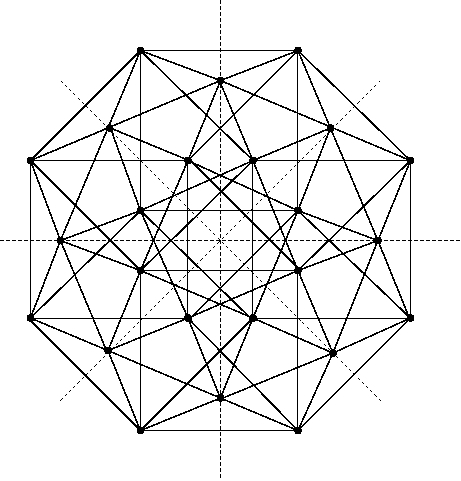
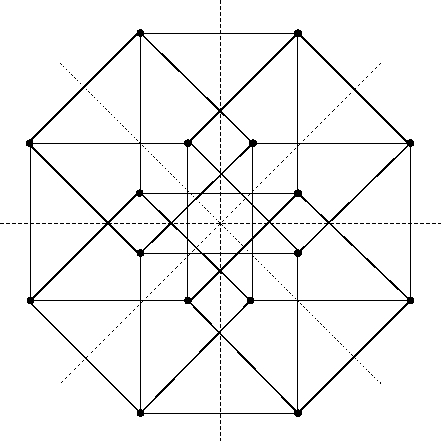
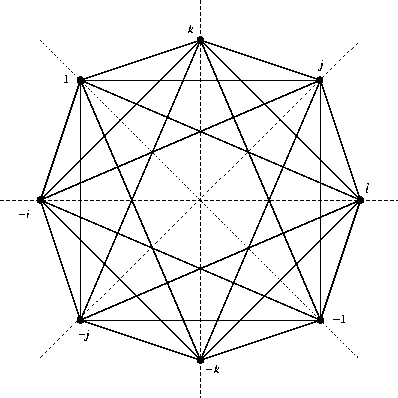
Suppose G is the set of rotational symmetries of the 4-cube. There are 192 elements in this group; one way to count this is to note that the full group of symmetries of the 4-cube can permute the 4 coordinate axes 4!=24 ways, as well as inverting any of them, giving 24=16 choices of inversions, for a total of 384 symmetries. Half of these, 192, will have determinant 1.

Now suppose we set both H and K equal to the order-8 cyclic subgroup generated by:

S:(w,x,y,z)→(-z,w,x,y)

It’s not hard to see that S has no fixed points except the zero vector. If you analyse its eigenstructure, you can show that it rotates by 45° in one plane, and 135° in a second, orthogonal plane. These two planes contain no “features” of the 4-cube: no vertices, edge-centres, face-centres, or 3-cube centres. They can’t, because the cosines of the angles between such k-cube-centres must be rational numbers (assuming our 4-cube has integer dimensions), whereas cos 45° is irrational.

So the choice of what we call a “figure” corresponding to H isn’t so obvious. We could choose one of the regular octagons where one of the planes of rotation of S intersects the boundary of the 4-cube. Or we could choose certain orbits of faces under the action of H, such as:

B1 = H . (1,1,0,0)

Successive applications of S produce face-centres rotated by 60° from the preceding one (though this is not a simple rotation in one plane, so we get back to where we started after eight operations, not six). What we end up with for B1 is a kind of band of eight faces zig-zagging around the 4-cube.

Band of Eight Faces

Because |H|=8, there will be 192/8=24 such bands of faces, meaning that each of the 4-cube’s 24 faces will belong to 8 different bands.

What are the possible invariant relations between two bands? I haven’t actually figured out the answer yet, so I’ll post again if I’m not too lazy to work this out, and I can find a reasonably simple way to describe the calculation …

Posted by: Greg Egan on April 28, 2007 12:01 PM | Permalink | Reply to this

Re: This Week’s Finds in Mathematical Physics (Week 250)

Oops, it turns out that the stabiliser of my figure B1 is larger than the cyclic group I gave for H. The map:

R:(w,x,y,z)→(z,y,x,w)

is not a power of S, but it preserves B1. So if we’re going to look at the invariant relations between these bands, we need to expand H to the 16-element subgroup that includes R, and note that there will only be 192/16=12 bands.

Posted by: Greg Egan on April 28, 2007 1:51 PM | Permalink | Reply to this

Re: This Week’s Finds in Mathematical Physics (Week 250)

OK, what are the invariant relations between bands of eight 2-faces wrapping around a 4-cube?

The stabiliser of one such band is the 16-element group generated by S and R, where:

S:(w,x,y,z)→(-z,w,x,y)

R:(w,x,y,z)→(z,y,x,w)

S has order 8 and R has order 2. We’re setting both H and K equal to this 16-element group. We’ve taken our canonical band to be:

B1 = H.(1,1,0,0)

and we can find all 8 elements of B1 by applying successive powers of S. Since S4=-I and every 2-face in B1 is accompanied by its opposite, we only really need to mention the first four 2-faces:

(1,1,0,0), (0,1,1,0), (0,0,1,1), (-1,0,0,1)

Our G is the 192-element group of rotational symmetries of the 4-cube, so there will be |G|/|H|=12 cosets of H in G/H, and hence twelve bands. I claim that there are just 4 double cosets of H in H\G/H.

(1) The first double coset has representative I, and is just H itself. The invariant relation between two bands this corresponds to is, of course, just being the same band.

(2) The second double coset has representative:

N:(w,x,y,z)→(w,-x,y,-z)

If we apply N to the first four elements of B1, we get:

{(1,1,0,0), (0,1,1,0), (0,0,1,1), (-1,0,0,1)}→

{(1,-1,0,0), (0,-1,1,0), (0,0,1,-1), (-1,0,0,-1)}

These elements are all orthogonal to the corresponding ones in B1, so N(B1) will have no 2-faces in common with B1, and that’s the invariant relation to which the double coset containing N corresponds.

In fact, N(B1) is a band that lies more or less in a plane orthogonal to that of B1; more precisely, while the 2-faces of B1 contain all the vertices of one octagon where one plane of rotation of S intersects the boundary of the 4-cube, N(B1) has the same relationship to the other plane of rotation of S. So N(B1) is the only band that has this precise relationship with B1.

(3) The next double coset has representative:

T:(w,x,y,z)→(w,x,z,-y)

If we apply T to the first four elements of B1, we get:

{(1,1,0,0), (0,1,1,0), (0,0,1,1), (-1,0,0,1)}→

{(1,1,0,0), (0,1,0,-1), (0,0,1,-1), (-1,0,1,0)}

The first 2-face is unchanged, but the others are mapped right out of the band. So only that first 2-face and its opposite will be in T(B1), and the invariant relation for the double coset containing T is sharing two 2-faces.

T(B1) is not unique in its relationship with B1; there are a total of 8 different bands that share two 2-faces with it, and for which the pair could be rotated into the same configuration.

(4) The last double coset has representative:

V:(w,x,y,z)→(w,x,-y,-z)

If we apply V to the first four elements of B1, we get:

{(1,1,0,0), (0,1,1,0), (0,0,1,1), (-1,0,0,1)}→

{(1,1,0,0), (0,1,-1,0), (0,0,-1,-1), (-1,0,0,-1)}

So V(B1) has every second 2-face, or 4 out of the 8, in common with B1, and so it corresponds to the invariant relation sharing four 2-faces.

There’s a second band besides V(B1) which has this relation to B1, and overlaps it on the other four 2-faces.

So we’ve accounted for all 12 bands:

  • B1 itself;
  • N(B1), which shares no 2-faces with B1;
  • eight bands that are like T(B1), sharing two 2-faces with B1; and
  • two bands that are like V(B1), sharing four 2-faces with B1.

I hope these grungy calculations haven’t lowered the n-categorical tone of the café too much. I can only really absorb these ideas if I work through a few specific examples and see all the greasy cogs in motion.

Posted by: Greg Egan on April 29, 2007 1:58 AM | Permalink | Reply to this

Re: This Week’s Finds in Mathematical Physics (Week 250)

Greg wrote ‘I hope these grungy calculations haven’t lowered the n-categorical tone of the café too much.’

Actually, I think they’re good for the n-categorical discourse (although I’m too busy to actually stop and digest them at the moment). I think in some ways the lack of detailed examples, due to page limits I’d imagine, ends up presenting the n-categorical stuff in a less than optimally appealing light (in my opinion).

Posted by: dave tweed on April 29, 2007 9:54 AM | Permalink | Reply to this

Re: This Week’s Finds in Mathematical Physics (Week 250)

Greg, I agree with Dave: concrete examples like yours are absolutely vital to getting a sense of what’s going on here. When Jim Dolan was first teaching me this stuff a couple of years ago, it was mainly through appeal to examples, and you’ve added some interesting ones!

By the way, Jim and I often call these double cosets ‘orientations’. Most of our examples have been of incidence geometry type, but I think ‘orientation’ still has a nice ring to it when applied to some of your other examples, such as SO(2)\SO(3)/SO(2).

Posted by: Todd Trimble on April 29, 2007 1:09 PM | Permalink | Reply to this

Re: This Week’s Finds in Mathematical Physics (Week 250)

Dave wrote:

I think in some ways the lack of detailed examples, due to page limits I’d imagine, ends up presenting the n-categorical stuff in a less than optimally appealing light (in my opinion).

Just so I don’t come across as some hoity-toity advocate of ‘example-free abstraction’, I should emphasize that I agree with this.

When trying to follow the Tale of Groupoidification, the best possible thing is to work through tons of concrete examples. It’s good for developing understanding, and it’s lots of fun.

The main reason I’m not doing this in This Week’s Finds is not quite ‘page limits’. It’s something more like ‘age limits’: I want to finish a sketchy version of the Tale before I get too old! We’re just at the very beginning of this story; there’s a lot more yet to come.

Another reason is that these examples are best described using lots of pictures, and those pictures take work to draw.

So far I’ve only emphasized three examples of atomic invariant relations (aka ‘double cosets’):

  1. those between a point and a line in projective geometry. There are 2 of these: the point can lie on the line, or the point can fail to lie on the line.
  2. those between a flag and a flag in projective plane geometry. In week250 I claimed there are 6 of these, as shown here:
                     \             /
          ------------x-----------x'----------
                       \         /         y
                        \       /
                         \     /
                          \   /
                           \ /
                            x"
                           / \
                          /   \
                       y'/     \y"
    
  3. Those between two timelike lines in Minkowski spacetime. Here there are infinitely many. In week250 we saw there are infinitely many of these: one for each pair of nonnegative real numbers, representing relative speed and distance of closest approach (in physics also known as ‘impact parameter’).

It’s also good to look at tons of examples involving finite groups. So, I’m really glad Greg is presenting some of those.

I’ll get around to some more soon. A bunch of nice ones come from Coxeter groups. The rotation/reflection symmetry groups of n-cubes are the B n series of Coxeter groups. So, what Greg is doing will fit into a nice big picture.

Posted by: John Baez on April 30, 2007 8:46 PM | Permalink | Reply to this

Re: This Week’s Finds in Mathematical Physics (Week 250)

Just to clarify: when talking about page limits I was more talking about the more formal publications (arxiv, journal, etc); the TWFs tend to be more example-rich.

One of the important points about concrete examples is that you can independently “weakly-verify” out something you believe you’ve understood in the original theory (because you can just work out things directly in the concrete example). From some of your posts I think you and your group also do this, it just isn’t obvious from reading some of the papers. As a real-life example, a while ago I tried doing some stuff in a (non-commutative) clifford algebra and it was slow going until I found the matrix representation so I could do numerical instances by computer as a weak-verification check I wasn’t implicitly using commutativity anywhere I shouldn’t have.

Posted by: dave tweed on May 1, 2007 9:00 AM | Permalink | Reply to this

Re: This Week’s Finds in Mathematical Physics (Week 250)

If I haven’t yet bored all café readers away from this sub-thread, here’s a question I meant to ask earlier: given a group G with an arbitrary subgroup H, and given a set X on which G has a left action, what’s the magic ingredient that guarantees that there will be some subset Y of X with a stabiliser that is isomorphic as a group to H?

It’s obvious that we can cook up a set X where everything works nicely: we just choose X=G/H, making the points of X the cosets of the form g1H, and the left action is:

g:g1H→(gg1)H

Then the stabiliser of the point g1H will be the subgroup g1Hg1-1.

But when we’re not free to choose X, things aren’t so clear.

I’m fairly sure that Y can’t always exist, because of the example I discussed in my last few posts, where the stabiliser of the figure I was looking at turned out to be larger than the cyclic group I originally planned to use.

Posted by: Greg Egan on April 29, 2007 5:11 AM | Permalink | Reply to this

Re: This Week’s Finds in Mathematical Physics (Week 250)

Greg wrote:

Given a group G with an arbitrary subgroup H, and given a set X on which G has a left action, what’s the magic ingredient that guarantees that there will be some subset Y of X with a stabiliser that is isomorphic as a group to H?

In the precise way you’ve written down this question: I don’t know.

But you’ve written it down in a strange way, haven’t you? I’m assuming you agree with the standard correspondence between

(1)transitiveGsetssubgroupsHGuptoconjugation.

Given a G-set X, pick xX and form H(X,x)=Stab(x). On the other hand, given HG, form the set X(H)=G/H on which G acts from the left.

Doing and then , we get a transitive G-set X(H(X,x)), each of whose stabilizer groups (of any point) are conjugate to H.

Doing and then , we get the subgroup H(X(H),H )=H since we had to pick an element (read : coset) H . But we know H is conjugate to H by construction.

But you’ve asked your question in a different way. You haven’t said that your G-sets are transitive - which I assume is just a typo - but you also talk about the stabilizers of subsets YX instead of the stabilizer of a point xX. This puts you out of the ‘first-order’ theory pic.

Actually, it’s a question worth asking. I’m assuming that we agree on our notion of stabilizer : the stabilizer of a subset YX is the set of all gG which leave Y fixed as a set , i.e. they don’t have to fix Y element-wise.

So, question :

What information can you get out by considering stabilizers of subsets instead of points?

This actually comes up in the context of Lie groups. Consider a Lie group G acting on itself by conjugation, we call the resulting G-set ΛG. On the other hand, consider the set Torii(G) of maximal tori (maximal abelian closed subgroups) of G.

G also acts on Tori(G) by conjugation, and it is a theorem (at least for compact Lie groups, I think) that this it acts transitively.

On the other hand, it’s clear that Tori(G) is some kind of ‘coarse-graining’ of ΛG. The stabilizers in Tori(G) are exactly the stabilizers of subsets in ΛG, and they’re related to the Weyl group, etc. Is there a nice way to understand this?

Posted by: Bruce Bartlett on April 29, 2007 11:22 AM | Permalink | Reply to this

Re: This Week’s Finds in Mathematical Physics (Week 250)

Thanks for the reply, Bruce. Needless to say I have no hope of answering your question!

Maybe I can make my own question clearer. If you hand me a G-set X and a subgroup H of G, my “generic expectation” (for want of a more precise criterion) would be that if I pick a generic point x in X, its orbit under H will have no extra symmetries other than those of H itself. The reason for this intuition goes back to Euclidean geometry. Suppose G is SO(2), X is the fundamental representation of SO(2) on R2, and H is the cyclic subgroup generated by a rotation by 2π/n. Unless I’m very unlucky and pick the origin as x, the orbit of x under H will consist of the vertices of a regular n-gon, and will have H as its stabiliser.

And in the example I’ve been puzzling over, where H is the cyclic subgroup generated by this linear operator on R4:

S:(w,x,y,z)→(-z,w,x,y)

(which happens to be a rotational symmetry of the 4-cube) if I choose a generic point x in R4, the stabiliser of its orbit under H will be H itself. But if my G-set is restricted down to any of the k-cube-centres of the 4-cube (e.g. face-centres, vertices, etc.), the stabiliser turns out to be a larger group, with H as a subgroup.

So I guess what I’m trying to do is put my finger on precisely what makes one case of this construction “sufficiently generic” and another not.

Posted by: Greg Egan on April 29, 2007 1:51 PM | Permalink | Reply to this

Re: This Week’s Finds in Mathematical Physics (Week 250)

It seems to me that the phenomenon you mention simply has to do with whether H acts freely or not.

Let me try to place it in a broader context, and write it in the language John has been using.

Suppose we have a G-set X. We think of this as a groupoid X//G. Notice that in this language, if HG is a subgroup, then an “orbit of H”, i.e. a set of the form Hx where xX, is just a subgroupoid of X//G:

(1)OrbitHxsubgroupoidofX//G.

That’s nice - it means we don’t have to mention H nor the point x at all to understand what an “orbit” is.

Okay, now for an area where the new terminology (groupoids instead of G-sets) seems to work so much better : automorphisms!

In the bad old days, given gG, we could act on the left by g to get a function f g:XX. But sadly it wasn’t an automorphism, since f g(x)=gx, but f g(hx)=ghxhf g(x). Nasty!

But in the groupoid picture, we can play this game. Given gG, we get a functor F g:X//GX//G, defined by sending

(2)hxghg 1 gx.

The trick here is that we’re kind of allowed to ‘rotate’ our group as we go along. So - we get a nice homomorphism

(3)GAut(X//G)!

Okay, back to your original question :-) Given a G-set X, a natural thing to consider is the category Sub(X) of all subgroupoids of X//G. Objects are subgroupoids (think : orbits), while morphisms are… functors. Something like that (I’m making this up - perhaps someone can help me out).

For example, think of the orbit space Hx. It’s a groupoid in its own right, and any hH determines a functor F h from this groupoid to itself, in the way described above. In other words, in John’s language, H is always a subgroup of the stabilizer of the orbit Hx,

(4)HAut(Hx//H).

But of course it can be bigger. For if there are two arrows going from a to b (think of the two element set which is acted on by 4 ), then these other arrows also give you automorphisms.

I’ll stop here, since this is too long by now.

Posted by: Bruce Bartlett on April 29, 2007 6:57 PM | Permalink | Reply to this

Re: This Week’s Finds in Mathematical Physics (Week 250)

The trick here is that we’re kind of allowed to ‘rotate’ our group as we go along. So - we get a nice homomorphism GAut(X//G)!

Nice point!

What about the converse?

Secretly – in one of the private corners of the n-Café – we were talking about this in the context of principal bundles, where X=P x would be a fiber of such a bundle.

Now, this seems to suggest an interesting relation to some other meme inhabiting the n-Café. Schreier theory combined with the integrated Atiyah sequence tells us that, given the principal G-space P x, we first form P x× GG, (where the G-action of G on P is the standard one (here taken to be from the right) and that on G itself is by the adjoint action).

This is a group. For tP x the group operation is (t,g)(t,g)=(t,gg). If, on the other hand, we multiply (t,g) with (t,g) we first find g˜ such that t=tg˜, which gives us (t,g)=(t,g˜gg˜ 1 ); and then use the above formula.

So this group P x× GG is isomorphic to G. But not canonically so. Every element of P x defines one group isomorphism P x× GGG.

Interestingly, also torsor automorphisms F act on this group, but only by inner automorphisms: (t,g)(F(t),g)=(tg˜,g)=(t,g˜gg˜ 1 ).

Anyway, we can form the automorphism 2-group of this: AUT(P x× GG).

This now reminds me a lot of your Aut(P x//G).

What precisely is the relation between the two?

Posted by: urs on April 30, 2007 5:39 PM | Permalink | Reply to this

Re: This Week’s Finds in Mathematical Physics (Week 250)

What precisely is the relation between the two?

Okay, I am short of time, but let’s see what can be done.

First: what is the most general automorphism of the groupoid Aut(X//G), in the case that G acts free and transitively?

Let F be such an automorphism. Pick some element xX. It will be sent to y=F(x). Moreover, it is clear that F has to act by group automorphisms of G on morphisms. So F:(xhhx)(yF(h)F(h)y). This shows that F is now also already fixed on all objects.

So: every choice (x,y)X×X of a pair of points in X together with a choice FAut(G) of a group automorphisms defines an automorphism of the action groupoid X//G. And every such automorphism is obtainable this way.

But not all such choices gives different automorphisms:

let x=x˜g and y=y˜F(g).

Then the above assignment reads F:(x˜ghhx˜g)(y˜F(gh)F(h)y˜F(g)), which is the same as that defined by ((x˜,y˜),F). This means we can always fix x and only vary y. So pick that fixed element x once and for all. Then automorphisms are given by pairs (y,F)X×Aut(G).

When Bruce defined the morphism GAut(X//G) he used g(xg,Ad g).

Hm, no time to ponder what this is now telling us…

Posted by: urs on April 30, 2007 6:11 PM | Permalink | Reply to this

Re: This Week’s Finds in Mathematical Physics (Week 250)

Good question. But since P x× GG is isomorphic to G as a group (even though the isomorphism is not canonical), it must be that their automorphism 2-groups are isomorphic,

(1)AUT(P x× GG)AUT(G).

Also, inner automorphisms of the one go over into inner automorphisms of the other.

On the other hand, consider Aut(P x//G). It seems there are three basic types of automorphisms :

(1) Torsor automorphisms, i.e. maps satisfying F(xg)=F(x)g (using a right-action). We think of these as functors which send

(2)xgF(x)g,

(2) ‘Rotating’ automorphisms for each hG, which send

(3)xgxhh 1 gh,

(3) Other, ‘outer’ automorphisms.

Heh, I guess I’m hedging my bets and avoiding your question! All I want to say here is that I would think of both the first two types as ‘inner’. Moreover, it’s clear that these two 2-groups are not the same… at least not obviously the same! For in the case of Aut(P x//G), each hG gives a distinct automorphism, while in the case AUT(P x× GG), the inner automorphisms are quite few in number. I mean if G is abelian, there is only one inner automorphism.

Posted by: Bruce Bartlett on April 30, 2007 6:57 PM | Permalink | Reply to this

Re: This Week’s Finds in Mathematical Physics (Week 250)

Moreover, it’s clear that these two 2-groups are not the same… at least not obviously the same!

I’d be surprised if they were not related, as I said. Maybe equivalent, maybe one being a sub-thing of the other.

Both are 2-groups that are canonically associated - up to equivalence already - with a group G and the notion of a torsor of it. Nothing else. Both essentially already look like AUT(G) already - up to choices of elements in a G-torsor.

So that’s why I would be surprised if they were not related.

But I should work it out.

Posted by: urs on May 2, 2007 9:43 AM | Permalink | Reply to this

Re: This Week’s Finds in Mathematical Physics (Week 250)

Thanks, Dave and Todd, for encouraging my grungy calculations! If I get the tablecloth dirty, I suppose I can pay off the damage by washing some dishes.

Bruce wrote:

It seems to me that the phenomenon you mention simply has to do with whether H acts freely or not.

Thanks! That seems to be a very important part of it, though maybe we need to talk about whether G acts freely, not just H.

In the two-dimensional example I gave, where H is Cn and G is SO(2), all of G acts freely on R2\{0}. But then if you change G to O(2), H still acts freely, of course, but there will now be some reflection not in H which is a symmetry of the n-gon H⋅x.

In the four-dimensional example, if we make G the rotation symmetries of the 4-cube, then obviously it doesn’t act freely on the 4-cube’s vertices, edge-centres, etc., or on points that lie in planes that contain certain of those k-cube-centres. If we make H the order-8 cyclic group I described, then H acts freely on R4\{0}, but then the annoying extra symmetry of the orbit H⋅(1,1,0,0):

R:(w,x,y,z)→(z,y,x,w)

obviously doesn’t act freely on H⋅(1,1,0,0), e.g. it fixes (0,1,1,0).

Ultimately, I’m trying to establish necessary and sufficient conditions for the situation where the orbit of x under H has extra symmetry:

(Extra) There is some g, not in H, such that g(H⋅x)=H⋅x.

I think this is equivalent to:

There is some g, not in H, such that for all h1 in H, there exists an h2 in H with:

gh1x=h2x, or

h2-1gh1x=x

But if G acts freely on x, that would imply gh1=h2, or putting h1=e, that g was in H. So G acting freely is certainly sufficient for (Not Extra). I don’t think it’s a necessary condition, though; the existence of some g1 such that g1x=x doesn’t seem to guarantee (Extra).

I’ll have to think a bit more about the other things you wrote.

Posted by: Greg Egan on April 30, 2007 1:36 AM | Permalink | Reply to this

Re: This Week’s Finds in Mathematical Physics (Week 250)

Suppose there is some g1 in (HG exclude H) — I won’t write that with a \, to avoid confusion! — where HG is the normaliser of H (the elements of G that give you back H when you use them to conjugate H). Suppose also that g1x = x, i.e. g1 fails to act freely on the point x in our G-set X. This also implies that g1-1x = x.

Then for all h1 in H, we have:

g1h1x = g1h1g1-1x = h2x

for some h2 in H. In other words, we’ve shown that g1(H⋅x)=H⋅x, and g1, though not in H, is an extra symmetry of the orbit H⋅x.

I don’t think the converse is true, though. If g2 is some extra symmetry of H⋅x, there must be at least one g1 that does not act freely on x, but what exactly can we say about g1?

Well, the extra symmetry condition tells us that for all h1 in H:

g2h1x = h2(h1)x

for some h2(h1) in H, and hence:

g1(h1) = h2(h1)-1g2h1

fails to act freely on x:

g1(h1)x = x

Because g2, by hypothesis, is not in H, g1(h1) can never be in H either. In fact, we’ve shown that there must be at least one free-action-violating group element g1 in the double coset Hg2H. I don’t know quite what to make of that!

Posted by: Greg Egan on April 30, 2007 7:33 AM | Permalink | Reply to this

Re: This Week’s Finds in Mathematical Physics (Week 250)

I’d just like to mention a few simple examples of orbits and their stabilisers, in case anyone else is pondering this.

(Example 1) Suppose G is the group of rotational symmetries of the cube, our G-set X is the set of vertices of the cube, and our subgroup H is the order-4 cyclic group generated by a rotation by 90 degrees around the z-axis. G acts transitively, but not freely, on X, since it includes 8 rotations whose axes are the lines joining opposite pairs of vertices.

The normaliser of H contains, in addition to H itself, 180-degree rotations around the x and y axes, and 180-degree rotations around the two pairs of opposite edge-centres that lie in the x-y plane (i.e. rotations around the lines y=±x), because conjugating with those rotations just turns elements of H into other elements of H.

It’s pretty obvious that the entire normaliser of H acts freely on X, i.e. none of its elements fixes a vertex.

If we take some vertex, x, then the orbit H⋅x will just be the four vertices that lie on some face parallel to the xy plane. And it’s clear that H itself is the entire stabiliser of H⋅x.

So this serves as a counterexample to the idea that G failing to act freely could in itself guarantee an extra symmetry of H⋅x. What it doesn’t make clear is exactly what relationship between the rotations that fix vertices, and our subgroup H, keeps the stabiliser of the orbit from being enlarged. As I noted, those rotations around the vertices lie outside the normaliser of H, but I want to stress that I haven’t proved that this condition alone is sufficient (and I don’t believe it is).

(Example 2) Keep the same G and H as Example 1, but now make our G-set X the set of face-centres of the cube. Once again, G will act transitively but not freely.

This time, neither H, nor two of the elements of its normaliser that lie outside H itself, will act freely on X. If we pick x to be a face-centre in the xy plane, then H will act freely on x, but one element of the normaliser outside H will fix x.

The orbit H⋅x will consist of the four face-centres that lie in the xy plane. And this time, the full stabiliser of H⋅x will be the entire 8-element normaliser of H, rather than just H itself. The result I proved in a preceding post was that any element of the normaliser of H that fixes x and isn’t in H must nevertheless belong to the stabiliser of H⋅x, and the whole normaliser of H turns out to be the smallest group we get by adding that element.

(Example 3) Suppose G is the group of rotational symmetries of the 4-cube, our G-set X is the set of 2-face-centres of the 4-cube (i.e. ordered quadruples containing two coordinates equal to zero, and two equal to ±1), and our subgroup H is the order-8 cyclic subgroup generated by:

S:(w,x,y,z)→(-z,w,x,y)

Once again, G acts transitively, but not freely, on X, since there are many non-trivial symmetries that fix 2-face-centres.

H, however, acts freely on X.

The normaliser of H contains 32 elements. The whole 32-element subgroup is generated by S, -I, and R, where:

R:(w,x,y,z)→(z,y,x,w)

-I acts freely on X, but R doesn’t, because R fixes (0,1,1,0).

If we choose x to be the 2-face-centre (0,1,1,0), then the orbit H⋅x will be one of the bands wrapping around the 4-cube that I described in an earlier post.

The stabiliser of H⋅x turns out to have 16 elements, i.e. it’s neither just H nor the full normaliser of H, but rather it’s the 16-element subgroup generated by adding R to H.

Posted by: Greg Egan on April 30, 2007 2:42 PM | Permalink | Reply to this

Correction to previous post; Re: TWF 250

I wrote (in Example 3 in my previous post)

The normaliser of H contains 32 elements. The whole 32-element subgroup is generated by S, -I, and R.

The normaliser of H does indeed contain 32 elements, including -I, but -I is S4. The other generator I should have listed was:

T:(w,x,y,z)→(-w,x,-y,z)

T acts freely on our G-set X of 2-face-centres, and it does not end up in the 16-element stabiliser of the orbit.

Posted by: Greg Egan on April 30, 2007 4:00 PM | Permalink | Reply to this

Re: This Week’s Finds in Mathematical Physics (Week 250)

Greg wrote:

Given a group G with an arbitrary subgroup H, and given a set X on which G has a left action, what’s the magic ingredient that guarantees that there will be some subset Y of X with a stabiliser that is isomorphic as a group to H?

Sorry not to answer sooner. I just got back from France, and I’ve had a night’s sleep. Maybe this has been hammered out to your satisfaction by now, but let me take a crack at it.

First, let me pose your question a bit more compactly, like this:

Given a G-set X and a subgroup HG, when does some element xX have a stabilizer isomorphic to H?

I don’t know an interesting answer to this question. I only know an interesting answer to a similar question, and a dull answer to your actual question.

We start with three basic facts:

First, there’s a unique way to take any G-set X and write it as the disjoint union of subsets on which G acts transitively. For lack of a better term, let’s call these subsets the blocks of X.

Second, any transitive G-set is isomorphic to the G-set G/H for some subgroup HG.

Third, the stabilizer of any element of G/H is not only isomorphic but actually conjugate to H.

Given these, there’s an interesting answer to a slightly modified version of your question. If you’d asked:

Given a G-set X and a subgroup HG, when does some element xX have a stabilizer conjugate to H?

I could correctly answer: this happens iff one of the blocks of X is isomorphic as a G-set to G/H.

However, for your actual question:

Given a G-set X and a subgroup HG, when does some element xX have a stabilizer isomorphic to H?

the best answer I can find is: this happens iff one of the blocks of X is isomorphic as a G-set to G/K, where KG is isomorphic as an abstract group to H.

The point is that being isomorphic as abstract groups is weaker than being conjugate as subgroups of G.

So, here’s a puzzle, helpful for understanding this issue more deeply:

Find a group G with two subgroups H,KG that are isomorphic as abstract groups, but not conjugate in G. Compare the G-sets G/H and G/K.

Here’s a possible nice solution, though I always get mixed up about this, due to a certain ‘paradox’ which I could explain if pressed.

Suppose G=PGL(3 ,) is the symmetry group of the real projective plane. Let H be the subgroup that stabilizes your favorite point, and let K be the subgroup that stabilizes your favorite line. Then H and K are isomorphic as abstract groups, but I think they’re not conjugate in G.

Another point, in case it’s not obvious, is that chopping a G-set into blocks is a bit like chopping a representation of G into irreducible representations. But, it has the advantage that you can always do it, and you can always do it in a unique way!

Posted by: John Baez on May 1, 2007 12:26 AM | Permalink | Reply to this

Re: This Week’s Finds in Mathematical Physics (Week 250)

In response to