Skip to the Main Content

Note:These pages make extensive use of the latest XHTML and CSS Standards. They ought to look great in any standards-compliant modern browser. Unfortunately, they will probably look horrible in older browsers, like Netscape 4.x and IE 4.x. Moreover, many posts use MathML, which is, currently only supported in Mozilla. My best suggestion (and you will thank me when surfing an ever-increasing number of sites on the web which have been crafted to use the new standards) is to upgrade to the latest version of your browser. If that's not possible, consider moving to the Standards-compliant and open-source Mozilla browser.

November 4, 2009

Who Discovered the Icosahedron?

Posted by John Baez

This weekend we’re having a meeting of the American Mathematical Society here at Riverside. Julie Bergner and I are running a special session on Homotopy Theory and Higher Algebraic Structures, and there will also be two special sessions on knot theory, one run by Alissa Crans and Sam Nelson. It should be fun! And it’s starting already: Khovanov will be giving a colloquium talk today.

But I’m giving a talk in another session — the session on History and Philosophy of Mathematics, run by Shawnee McMurran and James J. Tattersall. Shawnee was a grad student here at UCR back when I first arrived.

My talk is not very profound or professional, but I hope it’s at least fun:

It’s designed to look best in full screen mode, at least on my small laptop.

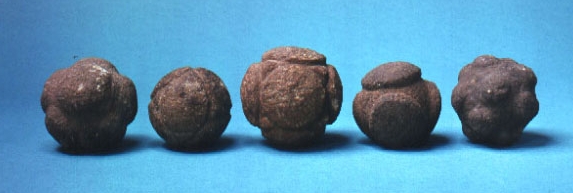
As usual, comments and corrections are eagerly awaited! I hope to keep delving into these issues as the years go by. I’m already trying to recruit my Scottish friends to investigate the mysterious stone balls at the National Museum of Scotland in Edinburgh and the Glasgow Art Gallery and Museum. And I’m going to find out more about Scholium 1 in Book XIII of Euclid’s Elements.

Posted at November 4, 2009 5:02 PM UTC

TrackBack URL for this Entry:   http://golem.ph.utexas.edu/cgi-bin/MT-3.0/dxy-tb.fcgi/2104

20 Comments & 0 Trackbacks

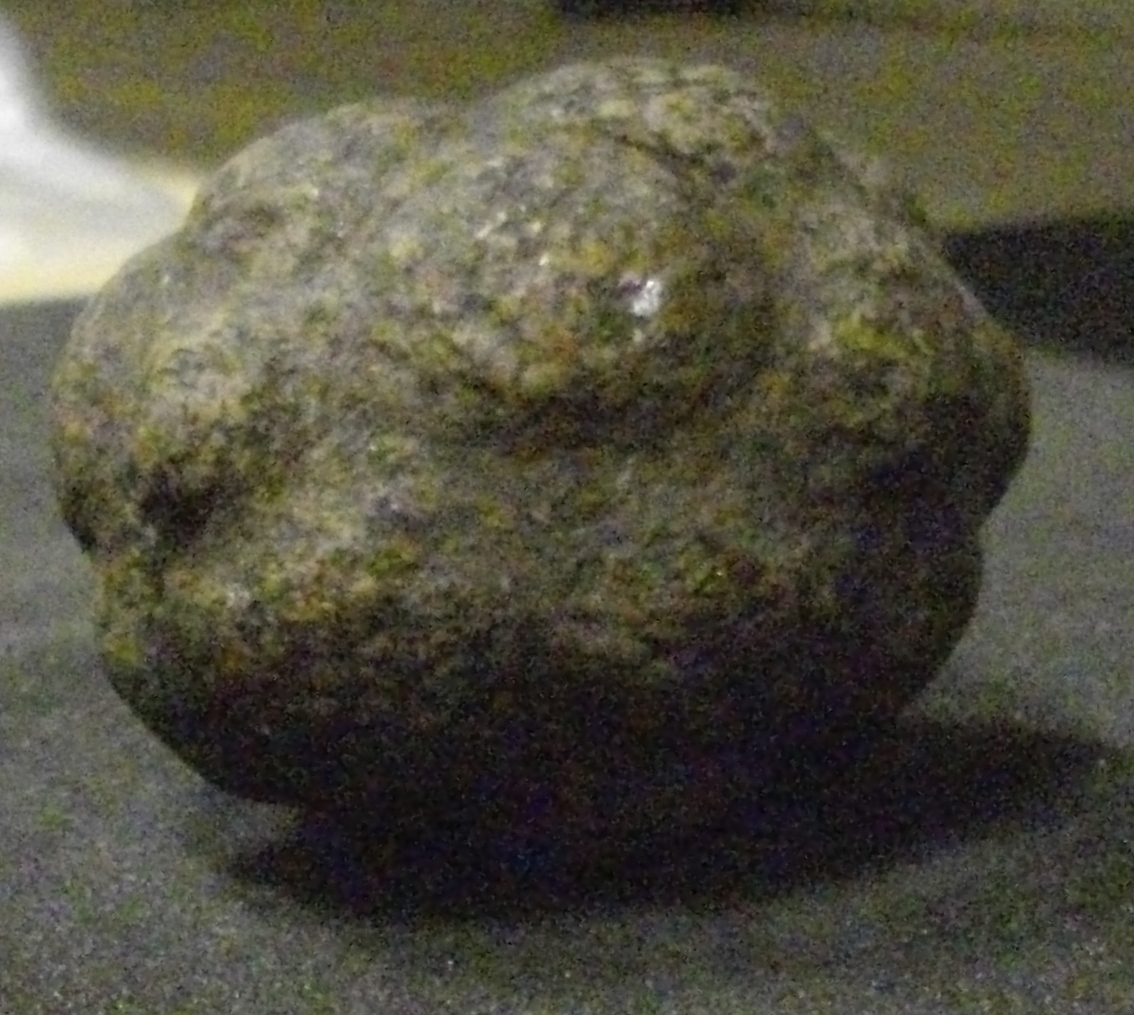
Prehistoric Scottish Carved Stone Balls

Here are the carved balls I found in the National Museum of Scotland when I was last there: carved balls.

Posted by: Dan Piponi on November 4, 2009 6:04 PM | Permalink | Reply to this

Re: Who Discovered the Icosahedron?

That’s the Kelvingrove Art Gallery and Museum, in Glasgow. The official website is here.

Posted by: Tom Leinster on November 4, 2009 6:16 PM | Permalink | Reply to this

Re: Who Discovered the Icosahedron?

Lieven le Bruyn links to a page of 21 ancient Scottish stone balls kept at the Hunterian Museum (part of the University of Glasgow). Amazingly, the museum has provided online 360 degree animations of every one of them. But as Lieven points out, none is an icosahedron.

Posted by: Tom Leinster on November 4, 2009 6:31 PM | Permalink | Reply to this

Re: Who Discovered the Icosahedron?

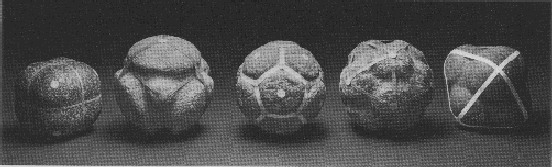
I made an interesting discovery today! I found Keith Critchlow’s book Time Stands Still — the oldest book I know that contains these pictures of Scottish balls dressed up in ribbons to look like the 5 Platonic solids:

Later authors, including Atiyah, claim these balls came from the Ashmolean Museum in Oxford. But reading this book, I found something interesting.

Posted by: John Baez on November 5, 2009 3:50 AM | Permalink | Reply to this

Re: Who Discovered the Icosahedron?

Now here is the obligatory dumb question: Why is the icosahedron a pure mathematical creation in contrast to the other four platonic solids?
Is it because it does not have an “associated crystallographic point group” (meaning perfect crystals with it’s symmetry group do not exist) unlike the dodecahedron?

Posted by: Tim vB on November 5, 2009 12:37 PM | Permalink | Reply to this

Re: Who Discovered the Icosahedron?

Tim wrote:

Why is the icosahedron a pure mathematical creation in contrast to the other four platonic solids?

I was quoting Benno Artmann on this because it’s an interesting notion, not because I necessarily agree with it.

I think his idea is that the Greeks could have seen things in nature shaped like regular tetrahedra, cubes, regular octahedra and roughly like regular dodecahedra. Or else ordinary folks could have invented some of these shapes without any mathematical thought. On the other hand, the icosahedron might have been discovered as part of the classification of regular polyhedra.

This classification theorem appears as a remark right near the end of Book XIII of Euclid’s Elements. It seems quite possible that Theaetetus was the first to prove this theorem, and that he discovered the icosahedron at about the same time.

If so, the icosahedron might be the first example of an ‘exceptional object’ in mathematics: roughly speaking, an object that’s not part of a systematic family of objects as its type, which is discovered while proving a classification theorem.

A more sophisticated example of an exceptional object is the simple Lie group E 8. And interestingly, the group E 8 is deeply connected to the icosahedron!

Is it because it does not have an “associated crystallographic point group” (meaning perfect crystals with it’s symmetry group do not exist) unlike the dodecahedron?

The regular dodecahedron doesn’t have an associated crystallographic point group either! The symmetries of the dodecahedron are the same as those of the icosahedron.

So what’s the difference?

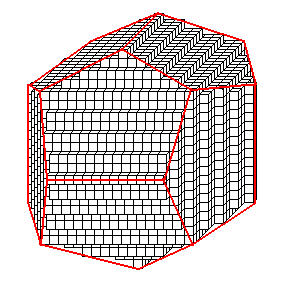
Iron pyrite commonly forms ‘pyritohedra’, which look similar to regular dodecahedra, but are made of little cubic crystal cells, like this:

See:

The pyritohedron has 12 pentagonal faces, orthogonal to these vectors:

(2,1,0)   (2,-1,0)   (-2,1,0)   (-2,-1,0)
(1,0,2)   (-1,0,2)   (1,0,-2)   (-1,0,-2)
(0,2,1)   (0,2,-1)   (0,-2,1)   (0,-2,-1)
On the other hand, a regular dodecahedron has 12 pentagonal faces orthogonal to the following vectors, in which the number 2 has been replaced by the golden ratio Φ =(5+1)/2:
(Φ,1,0)   (Φ,-1,0)   (-Φ,1,0)   (-Φ,-1,0)
(1,0,Φ)   (-1,0,Φ)   (1,0,-Φ)   (-1,0,-Φ)
(0,Φ,1)   (0,Φ,-1)   (0,-Φ,1)   (0,-Φ,-1)

These vectors are also the vertices of a regular icosahedron!

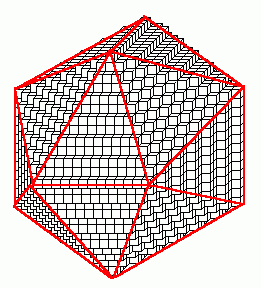
But if we use the number 2 instead of the number Φ, we get the vertices of a so-called ‘pseudoicosahedron’:

Apparently iron pyrite can also form a pseudoicosahedron! But I think this happens very rarely. I’ve asked around to see a photo of such a crystal, but nobody has ever shown me one.

In short, it’s probably just some subtle property of iron pyrite that caused the Greeks in Sicily — where pyrite is abundant — to see almost-regular dodecahedra, but not almost-regular icosahedra.

I wrote a lot more about this in week241. It turns out the pyritohedron is just one of a sequence of ‘fool’s dodecahedra’ in which Φ is approximated better and better by ratios of Fibonacci numbers. And some of the better approximations do arise in nature!

Also, the connection between E 8 and the icosahedron is equally well a connection between E 8 and the dodecahedron. For more on that see the end of week241, and also the appendix to my talk on the number 5 — the appendix entitled Quaternions, the dodecahedron and E 8.

Posted by: John Baez on November 5, 2009 9:09 PM | Permalink | Reply to this

Re: Who Discovered the Icosahedron?

Nice, I do promise myself to take the time to understand all of this one day.
But, if I understand your explanation, from a pure abstract point of view both icosahedron and dodecahedron deserve to be called exceptional (or none of the platonic solids does).
I learned about them first from playing the advanced dungeons and dragons games that use them as dice. The infinity engine computer games like Baldur’s Gate implemented a subset of those rules - the question is, if computer archaeologists living in the 27th century will figure out why the number 20 was so important to these programs.

Posted by: Tim vB on November 5, 2009 11:20 PM | Permalink | Reply to this

Re: Who Discovered the Icosahedron?

Tim wrote:

But, if I understand your explanation, from a pure abstract point of view both icosahedron and dodecahedron deserve to be called exceptional (or none of the platonic solids does).

That’s right: from a mathematical point of view the regular icosahedron and dodecahedron belong together, since they’re duals of each other and thus have the same symmetry group.

(This duality is why the vectors that represent the 12 vertices of the icosahedron are perpendicular to the 12 faces of the dodecahedron.)

I think they both deserve to be called exceptional, since if you look at Platonic solids in all dimensions, you’ll see that 5-fold symmetry arises only in dimensions 2, 3, and 4.

I learned about them first from playing the advanced dungeons and dragons games that use them as dice.

These have a long ancestry! There exist Egyptian icosahedral dice dating back roughly to 300 BC.

Posted by: John Baez on November 5, 2009 11:36 PM | Permalink | Reply to this

Re: Who Discovered the Icosahedron?

There exist Egyptian icosahedral dice dating back roughly to 300 BC.

Christie’s recently auctioned off a Roman D20 for ~$18000.

Posted by: Mike Stay on November 6, 2009 12:53 AM | Permalink | Reply to this

Viruses discovered it first; Re: Who Discovered the Icosahedron?

Putting on my Mathematical Biology hat for a moment…

Virus Polyhedral (Icosahedral) Symmetry.

“Crick and Watson have shown that the polyhedral capsids can have three possible types of symmetry, viz. tetrahedral, octahedral and icosahedral.”

“It has been shown that an icosahedron is the most efficient shape for the packing and bonding of the subunits of a near spherical virus Therefore viruses are icosahedral rather than tetrahedral of octahedral….”

“According to the rules of crystallography, only a certain number of capsomeres can be present in an icosahedral capsid.”

“The minimum number of capsomeres can theoretically be 12, followed by 32,42,72,92,162,252,362,492,642 and 812. Of these capsomeres, 12 are pentameres occupying the 12 corners, while the rest are hexameres.”

“The actual number of capsomeres found in different viruses are: φX174, 12; turnip yellow mosaic virus and poliovirus, 32; polyoma virus and papilloma virus, 72; reoviruses, 92; herpesviruses, 162; adenoviruses, 252, and tipula iridescent virus,812.”

“φX174. The bacteriophage φXI74 contains 12 capsomeres. It has been suggested that each capsomere is actually a cluster of five units. Therefore the capsid is probably made up of 60 identical units.”

“Turnip yellow mosaic virus (TYMV) has elongated capsomeres. Clusters of 5 or 6 protein molecules project from a core of RNA. Twelve clusters have 5 units each (pentameres) and 20 clusters 6 units each (hexameres)….”

Posted by: Jonathan Vos Post on November 6, 2009 5:50 PM | Permalink | Reply to this

Re: Who Discovered the Icosahedron?

A marginally related question: why does the octahedron have equators (three of them) when none of the other four Platonic solids do? The icosidodecahedron on the other hand, a non-Platonic solid midway between the dodecahedron and the icosahedron, has six equators.

Posted by: Vaughan Pratt on November 11, 2009 6:25 AM | Permalink | Reply to this

Re: Who Discovered the Icosahedron?

The cuboctahedron also has a bunch of equators.

I don’t know ‘why’ the octahedron is the only Platonic solid with equators. It’s an interesting question, but I don’t know how to get a handle on it.

(An easier question: the Poincaré dual of the octahedron is the cube. What’s special about the cube, corresponding to how the octahedron has equators?)

Posted by: John Baez on November 11, 2009 8:12 AM | Permalink | Reply to this

Re: Who Discovered the Icosahedron?

Is the answer to Vaughan’s question something to do with the fact that the octahedron is the only Platonic solid whose dual has faces with an even number of sides?

If you scroll down from here to the convex regular polyhedra with a spherical geometry, that seems to make sense.

Posted by: David Corfield on November 11, 2009 9:15 AM | Permalink | Reply to this

Re: Who Discovered the Icosahedron?

David wrote:

Is the answer to Vaughan’s question something to do with the fact that the octahedron is the only Platonic solid whose dual has faces with an even number of sides?

You’re right!

Let’s say it directly: the octahedron is the only Platonic solids where an even number of edges meet at each vertex. For Platonic solids, this is a necessary and sufficient condition for there to exist equators — since in this case, and only in this case, we can draw an edge path that goes ‘straight through’ each vertex. When we can draw such an edge path, a symmetry argument shows it must divide the polygon in half. So, it’s an equator.

A similar rule applies to tilings of the plane or hyperbolic plane by regular polygons. We can draw a ‘straight line’ in the tiling — or more precisely, a geodesic edge path — if and only if an even number of edges meet at each vertex. So there are lots of geodesics in {3,8}:

but none in {3,7}:


Posted by: John Baez on November 11, 2009 4:59 PM | Permalink | Reply to this

Re: Who Discovered the Icosahedron?

Do you happen to have these figures in the projective representation?

Thanks!
Christine

Posted by: Christine Dantas on November 11, 2009 5:25 PM | Permalink | Reply to this

Re: Who Discovered the Icosahedron?

No. I’m not even sure what you mean! I got these figures from the Wikipedia article on regular polytopes — the one that David cited.

Posted by: John Baez on November 11, 2009 5:31 PM | Permalink | Reply to this

Re: Who Discovered the Icosahedron?

Thanks for the link!

I’m not even sure what you mean!

Do you refer to the projective representation? If this is the case, see, here or Penrose’s first chapters (The road to reality), with beautiful pictures by Escher on both the projective and the conformal representations of the hyperbolic geometry. These representations (or models) have other names, so I guess this may be confusing.

Best,
Christine

Posted by: Christine Dantas on November 11, 2009 5:45 PM | Permalink | Reply to this

Re: Who Discovered the Icosahedron?

No, he’s using the Poincaré disc representation, in which geodesics appear as segments of circles, not the Klein representation in which they appear as straight lines. The Poincaré disc representation is conformal, so maybe that’s what’s meant by “conformal representation” (but the Poincaré half-plane representation is conformal, too, as are an infinite number of other representations … )

Posted by: Tim Silverman on November 11, 2009 6:57 PM | Permalink | Reply to this

Re: Who Discovered the Icosahedron?

Another way to say this is that the second number of the Schläfli symbol needs to be even. Wikipedia seems to have the triagonal dihedron’s Schläfli symbol wrong where I linked to above – it should be {3,2}.

Posted by: David Corfield on November 11, 2009 9:40 AM | Permalink | Reply to this

Re: Who Discovered the Icosahedron?

Wikipedia seems to have the triagonal dihedron’s Schläfli symbol wrong where I linked to above – it should be {3,2}.

You know, one of the nice things about Wikipedia is … well, I fixed it.

Posted by: Toby Bartels on November 11, 2009 4:30 PM | Permalink | Reply to this

Post a New Comment