Skip to the Main Content

Note:These pages make extensive use of the latest XHTML and CSS Standards. They ought to look great in any standards-compliant modern browser. Unfortunately, they will probably look horrible in older browsers, like Netscape 4.x and IE 4.x. Moreover, many posts use MathML, which is, currently only supported in Mozilla. My best suggestion (and you will thank me when surfing an ever-increasing number of sites on the web which have been crafted to use the new standards) is to upgrade to the latest version of your browser. If that's not possible, consider moving to the Standards-compliant and open-source Mozilla browser.

August 31, 2006

Letter from Grothendieck

Posted by John Baez

Alexander Grothendieck was the most visionary and radical mathematician in the second half of the 20th century - at least before he left his home and disappeared one fine day in 1991.
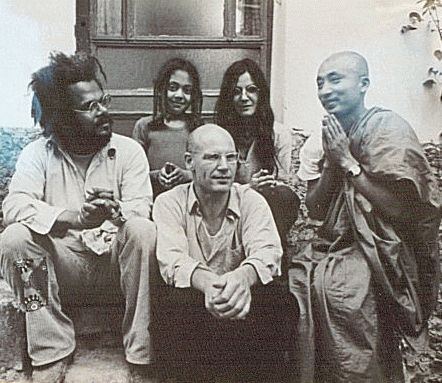
grothendieck_picture

For a quick tale of his life, try clicking on his name above. For a longer version, try this:
  • Allyn Jackson, Comme apellé du néante - as if summoned from the void: the life of Alexandre Grothendieck. Part 1, Part 2.

This newly available document will be interesting to his fans, and also students of n-category theory:

Ronnie Brown was one of the first champions of higher-dimensional algebra, studying topology using first groupoids, and then n-groupoids and related structures. For more on his philosophy, try these: Grothendieck became interested in n-groupoids and n-categories in the 1970s, so he began corresponding with Brown an others on these topics. In 1983 he sent a 593-page letter about these topics to Daniel Quillen - a letter which has now become extremely influential: In fact, it was released in installments to a number of people including Larry Breen, Ronnie Brown, and Tim Porter. For more on this story, try: In the newly released mail to Brown, Grothendieck wonders why Quillen didn’t reply to his letter! He also comments on how homotopy theorists seemed uninterested in higher-dimensional algebra:

It is all too evident that I am not an expert on homotopy theory, and the books I am writing now on foundational matters are very likely to be looked at as “rubbish” by most experts, unless I show up with π147(S123) as a byproduct (whereas it is for the least doubtful I will…).

His ideas were too far ahead of his time for easy acceptance. Only now are the times catching up!

According to Ronnie Brown, Pursuing Stacks will be published in Documents Mathématiques, with various correspondence as an appendix, edited by Georges Maltsiniotis. Maltsiniotis and Brown are now editing 69 letters exchanged between Grothendieck and Brown; this one is number 17.

I also hear that Colin McLarty is working on a biography of Grothendieck.

I thank Ronnie Brown for making this letter from Grothendieck available, and also for converting his 1987 paper “From groups to groupoids: a brief survey” into LaTeX.

Posted at August 31, 2006 2:34 AM UTC

TrackBack URL for this Entry:   http://golem.ph.utexas.edu/cgi-bin/MT-3.0/dxy-tb.fcgi/912

14 Comments & 1 Trackback

Re: Letter from Grothendieck

Answers to Grothendieck´s meter question?

Posted by: Florifulgurator on September 1, 2006 3:00 PM | Permalink | Reply to this

Re: Letter from Grothendieck

Answers to Grothendieck´s meter question?

Just so everyone can know what the question was, let me say a bit more. Leila Schneps, an expert on Grothendieck’s theory of dessins d’enfants and a founding member of the Grothendieck Circle, was one of the last mathematicians to meet Grothendieck and correspond with him. Sam Leithe writes:

One of the last members of the mathematical establishment to come into contact with him was Leila Schneps. Through a series of coincidences, she and her future husband, Pierre Lochak, learned from a market trader in the town he left in 1991 that ‘the crazy mathematician’ had turned up in another town in the Pyrenees. Schneps and Lochak in due course staked out the marketplace of the town, carrying an out-of-date photograph of Grothendieck, and waited for the greatest mathematician of the 20th century to show up in search of beansprouts.

‘We spent all morning there in the market. And then there he was.’ Were they not worried he’d run away? ‘We were scared. We didn’t know what would happen. But he was really, really nice. He said he didn’t want to be found, but he was friendly. We told him that one of his conjectures had been proved. He had no idea. He’d stopped being interested in maths at that stage. He thought his unpublished work would all have been long forgotten.’

Grothendieck’s first disappearance, in a sense, came in 1970, when at the very height of his powers he abandoned a post that had been created for him at the Institute of High Scientific Studies (and which remains probably the most prestigious tenure in his field of mathematics) on the grounds that it was partly funded by the military industrial complex. In 1988, he was awarded the Crafoord Prize. He refused to accept it.

Grothendieck’s father was an anarchist who died in Auschwitz; Alexandre, along with his German mother Hanka, was interned in France during the war as an ‘undesirable’. These days, what we know of Grothendieck’s thinking suggests his guiding preoccupation is the problem of evil. He lives alone and works, for 12 hours a day, on a 50-volume manuscript which addresses, among other things, the physics of free will.

One story has it that Grothendieck is now convinced that the Devil is working to falsify the speed of light. Schneps ascribes his concerns with the speed of light to his anxiety about the methodological compromises physicists make. He talks constantly, however, about the Devil, semi-metaphorically, sitting behind good people and nudging them in the direction of compromise, of the fudge, of the move towards corruption. ‘Uncompromising’ is the expression Schneps favours.

In his correspondence with Leila Schneps, he told her he would be willing to share his research into physics with her if she could answer one question: ‘What is a metre?’

She and Lochak, baffled, took a month to write back — and did so at length. But before this letter arrived, Grothendieck dispatched three letters in quick succession. His first letter appeared to threaten suicide. His second was ‘the warmest, warmest thing … saying it’s just amazing anyone cares….’ The third addressed ‘Leila Schneps’ in bitterly sarcastic inverted commas. They found their subsequent letters returned unopened. ‘We went to see him and he slammed the door in our faces….’

Has Grothendieck — runs the obvious question — gone mad? Well, possibly. It all depends on what you mean by ‘mad’.

‘He lives alone and he writes on really deep ideas,’ says Schneps. ‘In the past, what about saints or prophets? Did people think they had gone mad? He cannot bear to live in the world we’re in…. He’s certainly abnormal. I could not possibly call him mad. People say there’s normal and there’s insane. These are not the only two categories….’

I can give some more clues about Grothendieck’s question if people want.

Posted by: John Baez on September 1, 2006 4:25 PM | Permalink | Reply to this

Re: Letter from Grothendieck

if people want.

Yes, please.

Posted by: urs on September 1, 2006 4:39 PM | Permalink | Reply to this

Re: Letter from Grothendieck


Try Connes and Navarro on the ‘meter question’:

Posted by: Quidam on September 1, 2006 6:30 PM | Permalink | Reply to this

What is a meter?

What is a metre?

It’s 3.28 feet. And don’t tell me you don’t know what a foot is!

More seriously, I can imagine several perspectives from which this question is subtle and interesting. I am not sure which one of these subtleties we are supposed to be interested in.

For instance: are we allowed to assume that we know what a positron, and an electron are?

If so, there is a natural number n - which I can tell you if desired - such that a meter is n times the mean distance of the electron from the positron in the ground bound state of positronium.

(Actually, the official definition also involves a photon, and various quarks - namely the radiation emitted from caesium atoms. But that’s just a variation of the above theme.)

Of course, that explanation only works if we agree that we know what “distance” means in the first place.

So is the question maybe really: “What is distance?”

I must say I am slightly afraid that the real intention of the question is something like “What does it mean to observe something (like the ground state of positronium)?”

Hopefully David Corfield will be back from his vacation soon…

Posted by: urs on September 1, 2006 5:57 PM | Permalink | Reply to this

Re: What is a meter?

I am not sure which one of these subtleties we are supposed to be interested in.

Based on my impression upon skimming the story, I can guess that it is intended to be a toned down version of the similar question, “What is the speed of light?”

If that is anywhere near being correct, then it is one step from there to asking, “What is the fabric of the cosmos?” But maybe I am daydreaming (I know I am sleep deprived).

PS: Maybe it is just my PC, but I couldn’t get the arrow keys or copy/paste to work in Firefox. Had to resort to IE to post this *shudder*

Posted by: Eric on September 2, 2006 2:15 AM | Permalink | Reply to this

Re: Letter from Grothendieck

I can give some more clues about Grothendieck’s question if people want.

So can I.

Posted by: Kea on September 2, 2006 12:05 AM | Permalink | Reply to this

Re: Letter from Grothendieck

Sam Leithe wrote:

In his correspondence with Leila Schneps, he told her he would be willing to share his research into physics with her if she could answer one question: ‘What is a metre?’

There are, of course, many ways to take this question, and in some sense it’s a Rorschach ink blot test - one can assume Grothendieck is asking something profound and search for a profound answer, or assume he has gone crazy and dismiss the question, or anything in between.

Pierre Cartier writes:

If I can believe his most recent visitors, he is obsessed with the Devil, whom he sees at work everywhere in the world, destroying the divine harmony and replacing 300,000 km/sec by 299,887 km/sec as the speed of light!

(In fact the speed of light is 299,792.458 km/sec, exactly - by definition.)

Alain Connes writes:

It is sad tht while Grothendieck was asking the right question: “what is the metre” and rightly saying that the convention c = 300,000,000 m/s would have been simpler the standard reaction to his query was to see there the clear symptom of a deranged mind.

I will not try to guess what Grothendieck was thinking, but simply answer his question in a very literal-minded way:

A meter is the distance that light emitted by a cesium 133 atom transitioning between the two hyperfine levels of its ground state will travel as the light vibrates exactly 9,192,631,770 / 299,792,458 times.

Of course the definition of the meter has changed repeatedly and may change again, but this is the definition now. Clearly such a complicated definition is the work of the Devil.

Posted by: John Baez on September 2, 2006 2:14 AM | Permalink | Reply to this
Read the post links for 2006-09-03
Weblog: leuschke.org
Excerpt: Letter from Grothendieck | The n-Category Café some recently uncovered correspondence between Grothendieck and Ronald Brown (tags: grothendieck toread) Cornell Library Historical Mathematics Monographs 200,000 pages on file. amazing. some great thing...
Tracked: September 3, 2006 6:17 AM

Re: Letter from Grothendieck

I understand that Grothendieck disliked physics (though many of his ideas have found application in physics today) for its military uses, much in the same way Lev Landau disliked topology although for other reasons.

Can anybody elaborate on that comment of his regarding to “share all his research in physics”?

Posted by: Comentator on September 6, 2006 9:11 PM | Permalink | Reply to this

Re: Letter from Grothendieck

Here a nice new article from W. Scharlau on Grothendieck.

Posted by: Thomas Riepe on March 29, 2008 8:59 AM | Permalink | Reply to this

Re: Letter from Grothendieck

The obvious question - how do we know AG is still alive, if at all? I was under the impression someone keeps an indirect eye on him.

And what about the caption on the photo in the article?

“Alexander Grothendieck in May 1998 in the south of France. Three years later he disappeared” (translation provided by Google).

Posted by: David Roberts on March 31, 2008 4:10 AM | Permalink | Reply to this

Re: Letter from Grothendieck

As far as I know, he is not entirely without contact to other people. IMHO there are several other interesting questions, e.g. on his specific way of thinking, the content and meaning of his non-mathematical ideas etc. Much of the seemingly strange statements and attitudes ascribed to him appear to me as resulting from his growing up in the spiritual environment of Heydorn and the Weimar way to think of intellectuals in the 1920s.

Posted by: Thomas Riepe on March 31, 2008 6:30 PM | Permalink | Reply to this

Re: Letter from Grothendieck

Just to be correct : the photo in the Scharlau article is already from 1988…

but it’s good to see that you are still thinking about him:-)

Posted by: Iris on April 6, 2008 9:55 AM | Permalink | Reply to this

Re: Letter from Grothendieck

…from 1988…


I suspected that might be the case, since that would coincide with his 1991 disappearance.

Posted by: David Roberts on April 7, 2008 12:08 AM | Permalink | Reply to this

Post a New Comment