Coxeter and Dynkin Diagrams
Posted by John Baez

Dynkin diagrams have always fascinated me. They are magically potent language — you can do so much with them!
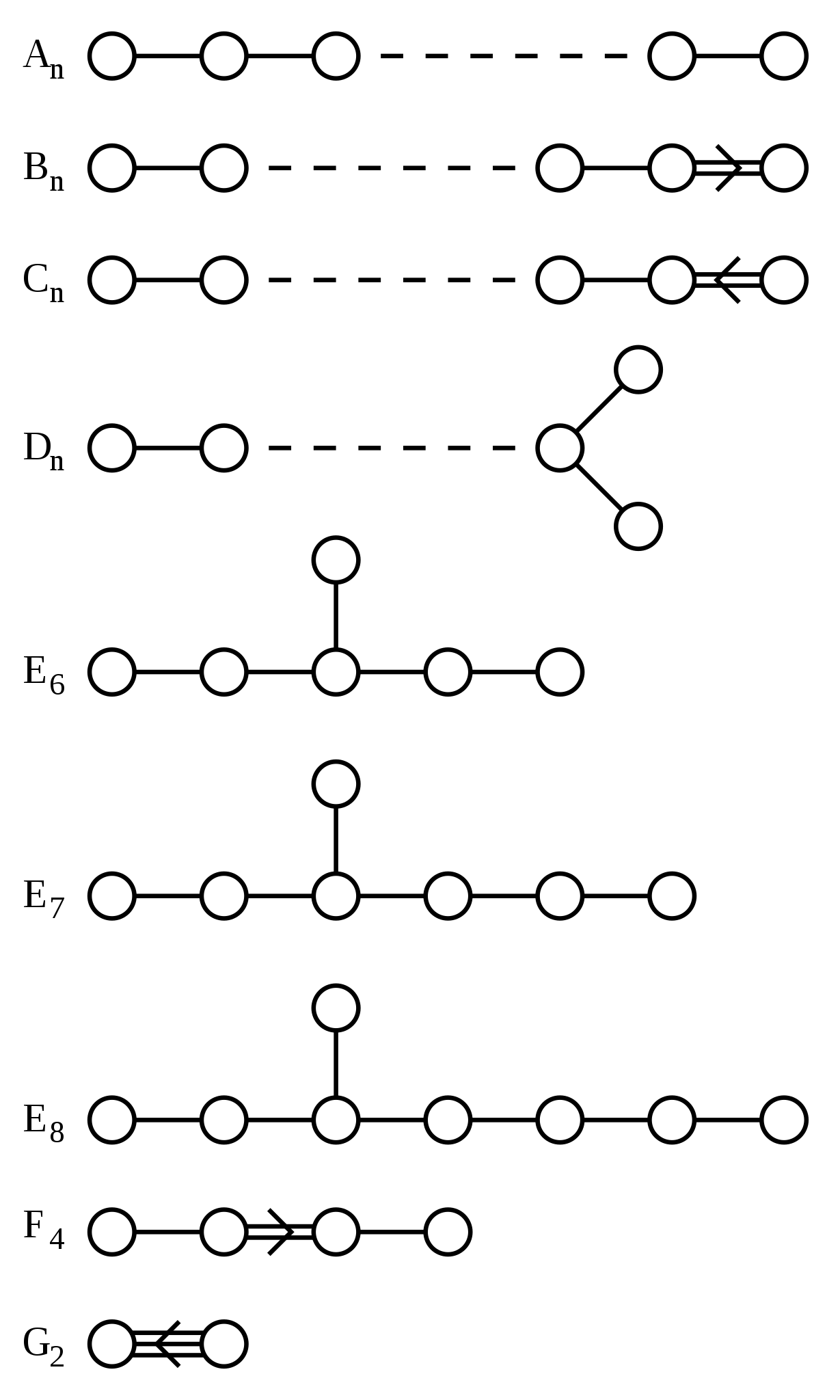
Here’s my gentle and expository intro to Dynkin diagrams and their close relative, Coxeter diagrams:
Abstract. Coxeter and Dynkin diagrams classify a wide variety of structures, most notably finite reflection groups, lattices having such groups as symmetries, compact simple Lie groups and complex simple Lie algebras. The simply laced or “ADE” Dynkin diagrams also classify finite subgroups of SU(2) and quivers with finitely many indecomposable representations. This introductory tour of Coxeter and Dynkin diagrams, based on the column This Week’s Finds in Mathematical Physics, is made to accompany a series of five lecture videos.
I’m a bit sorry that I didn’t probe deeper into why Dynkin diagrams are what they are: that is, why these and no others? I’m also sorry I didn’t dig into the “black magic” that I mention at the end: that is, why does this black magic work? I’d also like to include a little comparison of the 4 lattices you get from the Lie algebra of a compact simple Lie group: the weight lattice, the coweight lattice, the root lattice, and the coroot lattice — merely because I tend to get them confused, and my exposition needed to say a bit about these.
Luckily I can add these other things later. And I think keeping it short and snappy has its own charms.
Re: Coxeter and Dynkin Diagrams
Thank you for all of this and making it available. Some things that I find mysterious about this is what do root systems and the like show up in across mathematics and seem to parameterise many different classifications. They are somehow a fundamental notion but do not feel fundamental. The other thing about them is why do we have these exceptional (or sporadic) ones (you can of course ask that in other classifications like finite simple groups). It has a feeling of weird low(ish); dimensional accidents.